
This page is your curated guide to uplifting books, a mix of fiction and nonfiction chosen to bring hope, comfort, or gentle joy back into your reading life. Picks are pulled together by Book-a-holic's editorial team, with themed shortlists so you can match a title to whatever mood sent you looking in the first place.
TL;DR:
- Many uplifting books feature deep relationships, humor, and hopeful endings that show grief and hard parts can coexist with connection and warmth.
- Nonfiction titles ground optimism in real experiences, emphasizing that hope is a practice built through small, deliberate choices rather than innate traits.
- When choosing an uplifting book, consider tone, emotional intensity, pacing, theme, and format to match your current mood and needs.
- Books that make you cry can still be uplifting if they deliver genuine human connection and meaningful reflection, not just escapism.
- Selecting a book based on your current emotional state and avoiding unrelieved bleakness or trauma can help ensure it brings real comfort or inspiration.
Table of Contents
- Uplifting Books to Read Right Now: The Curated Shortlist
- Themed Shortlists for Every Mood
- Why These Books Actually Make You Feel Better
- How to Choose the Right Uplifting Book for Your Mood
- Curator Notes From a book podcast
- An Editor's Note on Reading for Hope
- Keep the Recommendations Coming With Bookaholic
- Sources
- FAQ
Uplifting Books to Read Right Now: The Curated Shortlist
Some books earn a permanent spot on feel-good lists because they simply work, no matter how many times readers return to them. This shortlist mixes contemporary favorites with a few classics, following the same instinct behind Penguin Random House's own feel-good fiction roundup, which leans on exactly this blend of new and familiar.
- The Alchemist by Paulo Coelho: A shepherd boy travels across the desert chasing a recurring dream. It uplifts because it treats your personal ambitions as sacred, not silly. Best for readers who need permission to want something bigger.
- A Man Called Ove by Fredrik Backman: A grumpy widower's routine gets upended by an accident-prone family next door. The humor sneaks up on you, and the tenderness underneath it lands even harder. Best for readers who love a curmudgeon with a hidden heart.
- Remarkably Bright Creatures by Shelby Van Pelt: A giant Pacific octopus and a lonely widow solve a decades-old mystery together. It uplifts through unlikely friendship and the reminder that grief and wonder can share the same room. Best for readers who want quirky alongside their comfort.
- Man's Search for Meaning by Viktor E. Frankl: A psychiatrist's account of surviving Nazi concentration camps, built around his theory that meaning, not comfort, is what keeps people alive. The book has sold over 18 million copies and been translated into more than 50 languages, a reach that says something about how badly people need this argument. Best for readers craving resilience over reassurance.
- The Book of Joy by the Dalai Lama and Archbishop Desmond Tutu: Two spiritual leaders, both familiar with real suffering, sit down to talk about what actually produces happiness. It became a New York Times bestseller, selling over 1 million copies while laying out an "Eight Pillars of Joy" framework. Best for readers who want joy explained with structure, not platitudes.
- Joyful, Anyway by Kate Bowler: Bowler, who has written openly about a terminal cancer diagnosis, distinguishes real joy from forced positivity and offers small, doable practices for finding it anyway. Best for readers wary of toxic positivity but still open to hope.
- The Little Paris Bookshop by Nina George: A bookseller who prescribes novels for emotional ailments finally has to treat his own broken heart. Best for readers who love books about books.
- The Travelling Cat Chronicles by Hiro Arikawa: A man and his cat take a road trip to visit old friends, and the reason for the trip unfolds slowly. It's the kind of tearjerker that leaves you warmer than when you started. Best for animal lovers who don't mind crying a little.
- The Very Secret Society of Irregular Witches by Sangu Mandanna: A young witch raised in isolation finally finds a found family, magic and all. Best for readers who want cozy fantasy with real emotional stakes.
- The Bright Side by Sumit Paul-Choudhury: A science journalist makes the case that optimism is an active skill, applying it to modern anxieties like climate change and artificial intelligence. Best for readers who want their hope grounded in evidence, not vibes.
- Anxious People by Fredrik Backman: A botched bank robbery turns into a hostage situation full of strangers who slowly reveal their own quiet griefs. Best for readers who like their comfort reads laced with dark humor.
- The House in the Cerulean Sea by TJ Klune: A caseworker is sent to investigate an orphanage for magical children and finds something closer to home. Best for readers who want whimsy with genuine emotional weight.
- Tuesdays with Morrie by Mitch Albom: A former student reconnects with his dying professor for a series of weekly lessons on living well. Best for readers who want wisdom delivered gently, one conversation at a time.
- Big Magic by Elizabeth Gilbert: Part memoir, part manifesto on creative living without perfectionism getting in the way. Best for readers who feel stuck and need permission to make something imperfect.
- Lessons in Chemistry by Bonnie Garmus: A brilliant, underestimated chemist in the 1960s ends up hosting a cooking show and quietly upending everyone's expectations of her. Best for readers who want a heroine who refuses to shrink.
- The Rosie Project by Graeme Simsion: A genetics professor with rigid habits designs a scientific method to find a wife, then falls for someone who breaks every rule on his checklist. Best for readers who want laugh-out-loud romance with real heart.
Themed Shortlists for Every Mood
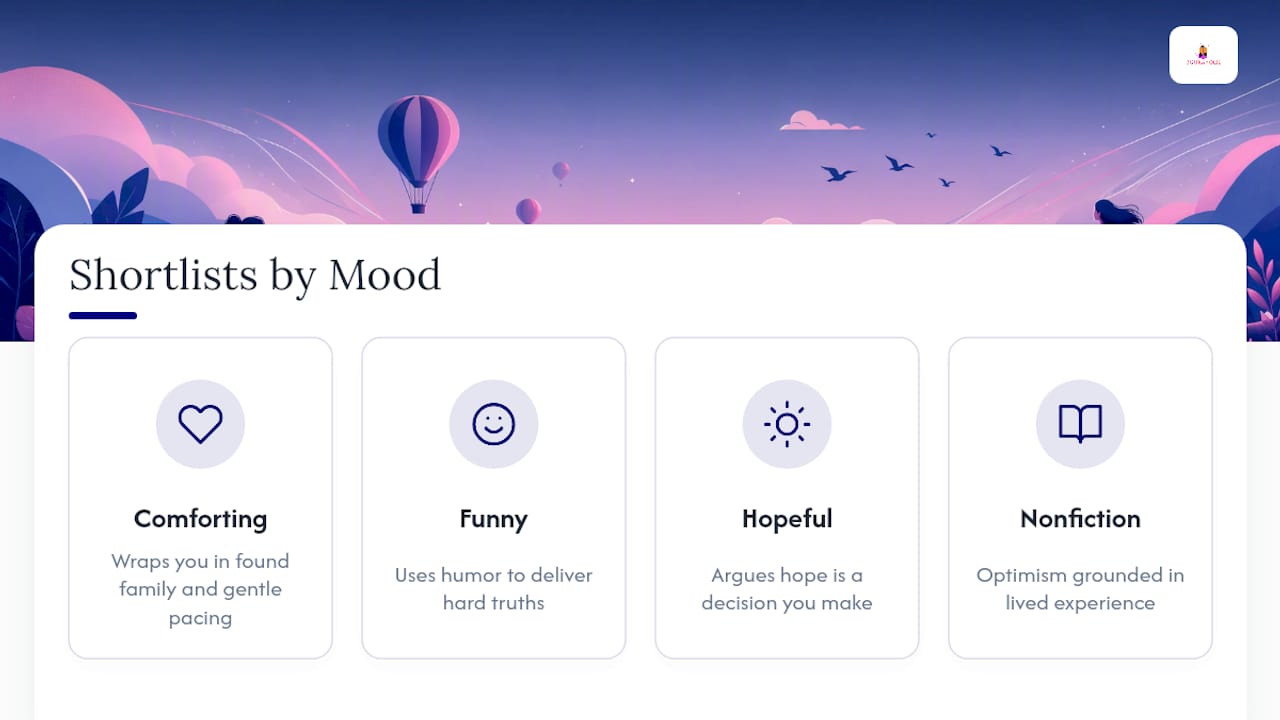
Sometimes you don't want the whole list. You want the right book for exactly how you're feeling tonight. These micro-lists sort the picks above (plus a few extras) by emotional need.
Comforting reads (for when you want to feel held): The Little Paris Bookshop, The House in the Cerulean Sea, A Man Called Ove, The Travelling Cat Chronicles. These books wrap you in found family and gentle pacing rather than plot twists.
Laugh-out-loud reads (for when you need to remember life is funny): A Man Called Ove, The Rosie Project, Anxious People, Remarkably Bright Creatures. Humor here isn't decoration. It's how these authors deliver hard truths without flattening you.
Quietly hopeful reads (for when you want optimism without the sugar rush): The Alchemist, Joyful, Anyway, The Bright Side, Lessons in Chemistry. Each one argues that hope is a decision you keep making, not a feeling that shows up on its own.
Inspiring nonfiction (for when you want proof, not just poetry): Man's Search for Meaning, The Book of Joy, Tuesdays with Morrie, Big Magic. These titles ground their optimism in lived experience, from a concentration camp to a hospice bed to a creative career built on trial and error.
Why These Books Actually Make You Feel Better
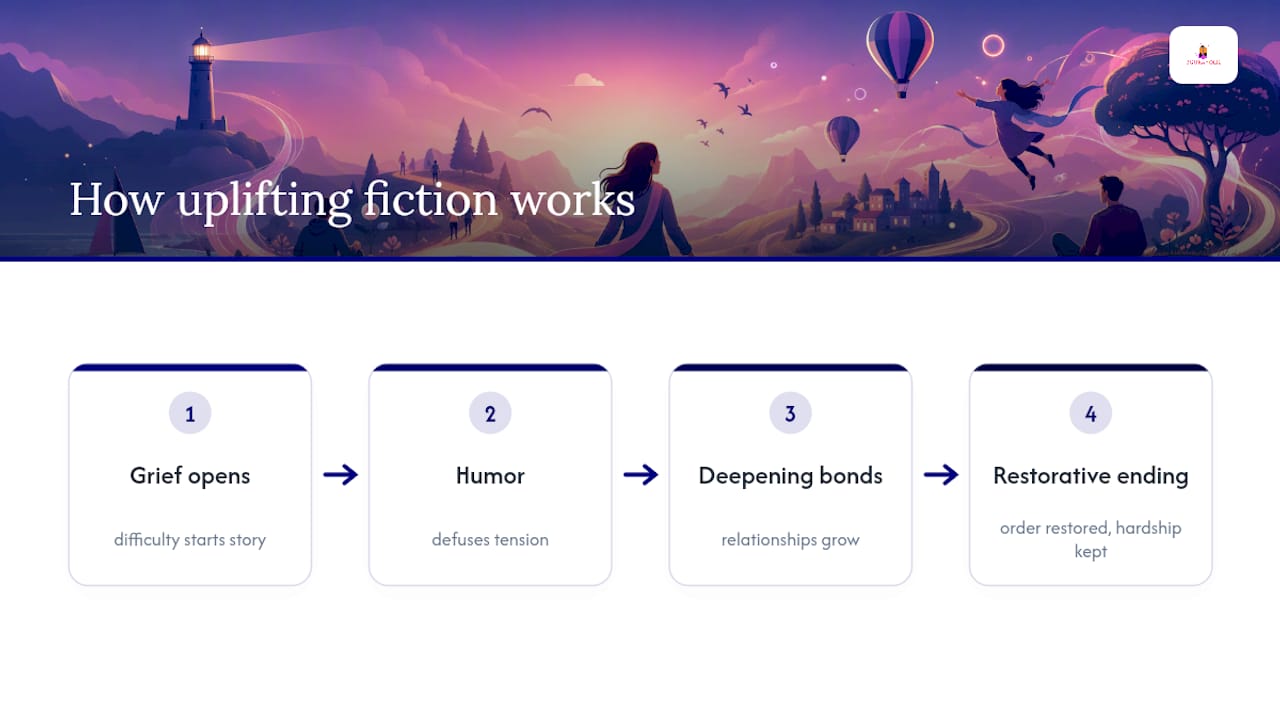
The mechanics behind uplifting fiction are fairly consistent once you notice them: warm relationships that deepen instead of dissolving, humor that defuses tension rather than avoiding it, and endings that restore order without pretending the hard parts never happened. A Man Called Ove and Remarkably Bright Creatures both lean on this exact pattern. Grief opens the story, connection closes it.
Nonfiction works differently but lands in the same place. Research on optimism frames it as a practice, not a personality trait, something you build through repeated small choices rather than luck. That's the entire argument of The Book of Joy and Joyful, Anyway, both written by people who watched suffering up close and still chose to study joy on purpose.
Here's the part people miss: books that make you cry aren't the opposite of uplifting. Publishers and readers alike treat catharsis and comfort as overlapping experiences, not competing ones. A tearjerker that ends in genuine human connection can leave you steadier than a book that never asked anything hard of you.
How to Choose the Right Uplifting Book for Your Mood
Picking the right title takes about thirty seconds if you ask yourself the right questions first.
- Tone. Do you want whimsical and light, or grounded and reflective? The House in the Cerulean Sea and Man's Search for Meaning sit at opposite ends of that spectrum, and both count as uplifting.
- Emotional intensity. Are you looking for gentle distraction or something that lets you actually process a hard week? Catharsis and comfort ask different things of you.
- Pacing and length. A dense memoir on a Tuesday night after work is a different commitment than a breezy novel on a Sunday afternoon.
- Theme: hope versus catharsis. Some books uplift by promising things get better. Others uplift by proving you can survive things getting worse first.
- Format. Audiobooks work well for commutes and chores; a paperback might suit slower, quieter reading time.
Quick gut check: if you need distraction, reach for something funny. If you need to process something, reach for something honest. If you just need to laugh, don't overthink it.
Watch for three warning signs before you commit to a book marketed as uplifting: unrelieved bleakness with no restorative turn, trauma used as shock value rather than substance, and prose so flat it can't carry the emotional weight it's promising.
Pro Tip: Read the last two pages of reviews, not the first two. Early reviews chase hype; later ones tend to tell you honestly whether a book delivered on its promise.
Curator Notes From a book podcast
The Bookaholic Podcast is built on the idea that literary conversations should feel like talking with a well-read friend, not sitting through a lecture. Through author interviews and honest reviews, it tracks books that help listeners through difficult times, including mental health struggles.
A few picks the podcast keeps circling back to:
- A Man Called Ove comes up often in listener questions about grief disguised as humor.
- The Book of Joy gets discussed alongside episodes touching on faith, resilience, and aging well.
- Man's Search for Meaning is a recurring reference point whenever guests talk about writing through personal hardship.
For readers who want to go deeper into specific emotional territory, Book-a-holic's clinician-recommended books on depression and therapist-recommended grief reading both build on the same principle: the right book at the right moment does real work.
An Editor's Note on Reading for Hope
I keep one uplifting book on my nightstand at all times, not to read every night, but because knowing it's there changes how I feel about the pile next to it. Some weeks call for Joyful, Anyway. Other weeks call for something as simple as The Rosie Project and its refusal to take itself too seriously.
If you're starting fresh, don't try to read all sixteen titles above. Pick one, set a gentle goal like two chapters a night, and let it do its work slowly.
— Deirdre
Keep the Recommendations Coming With Bookaholic
A curated list is a great starting point, but reading taste keeps shifting, and so do the books worth knowing about. Book-a-holic exists precisely for that ongoing search: real author interviews, honest reviews, and conversations about mental health and the writing life that go further than a static list ever could.

If Kate Bowler's approach to joy resonated with you, the podcast has covered similar creative and personal journeys, including this conversation on a young writer's path from fairytale ambition to published reality. And if audiobooks are your preferred way into an uplifting story, the episode with Audiofile Magazine founder Robin Whitten is a genuinely useful listen before you pick your next format. Start with either episode, and let it lead you to the next book on your list.
Sources
- Man's Search for Meaning — Books-A-Million product page
- Academic article on optimism and wellbeing (PMC)
- Penguin Random House: Feel-good fiction to read right now
FAQ
What is a good lighthearted book to read?
A Man Called Ove and The Rosie Project both balance genuine humor with emotional depth, which makes them reliable picks when you want to laugh without feeling like the book has nothing to say. Remarkably Bright Creatures works too, if you want quirky alongside the lightness.
What are the top inspirational books to read?
Man's Search for Meaning, The Book of Joy, Joyful, Anyway, The Alchemist, and Tuesdays with Morrie consistently top inspirational reading lists. Man's Search for Meaning alone has sold over 18 million copies worldwide, a scale that reflects just how widely its message has traveled.
What are some good books to read to feel positive?
Look for titles built around active optimism rather than escapism, like The Bright Side or The Book of Joy, which outlines an "Eight Pillars of Joy" framework grounded in lived experience. Fiction like A Man Called Ove or The House in the Cerulean Sea works just as well if you want warmth over a framework.
Can a sad book still count as uplifting?
Yes. Books that move you to tears, like The Travelling Cat Chronicles or Man's Search for Meaning, often uplift precisely because they earn their emotional payoff through honest struggle rather than avoiding it. The distinction is whether the story restores a sense of connection or meaning by the end, not whether it made you cry along the way.
Where can I find these uplifting books?
Most titles on this list are widely stocked at public libraries, independent bookstores, and major retailers, and many are available as ebooks or audiobooks through library apps like Libby. Bookaholic's podcast episodes and blog posts, including its self-love reading picks, offer additional direction if you want to keep building your list.