
If you need comfort right now, reach for a short, validating memoir or a lyric essay you can put down mid chapter. If you need tools, reach for an evidence-based guide built on approaches like ACT and CBT. Between memoir, practical workbooks, and children's picture books, bereavement counselors and the Bookaholic podcast both point to commonly recommended selections below, so scan the categories and pick the one that matches where you are today.
TL;DR:
- Short, standalone chapters are most effective during early grief when concentration is limited, as they allow for brief, manageable reading sessions.
- Books addressing non-death losses like divorce or infertility are often more relatable for disenfranchised grief, which many cultures validate differently from traditional bereavement.
- Evidence-based self-help books utilizing ACT, CBT, and mindfulness techniques provide practical tools for managing complex grief, especially for traumatic or prolonged losses.
- The timing of grief stages influences recommended readings, with immediate aftermath requiring brief, comforting texts and later stages benefiting from deeper, reflective narratives.
- Audio format can significantly ease reading difficulty, especially for those experiencing physical or emotional exhaustion, making listening a viable alternative.
Table of Contents
- The Best Books About Grief, Organized by What You Need
- How Books Actually Help You Move Through Grief
- How to Choose the Right Grief Book for Right Now
- Matching Books to Where You Are in Grief
- Grief Books for Children and Teens
- What Therapists Actually Recommend, and Why
- How Reading Actually Supports the Work of Grieving
- Cultural Perspectives on Grief and What to Read
- Books for Anticipatory, Complicated, and Disenfranchised Grief
- Why We Put This List Together the Way We Did
- Keep the Conversation Going With Bookaholic
- Sources
- FAQ
The Best Books About Grief, Organized by What You Need
Every grief reading list benefits from range. A book that comforts you at 2 a.m. is rarely the same book that gives you a framework for Tuesday afternoon, so the picks below split into four lanes: memoir, evidence-based self-help, essays and fiction, and short reads built for low concentration.
Memoir and narrative comfort
- A Grief Observed by C.S. Lewis. Written from Lewis's own notebooks after his wife's death, this slim classic reads like a private journal. Best for readers who want permission to rage, doubt, and grieve without a tidy resolution.
- The Year of Magical Thinking by Joan Didion. Didion's account of losing her husband and, soon after, her daughter is unflinching and precise. Best for readers who process loss through language and want a writer's clarity rather than comfort.
- Grief Works by Julia Samuel, a UK psychotherapist whose publisher page frames it as case studies paired with practical guidance. Best for readers who like real stories anchored to clinical insight.
Evidence-based self-help
- How Will I Ever Get Through This? by Dr. Lucy Hone. Hone, a grief researcher, organizes chapters around the practical questions grieving people actually ask, using strategies drawn from ACT and CBT. Best for readers who want structure over sentiment, and it explicitly covers non-death losses like divorce and infertility.
- Conscious Grieving by Claire Bidwell Smith, a licensed clinical counselor whose framework encourages active engagement with loss through ritual and presence-based practice rather than passive waiting. Best for readers who feel stuck and want a nudge toward doing something with their grief.
- Bearing the Unbearable by Joanne Cacciatore, a scholar of traumatic loss. The book is split into 52 short, standalone chapters, making it usable even when concentration is shot. Best for sudden, violent, or traumatic loss.
Essays and fiction
- The Long Goodbye by Meghan O'Rourke. A hybrid of memoir and cultural criticism about losing a mother to cancer. Best for readers who want mourning placed inside a larger conversation about how American culture handles death poorly.
- H is for Hawk by Helen Macdonald. Not marketed as a grief book, but its account of training a hawk after her father's death is one of the more original mourning narratives in print. Best for readers who want metaphor instead of direct address.
- Extremely Loud and Incredibly Close by Jonathan Safran Foer. A novel following a boy after losing his father on 9/11. Best for readers who process loss through story rather than direct reflection.
Short reads and audio-friendly picks
- It's OK That You're Not OK by Megan Devine. Written in short, punchy sections that push back against toxic positivity around loss. Best for readers who are tired of being told to "look on the bright side."
- Option B by Sheryl Sandberg and Adam Grant. Blends personal account with research on resilience; chapters work well as standalone audio listens.
- No Cure for Being Human by Kate Bowler. Essay-length reflections from a woman diagnosed with terminal cancer in her 30s. Best in small doses, ideal for audiobook.
How Books Actually Help You Move Through Grief
Reading is not a substitute for support, but it is a recognized part of bereavement care. Hospitals and hospice programs actively use targeted books from diagnosis through the first year after a loss, according to reporting from the New York Times, because the right book at the right time reduces isolation and offers perspective a grieving person cannot generate alone.
That's the statistic worth sitting with: books aren't just comfort reading in bereavement care, they're a deliberate clinical tool, deployed on a timeline that mirrors the arc of grief itself.
Modern grief books increasingly bake in tools from Acceptance and Commitment Therapy, mindfulness, and Cognitive Behavioral Therapy rather than offering pure sentiment. Dr. Lucy Hone's work is a clear example, structuring chapters around practical, evidence-based strategies instead of abstract encouragement. These frameworks give readers something to do with their hands and minds when the grief itself feels formless.
Format matters as much as content. Books built from short, standalone chapters, like Bearing the Unbearable's 52-chapter structure, work because acute grief genuinely narrows concentration. A 300-page linear memoir can feel impossible; a five-page vignette does not.
How to Choose the Right Grief Book for Right Now
Not every excellent grief book fits every grieving moment. Match the book to your stage, your loss type, and your energy level before you buy.
- Is this loss a death, or a living loss like divorce, infertility, or job loss? Books written for bereavement don't always translate to non-death grief, and vice versa.
- How many weeks or months out from the loss am I? Fresh shock calls for different material than six months of integration work.
- Do I want tools, or do I want to feel less alone? Workbooks and memoirs serve different needs, and it's fine to want both.
- Can I sustain a full chapter, or do I need standalone sections?
- Does this book acknowledge my specific type of loss, or does it generalize in a way that feels dismissive?
- Is the tone clinical, spiritual, literary, or blunt? Pick the register you can actually tolerate right now.
- Do I have energy to read, or would audio work better?
- Am I choosing this for myself, or to hand to someone else? The right book for a griever is rarely the right book to gift unprompted.
Pro Tip: Before buying, read the first chapter on a retailer preview or listen to an audiobook sample. If the author's voice grates on you in five minutes, it will grate on you at page 200, no matter how good the reviews are.
Watch for red flags too: books that promise a fixed timeline for "moving on," language that implies you're grieving wrong, or claims about supplements, cures, or medical shortcuts with no clinical backing. Grief has no schedule, and any book that insists otherwise is selling certainty it doesn't have.
Matching Books to Where You Are in Grief
Timing changes what a book can do for you. Practitioners note that immediate-stage reading needs to work differently than material meant for later integration.
- Immediate aftermath (days to weeks): ultra-short chapters, lyric essays, or guided journals. A Grief Observed and Bearing the Unbearable both work here because neither demands sustained focus.
- Months in: validating memoirs paired with practical workbooks. This is where How Will I Ever Get Through This? and Conscious Grieving earn their place, once you have bandwidth for exercises.
- Long-term integration: essays, poetry, and meaning-making narratives like The Long Goodbye or No Cure for Being Human, which help you fold loss into an ongoing life rather than "resolve" it.
If reading feels physically hard, audiobooks remove the concentration barrier entirely.
Grief Books for Children and Teens
Kids process loss differently at every age, and the right book gives language to feelings they can't yet name themselves. For younger children, picture books that use gentle metaphor work best; for teens, first-person narratives that don't sugarcoat the messiness of loss tend to land better than anything overtly instructional.
- The Invisible String (ages 4 to 8): a picture book that frames connection as unbreakable, even after death.
- Charlotte's Web (ages 8 to 12): not marketed as a grief book, but E.B. White's handling of loss and continuity has helped generations of kids indirectly.
- The Fault in Our Stars (teens): direct, unsentimental, and respected by teen readers who resent being talked down to.
Read alongside your child rather than handing the book over solo, and follow up with open questions like "What did that part make you think of?" rather than "Did that make you sad?" For a deeper dive into selecting age-appropriate emotional books, Icon Literary's guide on children's grief reading is worth a look.
What Therapists Actually Recommend, and Why
Therapist-recommended grief books share a pattern: they don't just describe emotions, they teach a skill. That's the throughline connecting How Will I Ever Get Through This?, Conscious Grieving, and clinician-authored titles like Grief Works. Each one borrows from a specific modality rather than inventing feel-good advice from scratch.
ACT (Acceptance and Commitment Therapy) shows up as exercises around accepting difficult feelings rather than fighting them. Mindfulness shows up as grounding practices for the moments grief spikes without warning. CBT shows up as reframing exercises that challenge the guilt or "should have" thinking so common after loss.
Curated lists from organizations like the Dougy Center, a nonprofit focused on grieving children and families, function as reference points that clinicians actually hand to clients. That's a meaningfully different endorsement than a bestseller list. It means the book has been tested against real caseloads, not just sales figures.
If you're deciding between a memoir and a workbook, consider whether you want to feel understood or whether you want a next step. Many readers need both, at different points in the same week.
How Reading Actually Supports the Work of Grieving
Books do four things well: they validate what you're feeling, they offer perspective from someone further down the road, they can suggest rituals, and some hand you practical exercises to try today.
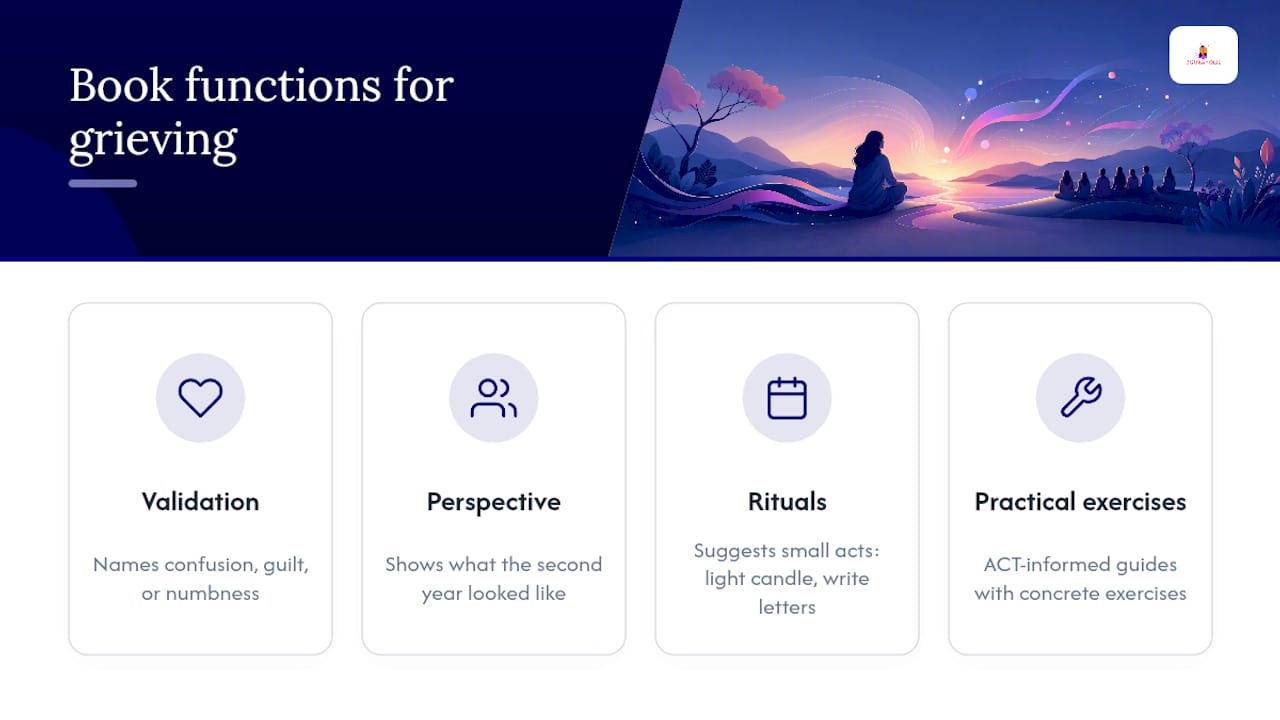
Validation matters most in early grief, when the loudest internal voice often insists you're doing it wrong. A memoir that names your exact confusion, guilt, or numbness does something a well-meaning friend often can't.
Perspective comes later, once the initial shock fades and you can absorb someone else's account of what the second year looked like. Rituals show up in books like Conscious Grieving, which push readers toward small, repeatable acts (lighting a candle, writing letters) that give grief a container. And practical exercises, the kind found in ACT-informed guides, give you something concrete to do on the days when reading a memoir feels too passive.

None of these functions replace therapy or grief counseling. They complement it, and for many readers, a book is the first low-pressure entry point before they're ready to sit across from a therapist.
Cultural Perspectives on Grief and What to Read
American grief culture tends to prize resolution: return to work, "closure," moving forward on a schedule. Books that push against that framing tend to age well, because most cultures outside the mainstream American norm treat grief as ongoing rather than resolvable.
Continuing bonds traditions, common across many Asian and Latin American cultures, treat maintained connection with the dead (through altars, anniversaries, ancestor rituals) as healthy rather than as failure to "move on." Books that reflect this, even implicitly, like H is for Hawk's sustained relationship with memory through action, resonate with readers whose own cultural background never asked them to let go.
Disenfranchised grief, loss that isn't socially recognized as grief-worthy, also varies by culture. Miscarriage, pet loss, estrangement, and immigration-related loss get different levels of social permission depending on where you grew up. How Will I Ever Get Through This? is notable for explicitly naming these losses rather than assuming grief only counts after a death.
If your grief doesn't match the American cultural script of a funeral, a few weeks off work, and a return to normal, that mismatch is common, not a sign you're grieving incorrectly.
Books for Anticipatory, Complicated, and Disenfranchised Grief
Grief isn't one experience, and the reading list changes depending on which kind you're facing.
Anticipatory grief, the grief that begins before a death, during a terminal diagnosis or a long decline, calls for books that address dread and caregiving exhaustion directly. Grief Works handles this well through its case-study structure, since Julia Samuel's clients include people grieving before a loss has technically occurred.
Complicated grief, marked by grief that doesn't ease with time and interferes with daily functioning, is where Bearing the Unbearable earns its reputation, since Joanne Cacciatore's clinical focus is specifically traumatic and prolonged loss.
Disenfranchised grief, loss society doesn't fully validate (a miscarriage, an ex-spouse, a pet, a friendship), needs books willing to name the loss as real without qualification. How Will I Ever Get Through This? again stands out here, since Hone's framework explicitly folds in living losses like divorce and infertility alongside death.
Matching the book to the grief type matters because the goals differ: anticipatory grief work is about bracing and connecting while time remains, complicated grief work is about processing what got stuck, and disenfranchised grief work is often, first and foremost, about being believed.
Why We Put This List Together the Way We Did
We built this list the way we'd want a friend to hand us a book: matched to the moment, not just the topic. That meant listening back through conversations we've had on the podcast, including our episode with author Mandy Capeheart, which shaped how we think about active grieving versus passive waiting.
The mission has always been to build a community where readers don't have to justify why a book moved them. If you want more author conversations like Capeheart's, or context on how trauma shows up in memoir, our mental health episode series is a good next stop.
— Deirdre
Keep the Conversation Going With Bookaholic
Grief reading rarely stops at one book, and the conversation around it deserves more room than a single list can give. Book podcasts often pick up where such articles leave off, with author interviews and mental health episodes that go deeper into the ideas behind the books, featuring people who have read the same pages.

Start with our conversation on writing through hard material in "From Fairytales to Reality: A Young Writer's Dream", or go straight to the mental health awareness series for episodes built around loss, trauma, and recovery. If you'd rather read alongside people instead of alone, our community membership connects you with other listeners running informal shared-reading threads around exactly these titles. Press play on an episode today, or join the community to find a reading partner for the book you just picked from this list.
FAQ
What are the best books about grief?
The Year of Magical Thinking, A Grief Observed, Bearing the Unbearable, How Will I Ever Get Through This?, and Conscious Grieving cover the widest range of needs, from literary memoir to evidence-based coping tools.
What is a good book for someone who is grieving right now?
For someone in acute, early grief, a short-chapter book like Bearing the Unbearable or a slim memoir like A Grief Observed works better than a dense workbook, since concentration is often limited in early grief.
How long does grief last after the death of a mother?
Grief has no fixed timeline, and it varies widely by person, but books like How Will I Ever Get Through This? address the long, non-linear nature of loss rather than promising a fixed recovery window.
What are some effective grief interventions for adults?
Evidence-based approaches like ACT, mindfulness, and CBT, the same frameworks built into books like How Will I Ever Get Through This?, are commonly used in grief counseling alongside memoir-based bibliotherapy and support groups.