
Start with Self-Compassion by Kristin Neff for the science, The Self-Love Workbook by Dr. Shainna Ali for daily exercises, and Tiny Beautiful Things by Cheryl Strayed for the perspective shift that makes the work feel human. Together they cover action, evidence, and empathy, which is the combination that actually moves people from reading about self-love to practicing it. The full shortlist and how to use it follow below.
TL;DR:
- Choose self-love resources based on your current state, whether you need research-backed skills, action-oriented exercises, or comfort through reflection.
- Workbooks like The Self-Love Workbook demand active participation and are best when you have the energy to engage regularly.
- Memoirs and poetry collections provide empathy and insight without requiring effort, ideal for difficult days.
- Be aware that self-compassion exercises may surface difficult feelings, so pacing and support from a therapist can improve your experience.
- Listening to author interviews and discussing these books can deepen understanding and help turn reading into lasting practice.
Table of Contents
- Books For Self Love: The Curated Shortlist
- What Kind of Self-Love Book Do You Actually Need?
- How to Turn Reading Into an Actual Practice
- What The Bookaholic Podcast Looks For In A Self-Love Book
- Why These Books Change How I Talk About Self-Love On The Show
- Keep The Conversation Going After You Close The Book
- Sources
Books For Self Love: The Curated Shortlist
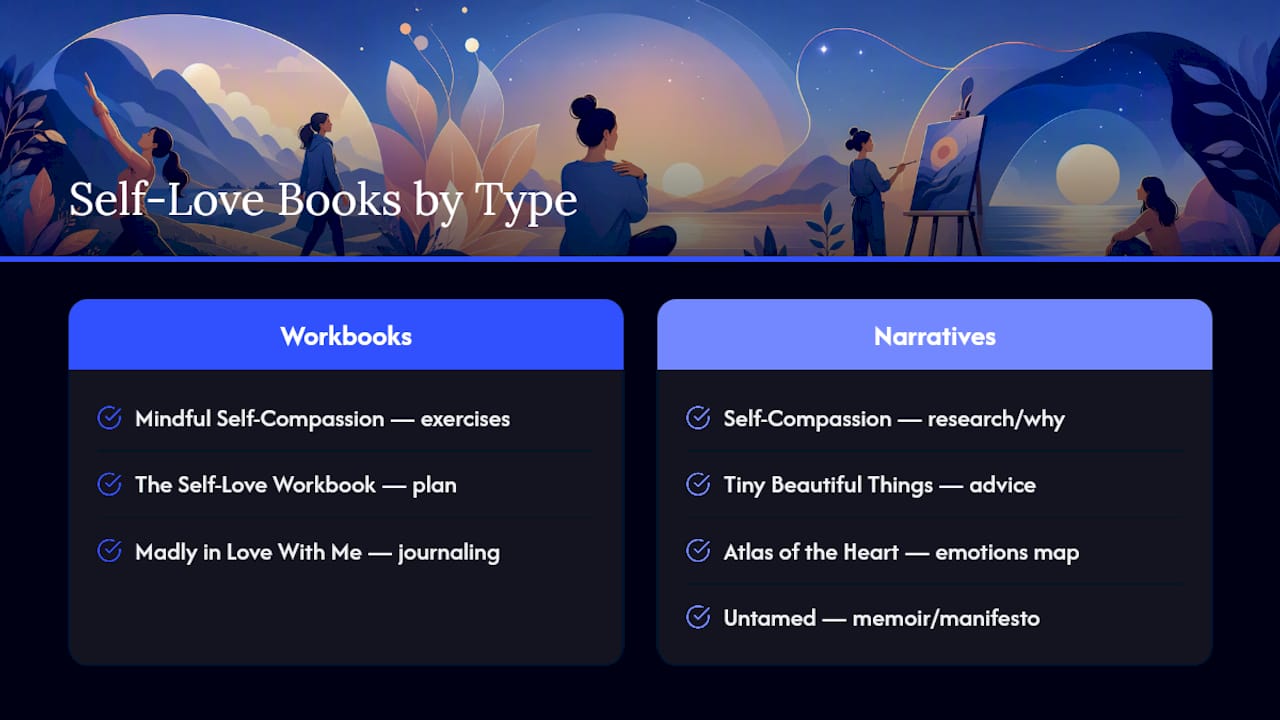
Reading about self-love and building it are two different skills. The books below split roughly evenly between workbooks that ask something of you and narrative works that change how you see yourself. Here are nine worth your shelf space, US-available and picked for range rather than repetition.
1. Self-Compassion by Kristin Neff
Neff's research makes the case that self-compassion beats self-esteem as a foundation for wellbeing, because it doesn't depend on winning or comparing yourself to anyone. Best for: readers who want the "why" behind self-compassion before committing to exercises.
2. The Mindful Self-Compassion Workbook by Kristin Neff and Christopher Germer
This is the doing half of Neff's work: guided exercises that walk you through self-compassion practices week by week, including direct guidance on what to do when old pain resurfaces. Best for: readers who finished Self-Compassion and want a structured follow-up.

3. The Self-Love Workbook by Dr. Shainna Ali
A licensed mental health counselor built this around a Seven Segments framework that breaks self-love into concrete, workable pieces instead of one vague goal. Best for: anyone who does better with a plan than a mantra.
4. Madly in Love With Me by Christine Arylo
Arylo's Tree of Self-Love model splits self-love into ten branches, with journaling prompts and what she calls "daring acts," small real-world dares that force practice past the page. Best for: readers who want structure with more edge and humor than a clinical workbook.

5. Tiny Beautiful Things by Cheryl Strayed
A collection of Strayed's advice columns written as "Dear Sugar," blunt and generous in equal measure, proving that self-compassion often looks like radical honesty rather than gentleness. Best for: readers who connect better through story than instruction.
6. Atlas of the Heart by Brené Brown
Brown maps 87 emotions and experiences with research and language for feelings most people never learned to name, which matters because you can't be kind to what you can't identify. Best for: readers who intellectualize their emotions and need a vocabulary bridge.
7. Untamed by Glennon Doyle
Part memoir, part manifesto, Doyle's book challenges the idea that self-sacrifice equals virtue, and it lands hardest with readers who've spent years shrinking to keep others comfortable. Best for: anyone untangling self-worth from other people's expectations.
8. The Body Is Not an Apology by Sonya Renee Taylor
Taylor frames radical self-love as political as well as personal, connecting body shame to systems bigger than any one person's insecurity. Best for: readers confronting body image wounds tied to race, size, disability, or gender.
9. Home Body by Rupi Kaur
A poetry collection built for slow reading, one page or one sitting, when you need resonance more than instruction. Best for: readers who find prose exercises exhausting and want something to sit with instead.
What Kind of Self-Love Book Do You Actually Need?
Not every book on that list does the same job, and matching format to your current state matters more than picking the "best" title.
- Workbooks (The Self-Love Workbook, The Mindful Self-Compassion Workbook, Madly in Love With Me) are action-oriented. They ask you to write, reflect, and try things. Best when you have energy to engage, not just consume.
- Memoirs and essays (Tiny Beautiful Things, Untamed) build empathy and perspective through someone else's story. Best when you feel isolated in your struggle and need to feel understood before you're ready to act.
- Self-compassion science (Self-Compassion, Atlas of the Heart) gives you skills backed by research. Best when you're skeptical of self-help language and want evidence before buy-in.
- Poetry and reflective collections (Home Body) offer comfort without demanding effort. Best on hard days when a workbook prompt would feel like one more task.
Pairing a mindfulness text like Jon Kabat-Zinn's Wherever You Go, There You Are alongside any of these adds present-moment awareness that makes self-compassion exercises land better, since you have to notice a feeling before you can respond to it kindly.
How to Turn Reading Into an Actual Practice
Buying the book is the easy part. Here's a starter sequence that keeps momentum without overwhelming you:
- Start with grounding. Spend a week on short guided exercises from Self-Compassion or a few minutes of mindful breathing before you open any workbook.
- Move into structured practice. Pick one workbook and commit to one section a week rather than racing through it.
- Read a memoir alongside it. Let Untamed or Tiny Beautiful Things run in parallel so you get story and structure at once.
- Revisit and track. Return to specific exercises or "pulse checks" monthly. Readers who reuse checkpoints report better adherence than those who read a workbook once and shelve it.
Watch for "backdraft," a documented effect where old, disowned emotions surface once you start being kind to yourself. It sounds counterintuitive, but self-compassion can feel worse before it feels better, especially if you've spent years avoiding certain feelings. If a prompt hits too hard, pause, ground yourself with a few slow breaths, and consider talking it through with a therapist or a trusted friend instead of pushing through alone.
Pro Tip: Read the hardest workbook prompts at the start of your day, not right before bed. If backdraft surfaces, you'll have hours to process it instead of lying awake with it.
What The Bookaholic Podcast Looks For In A Self-Love Book
We don't recommend a book because it trended. The Bookaholic Podcast curates around three things: whether the exercises actually work outside the page, how deep the author goes in conversation, and what listeners tell us stuck with them weeks later.
- The Self-Love Workbook came up repeatedly in listener messages because the Seven Segments structure gave people something to return to, not just a one-time read.
- Madly in Love With Me stood out in interview because Arylo talks candidly about the "daring acts" that make her Tree of Self-Love model harder to ignore than a typical journaling prompt.
- Tiny Beautiful Things keeps resurfacing in author conversations about craft and vulnerability, since it shows self-compassion delivered through blunt honesty rather than soft language.
Pair any of these with the matching podcast episode. Hearing an author explain their own exercises often clarifies a prompt that reads confusingly on the page.
Why These Books Change How I Talk About Self-Love On The Show
Certain books shift how you host, not just how you read. The Self-Love Workbook changed how I frame recommendations on the podcast, because Dr. Ali's segmented approach gave me language for guiding listeners toward one small step instead of an abstract idea. Author interviews consistently surface the same truth: the exercises that sound simplest in a book, a journaling prompt, a five-minute pause, are usually the ones authors say worked on them personally. That's the detail worth sitting with before you skip past a prompt as too basic.
If any of these titles resonate, the conversation doesn't have to end when you close the book.
— Deirdre
Keep The Conversation Going After You Close The Book
Reading builds the foundation, but talking through a book with other people who are working through the same prompts is where it sticks. That's the gap between a bookstore recommendation and what a podcast built around books can actually give you.
The Book Recs Podcast pairs titles like these with in-depth author interviews and episode-based reading lists, so you get the author explaining their own exercises in their own words, not just the page. You'll find playlists organized around self-love and mental health, along with the kind of author conversations that make a workbook prompt actually click. If you want a practice guide with a rhythm to it, a 90-day journaling structure pairs well with any workbook on this list for readers who want a daily container to write in. Visit the Book-a-holic landing page, pick an episode tied to a title above, and start there.