This is a curated, cross-genre list of the best found family books, organized by genre with short blurbs so you can pick your next read fast. You will find a scannable top-picks section, deep dives into fantasy, young adult, romance, and cozy literary fiction, plus a research-backed look at why this trope hits so hard. Content warnings and selection tips are woven in throughout.
TL;DR:
- Found family stories can be high-stakes or cozy, with longer or shorter books depending on whether they focus on survival or gentle support.
- Fantasy picks like Six of Crows emphasize intense loyalty forged through danger, while novels like Legends & Lattes offer warm, low-stakes camaraderie.
- YA titles such as Counting by 7s depict adolescents building alternative families after loss or rejection, often exploring grief and identity.
- Content warnings are common in several titles, especially those involving grief, trauma, or violence, requiring pre-reading caution.
- Selecting a book depends on tone, stakes, length, and emotional content, with suggestions tailored to reader mood and readiness for heavy themes.
Table of Contents
- The Best Found Family Books Across Every Genre
- Best Fantasy Found Family Books
- Best Young Adult Found Family Books
- Best Romance and Romantasy Found Family Books
- Cozy and Literary Found Family Picks
- Why Found Family Resonates: The Research Behind the Trope
- How to Pick Your Next Found Family Book
- A Curator's Note on Found Family Books
- Keep the Conversation Going With the Bookaholic Podcast
- Sources
The Best Found Family Books Across Every Genre
Some tropes get tired. This one hasn't, and there's a reason for it: found family stories let a writer build intimacy from scratch, without the shorthand (or the baggage) that comes with blood relation. Below are twelve books about chosen family that show the trope working in wildly different registers, from heist fantasy to cozy coffee-shop fiction to unflinching literary realism.
- Six of Crows by Leigh Bardugo. Six criminals with nothing in common but desperation become each other's only loyalty, and the found family here is forged in blood, banter, and betrayal that never quite breaks the bond.
- The House in the Cerulean Sea by TJ Klune. A buttoned-up caseworker sent to inspect a magical orphanage ends up rebuilding his own capacity for belonging alongside six children nobody else wanted.
- Legends & Lattes by Travis Baldree. A retired orc barbarian opens a coffee shop and, without meaning to, assembles a ragtag staff that becomes the family she never had time for during her fighting years.
- The Raven Boys by Maggie Stiefvater. Four boys chasing a Welsh king's ley line become bound to each other and to Blue Sargent in ways their actual families can't touch.
- Counting by 7s by Holly Goldberg Sloan. A grieving genius twelve-year-old finds a strange, patchwork network of neighbors and near-strangers who become the family she has left, a dynamic explored in detail on LitCharts's theme breakdown.
- The Long Way to a Small, Angry Planet by Becky Chambers. A tunneling ship's crew, human and alien alike, forms the emotional core of a book where the plot is almost secondary to the relationships.
- The Gilded Wolves by Roshani Chokshi. A treasure hunter assembles a crew of outcasts and specialists in Belle Époque Paris, each one carrying a wound that the group quietly helps heal.
- A Man Called Ove by Fredrik Backman. A cantankerous widower's accidental neighbors slowly become the only people who understand him, proof the trope works just as well in literary fiction as fantasy.
- The Kitchen House by Kathleen Grissom. An unflinching historical novel where enslaved and indentured characters build fierce loyalty and protection across a household that biology never intended to connect.
- Beach Read by Emily Henry. A grief-stricken novelist and her writer neighbor build an unlikely support system that becomes as central to the book as the romance itself.
- The Fishermen by Chigozie Obioma. Two Nigerian brothers and the friends who orbit them form bonds that carry more weight than the family structure fracturing around them.
- Legends of the North Cairn (reader-favorite pick surfaced in book community discussions). A lower-profile fantasy that community readers keep recommending for its slow-burn crew loyalty, worth a look if you've already burned through the bestsellers above.
Content warning: several picks above, especially Counting by 7s and The Kitchen House, deal directly with grief, loss, and trauma. Keep that in mind if you're choosing a book for a hard week rather than an escape from one.
Best Fantasy Found Family Books
Fantasy is where the found family trope does its heaviest lifting, mostly because fantasy plots love throwing strangers into high-stakes situations together. Crews, guilds, and ragtag bands of misfits are baked into the genre's DNA, and editorial roundups consistently point to a handful of titles as the clearest examples of the pattern.
Six of Crows by Leigh Bardugo remains the genre's sharpest showcase. Six teenage criminals, each running from a different kind of damage, get thrown together for an impossible heist and end up more loyal to each other than to any cause. The tone is high-stakes and occasionally brutal, with violence and trauma threaded through the backstory of nearly every character.
The Long Way to a Small, Angry Planet by Becky Chambers takes the opposite tack. It's a slow, gentle space opera where the found family isn't forged under pressure so much as grown, meal by meal, argument by argument, on a ship crewed by species who barely understand each other's biology, let alone each other's feelings. If Six of Crows is a knife fight, this is a long dinner conversation, and both versions of the trope work.
Legends & Lattes by Travis Baldree splits the difference: low stakes, cozy tone, but a genuine found family arc as a retired warrior builds a business (and a found household) out of former strangers who wander into her coffee shop.
A few more fantasy picks worth your shelf space:
- The Gilded Wolves by Roshani Chokshi, for readers who want the heist-crew dynamic with a Belle Époque backdrop.
- Nine Liars by Maureen Johnson, for boarding-school found family with a mystery spine.
- The Priory of the Orange Tree by Samantha Shannon, for readers who want an ensemble cast spread across continents that still reads as one tight unit by the final act.
Pro Tip: If you're not sure whether a fantasy found family book leans cozy or brutal, check the page count and the body count in early reviews. Longer books with a high early death toll (Six of Crows, The Gilded Wolves) tend to stay high-stakes. Shorter, warmer books (Legends & Lattes) usually stay gentle.
Best Young Adult Found Family Books
Young adult found family books tend to do a specific kind of emotional work: they let teenage characters build identity outside the family structure they were handed, often because that structure has failed them, sometimes because it simply isn't enough. This is one reason the trope shows up so often in coming-of-age arcs, according to scholarly analysis of the pattern in contemporary YA, which traces how chosen bonds increasingly stand in for, or supplement, biological family in the genre.
The Raven Boys by Maggie Stiefvater is the clearest example on any list. Blue Sargent and the four boys chasing a dead Welsh king's ley line don't share blood, class, or backstory, but by book two they share something closer to loyalty than most siblings manage. The series is a slow burn across four books, appropriate for teen readers, with some violence and grief in later installments.
Counting by 7s by Holly Goldberg Sloan follows a twelve-year-old genius named Willow Chance after she loses both parents, and the patchwork of neighbors, a school counselor, and a Vietnamese family who take her in becomes the emotional center of the book. LitCharts's analysis frames this as a textbook case of nonbiological guardians filling a family role the plot desperately needs filled. It's appropriate for middle-grade and up, though the grief content is significant and worth flagging for younger or more sensitive readers.
Other strong YA picks:
- We Are Okay by Nina LaCour, for a quieter, grief-centered take on chosen support systems.
- The Extraordinaries by TJ Klune, for a superhero-adjacent found family with a lighter tone than his adult work.
- Legendborn by Tracy Deonn, for a secret-society found family with real stakes and a strong Black Southern Gothic voice.
None of these require content warnings beyond grief and loss, but if you're recommending to a younger reader, Counting by 7s and We Are Okay both merit a heads-up conversation first.
Best Romance and Romantasy Found Family Books
Found family in romance rarely stands alone. It usually shows up as the scaffolding around the central relationship: the small-town friend group, the blended household, the found parents who show up for a wedding nobody's biological family would attend. Editors covering the overlap between romance and found family note that the trope often intersects with grief and chosen parenting storylines, which is why content warnings matter more here than in lighter genres.
Beach Read by Emily Henry uses found family almost as a coping mechanism. January's grief over her father collides with January and Gus's slow-burn romance, but it's the neighboring writers and small beach town regulars who round out the emotional support system that makes the romance land.
A few more romance and romantasy picks:
- Loveless by Alice Oseman, for a college friend-group found family that reframes what romantic and platonic love can mean together.
- The Ex Hex by Erin Sterling, for a witchy small-town cast where found family and romance tangle together over a single chaotic autumn.
- Fangirl Down by Tessa Bailey, for a lighter romance where a golf caddie's found crew on the road becomes as important as the central couple.
- Payback's a Witch by Lana Harper, for a found-family coven dynamic layered under a romantic rivalry plot.
If you're drawn to this pairing of tropes, our roundup of romantasy books that match your mood goes deeper on titles where the romantic plot and the ensemble cast carry equal weight. Content warning: several of the grief-adjacent picks above (Beach Read especially) deal with parental death, so pace your reading accordingly if that's a raw subject right now.
Cozy and Literary Found Family Picks
Not every found family book wants to raise your heart rate. Some are built for the opposite: slow warmth, quiet healing, and the sense that belonging doesn't have to be earned through crisis. Editorial roundups that group found-family titles by tone consistently separate this "cozy" register from the higher-stakes ensemble fantasy or YA coming-of-age categories, and it's a useful distinction if you're choosing a book to match your mood rather than a plot you want to survive.
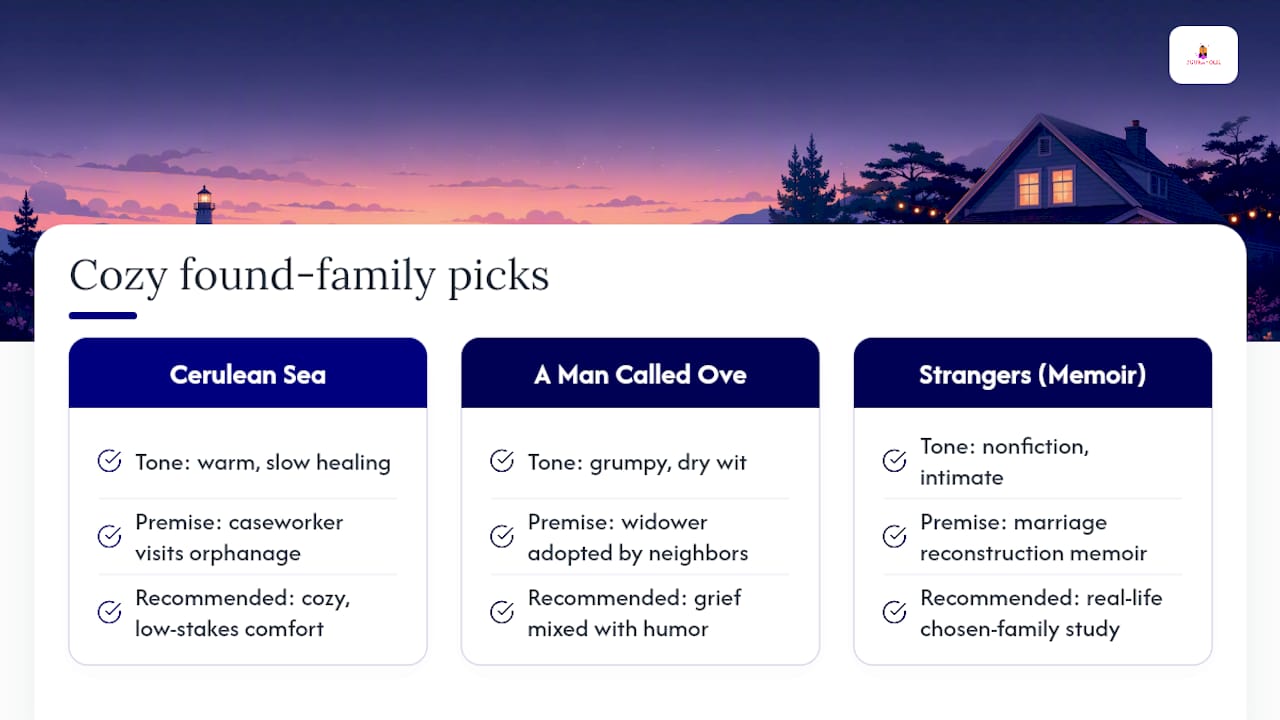
The House in the Cerulean Sea by TJ Klune is the genre's current standard bearer. Linus Baker, a rule-following caseworker, spends a summer inspecting a magical orphanage and slowly realizes the six unusual children living there, and the man who runs the place, have built something he's never had: a home that doesn't require him to shrink himself to fit. It's warm almost to a fault, which is exactly the point.
A Man Called Ove by Fredrik Backman takes a grumpier route to the same destination. A widower who has decided life no longer has anything for him gets slowly, stubbornly adopted by his chaotic new neighbors, and the found family that results is funnier and sadder than most fantasy versions of the trope manage.
Strangers: A Memoir of Marriage offers a nonfiction angle worth considering if you want to see how chosen bonds and reconstructed family structures play out in a real marriage rather than a novel; you can find our full recommendation write-up for more on that one.
For readers who want warmth and healing over action, start with Cerulean Sea. For readers who want the trope filtered through dry wit and grief, Ove is the better fit. If you'd rather stay in fantasy but keep the cozy register, our list of cozy fantasy books for a coffee shop afternoon pulls from the same emotional territory.
Why Found Family Resonates: The Research Behind the Trope
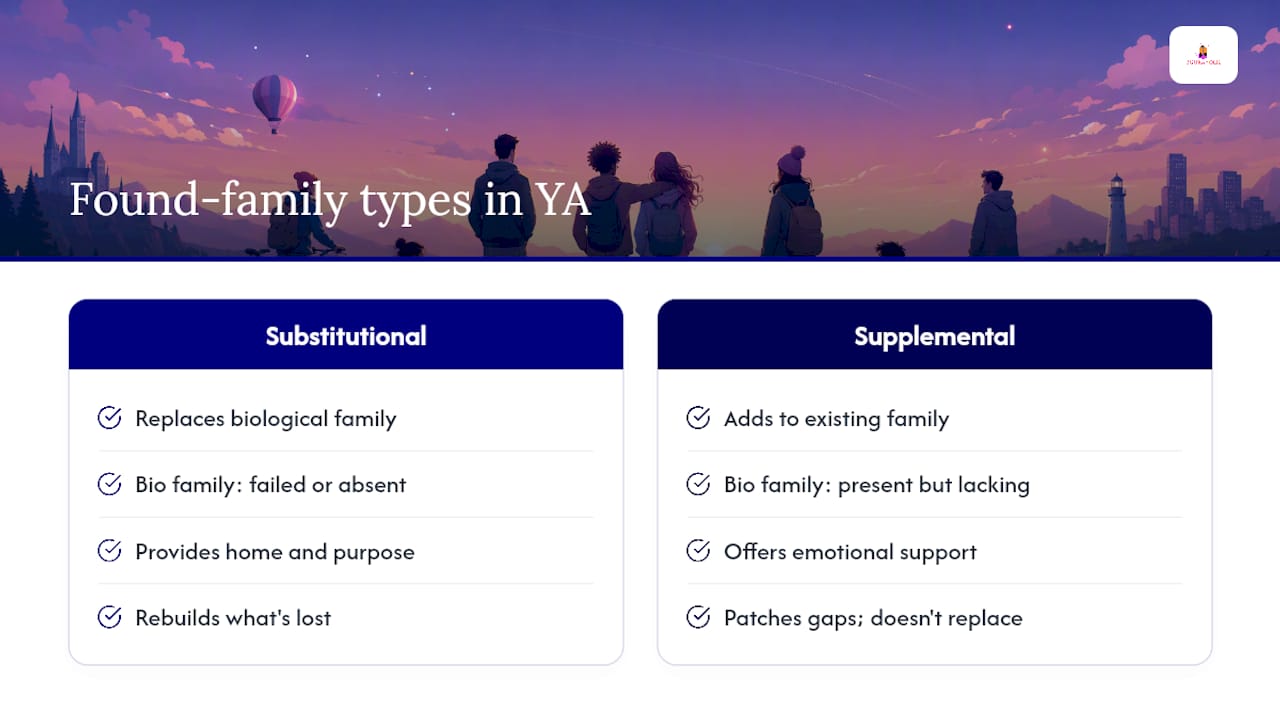
Found family in fiction splits into two distinct categories, and knowing the difference changes how you read almost every book on this list. Scholarly analysis of the trope in contemporary YA distinguishes substitutional found families, which provide a home and a sense of purpose a character's biological family failed to give them, from supplemental found families, which add emotional support alongside a family structure that's still present but insufficient, according to research from Penn State's Schreyer Honors College. Six of Crows runs almost entirely substitutional: every member of the crew is running from a family that failed them outright. Beach Read runs supplemental: January's found support system doesn't replace her family, it fills in the gaps grief has left behind.
The trope's staying power comes from this flexibility. It can rebuild what was lost, or it can quietly patch what was never quite enough, and readers recognize both versions in their own lives.
The same research notes that found family narratives in YA fiction have grown more diverse over the past decade, both in who gets to be part of the found family and in what kind of bond the story is portraying. That diversification shows up clearly across the picks in this list, from the queer chosen-family household in The House in the Cerulean Sea to the intergenerational, cross-cultural network in Counting by 7s.
Editorial coverage backs this up from a different angle. Outlets that build found-family reading lists tend to organize titles by tone and emotional function rather than by publication date, according to Modern Mrs. Darcy's analysis of the pattern, a structure this article deliberately mirrors. Deirdre has explored similar territory on the Bookaholic Podcast, where conversations about grief, community, and the families we build around loss surface again and again across genres, from memoir to fantasy.
How to Pick Your Next Found Family Book
Choosing well takes about ninety seconds if you run through this order:
- Set your tone first. Do you want cozy and low-stakes (Legends & Lattes), or high-stakes and morally messy (Six of Crows)? Tone matters more than genre for this trope specifically.
- Check the stakes level. Books with a heist, war, or death-toll plot (The Gilded Wolves, Six of Crows) run hotter than slower character studies (The Long Way to a Small, Angry Planet, A Man Called Ove).
- Match age appropriateness. YA picks like The Raven Boys and Counting by 7s work for teen readers; some romance picks and literary fiction (The Kitchen House, The Fishermen) are firmly adult.
- Consider length and pacing. A four-book series (The Raven Boys) is a different commitment than a standalone (Legends & Lattes).
- Scan for content warnings before you commit. Grief, trauma, and violence show up often in this trope, and knowing that upfront changes whether a book fits your week.
Two quick reader profiles: if you want something to read on a rainy Sunday with tea in hand and nothing urgent, start with Legends & Lattes or The House in the Cerulean Sea. If you want to stay up until 2 a.m. because you can't stop turning pages, Six of Crows or The Gilded Wolves will do it.
Pro Tip: Read the first chapter and skim a few reader reviews for content warnings before committing to a book dealing with grief or trauma. It takes five minutes and saves you from starting a book at the wrong moment.
A Curator's Note on Found Family Books
I keep coming back to found family books for the same reason listeners keep bringing them up on the podcast: they're honest about the fact that the people who save us aren't always the people we're related to. My three personal favorites, if you're forcing me to choose, are The House in the Cerulean Sea for its warmth, Six of Crows for its refusal to make loyalty easy, and Counting by 7s for how quietly it builds an entire support network out of near-strangers.
Curating this list wasn't about finding the trendiest titles. It was about finding books where the found family actually does narrative work, not just decoration. If you want more conversations like this, our interview episodes dig into exactly how authors build these bonds on the page.
— Deirdre
Keep the Conversation Going With the Bookaholic Podcast
Reading the list is one thing. Hearing the authors talk about why they built their found families the way they did is another experience entirely, and it's one you won't get from a blog post alone. A podcast pairs author interviews with in-depth book discussions, offering context a review can't give you: why a writer chose a substitutional found family over a supplemental one, what almost got cut, what the ending meant to them personally.

A great starting point is the episode "From Fairytales to Reality: A Young Writer's Dream", which explores how a young author's own path shaped the kind of chosen-family stories they wanted to tell. If you're curious about the craft side of building found family dynamics, the Writers Workshop episode with international guest Lauca breaks down plotting decisions that never make it into a Goodreads review. Subscribe wherever you listen, and start with either episode to hear the stories behind the stories on this list.
Sources
- “Being Related Doesn’t Make Us Family”: An Examination of Found Family in All For the Game and The Raven Cycle — Schreyer Honors College
- 15 novels about creating (and maintaining) a found family – Modern Mrs. Darcy
- 28 Incredible Books with the Found Family Trope – Epic Reads
- Chosen Family theme in Counting by 7s | LitCharts