
This is a curated list of the best books about friendship, sorted by age and genre, with discussion prompts built in. If you need a starting point right now, grab The Rabbit Listened for a young reader, *The ‘Lightning Thief’-style loyalty in middle-grade favorites like Front Desk for a tween, My Friends by Fredrik Backman for adult fiction, and Cicero's How to Be a Friend for nonfiction. Everything else below builds out from there.
TL;DR:
- Most children's picture books about friendship demonstrate empathy and acceptance without moralizing, fostering genuine understanding from simple stories.
- Middle-grade and YA novels depict friendship as complex and evolving, often tested by circumstances like class, grief, or individual growth.
- Adult fiction explores friendship's depth and difficulty, emphasizing loyalty, moral conflict, and how shared history shapes enduring bonds.
- Nonfiction titles highlight friendship as a skill and cultural phenomenon, with timeless advice from Cicero and modern insights into maintaining adult relationships.
- Found-family and cross-cultural stories expand the idea of friendship beyond traditional kinship, illustrating its transformative power across diverse backgrounds.
Table of Contents
- Best Children's Books About Friendship
- Best Middle-Grade and YA Books About Friendship
- Best Adult Fiction About Friendship
- Best Nonfiction and Essays About Friendship and Belonging
- Found-Family and Cross-Cultural Friendship Picks
- How to Read These Books With Friends
- Curator Picks From The Bookaholic Podcast
- Where to Find These Titles and Read Further
- Why These Friendship Stories Stay With Me
- Sources
- FAQ
Best Children's Books About Friendship
Picture books do something novels can't: they teach a friendship lesson in the time it takes to finish a bedtime cup of tea. The best ones don't lecture. They just show a kid making a mistake, or a rabbit sitting quietly with a friend who's sad, and let the feeling land on its own.
- The Rabbit Listened by Cori Doerrfeld — no advice, no fixing, just presence. A quiet, powerful model for what it means to show up for someone in pain.
- Frog and Toad Are Friends by Arnold Lobel — gentle, funny vignettes about two very different personalities who accept each other completely. A classic for a reason.
- Should I Share My Ice Cream? by Mo Willems — Gerald's internal panic over sharing is comedy gold, and it opens up an easy conversation about generosity without moralizing.
- The Invisible Boy by Trudy Ludwig — a picture book about inclusion, told from the point of view of a kid nobody notices until one classmate does.
- Extra Yarn by Mac Barnett and Jon Klassen — a fable about generosity and community that resonates even with adults reading it aloud.
- We're Different, We're the Same by Bobbi Kates — a Sesame Street favorite that makes the case for friendship across every visible difference, perfect for classroom circle time.
- Big Red Lollipop by Rukhsana Khan — sibling rivalry meets a hard lesson about fairness and forgiveness, ideal for slightly older early readers.
For read-alouds, The Rabbit Listened and Extra Yarn tend to spark the best follow-up conversation because the endings leave a little room for kids to fill in their own interpretation.
Best Middle-Grade and YA Books About Friendship
Once readers hit middle grade, friendship stories get more complicated, and that's the point. These books show loyalty tested, friendships that outgrow each other, and the messy work of repair.
- Front Desk by Kelly Yang (ages 9 to 12) — a friendship across class and cultural lines, built inside the pressure cooker of a family-run motel.
- The Thing About Jellyfish by Ali Benjamin (ages 10 to 13) — grief and a fractured friendship collide after a former best friend dies, and the narrator searches for a scientific explanation to avoid the emotional one.
- Two Naomis by Olugbemisola Rhuday-Perkovich and Audrey Vernick (ages 9 to 12) — two girls with the same name forced together by a blended family, learning friendship isn't always a choice at first.
- The Serpent's Secret by Sayantani DasGupta (ages 10 to 13) — fantasy adventure with a fierce, funny friend dynamic rooted in Bengali folklore.
- We Are Okay by Nina LaCour (YA, ages 14 and up) — a quieter, aching look at how grief can isolate a friendship right when you need it most.
- The Downstairs Girl by Stacey Lee (YA, ages 13 and up) — historical fiction where friendship crosses race and class lines in the 1890s Atlanta.
- I'll Give You the Sun by Jandy Nelson (YA, ages 14 and up) — twins whose bond fractures and slowly rebuilds, told in alternating timelines.
Front Desk and Two Naomis pair especially well for a joint read since both explore friendship formed under circumstance rather than choice.
Best Adult Fiction About Friendship
Adult fiction tends to treat friendship the way it deserves: as complicated as any romance, and often more durable. These picks range from tender to genuinely uncomfortable, which is exactly what makes them good book-club material.
- My Friends by Fredrik Backman — a novel about how a single act of teenage friendship and art can echo across decades, described by Simon & Schuster as a story of how youthful bonds shape the adults we become. Heartwarming with an undercurrent of melancholy.
- Best of Friends by Kamila Shamsie — Penguin Random House frames this as an examination of a lifelong friendship strained by loyalty and moral compromise between two women who grew up together in Karachi. Tone: tense, morally complicated.
- Big Little Lies by Liane Moriarty — school-gate friendships with secrets underneath. Messy, propulsive, great for a lighter discussion night.
- Conversations with Friends by Sally Rooney — friendship, romance, and jealousy tangle together in a way that resists easy answers.
- The Vanishing Half by Brit Bennett — twin sisters whose separate paths test what friendship and family owe each other.
- Where'd You Go, Bernadette by Maria Semple — funny, satirical, and surprisingly moving about a friendship an outsider builds through obsession and detective work.
- The Immortalists by Chloe Benjamin — siblings more than friends, but the loyalty dynamics read the same way.
- Commonwealth by Ann Patchett — blended-family friendships across decades, quietly devastating.
For a book-club pairing, put My Friends next to Best of Friends: both ask what a friendship owes you decades later. The NYPL's curated friendship list recommends exactly this kind of shared reading to deepen conversation about loyalty and betrayal, and Literary Hub's essay on friendship novels makes a strong case for seeking out titles that show friendship's contradictions rather than its highlight reel.
Best Nonfiction and Essays About Friendship and Belonging
Nonfiction earns its place on this list because friendship isn't only a plot device. It's also a skill, a philosophy, and increasingly, a subject of cultural anxiety about adult loneliness.
- Cicero's How to Be a Friend (Princeton University Press translation) treats friendship as central to a well-lived life, and Princeton University Press notes the text has guided readers on choosing and keeping friends for more than two thousand years.
- Big Friendship by Aminatou Sow and Ann Friedman examines what it actually takes to maintain a serious adult friendship through distance, conflict, and change, drawing on the authors' own decade-long bond.
- Bookshop rounds out practical and reflective picks worth browsing if you want more range.
- The Lonely Century by Noreena Hertz widens the lens to the social and economic forces behind rising isolation, useful if your discussion wants a cultural-criticism angle.
- You're Not Listening by Kate Murphy isn't strictly about friendship, but its research on real listening applies directly to how friendships survive or fail.
Pair Cicero with Big Friendship for a session that spans two thousand years of thinking on the same basic question: what do we actually owe our friends?
Found-Family and Cross-Cultural Friendship Picks
Some of the richest friendship stories happen outside traditional family lines entirely. These picks widen the category on purpose.
- A Man Called Ove by Fredrik Backman — an unlikely intergenerational bond between a grumpy widower and his immigrant neighbors, reframing friendship as something that rescues you from isolation.
- The Kite Runner by Khaled Hosseini — a friendship across class lines in Afghanistan that carries the weight of guilt and redemption across decades.
- Fried Green Tomatoes at the Whistle Stop Cafe by Fannie Flagg — friendship as chosen family in the American South, layered with a quietly radical queer subtext.
- The Guncle by Steven Rowley — an unconventional caregiving friendship between an uncle and his grieving niece and nephew.
- Interior Chinatown by Charles Yu — identity, belonging, and friendship refracted through the lens of representation itself.
Any of these work well in a themed reading set built around found family; readers wanting more in this vein should look at a curated found-family book list for further picks.
How to Read These Books With Friends
You don't need a formal book club to get the most out of these lists. A single afternoon and one good friend will do.
- Pick one sharp prompt, not five shallow ones. Ask "Whose sacrifice mattered more in this friendship?" or "Where did the balance of investment tip unevenly?" Research on group reading suggests pointed questions about turning points and sacrifice produce sharper conversation than a long list of surface-level ones.
- Try a single-session format. Pick a shorter novel, read it over a week, and meet once. Short book-club books under 300 pages work well for this.
- Or run a month-long arc. Pair a classic with a contemporary title, as Cicero and Big Friendship do, and spend four weeks moving between them.
- Ask "What would you have done?" It's the single most reliable question for surfacing disagreement, which is where the good conversation actually starts.
Pro Tip: Assign one person to argue the unpopular side of a character's choice, even if nobody in the group actually agrees with it. Forced debate produces better conversation than polite consensus every time.
For copy-paste discussion questions, Bookaholic's book club discussion questions guide covers most of these titles and more.
Curator Picks From The Bookaholic Podcast
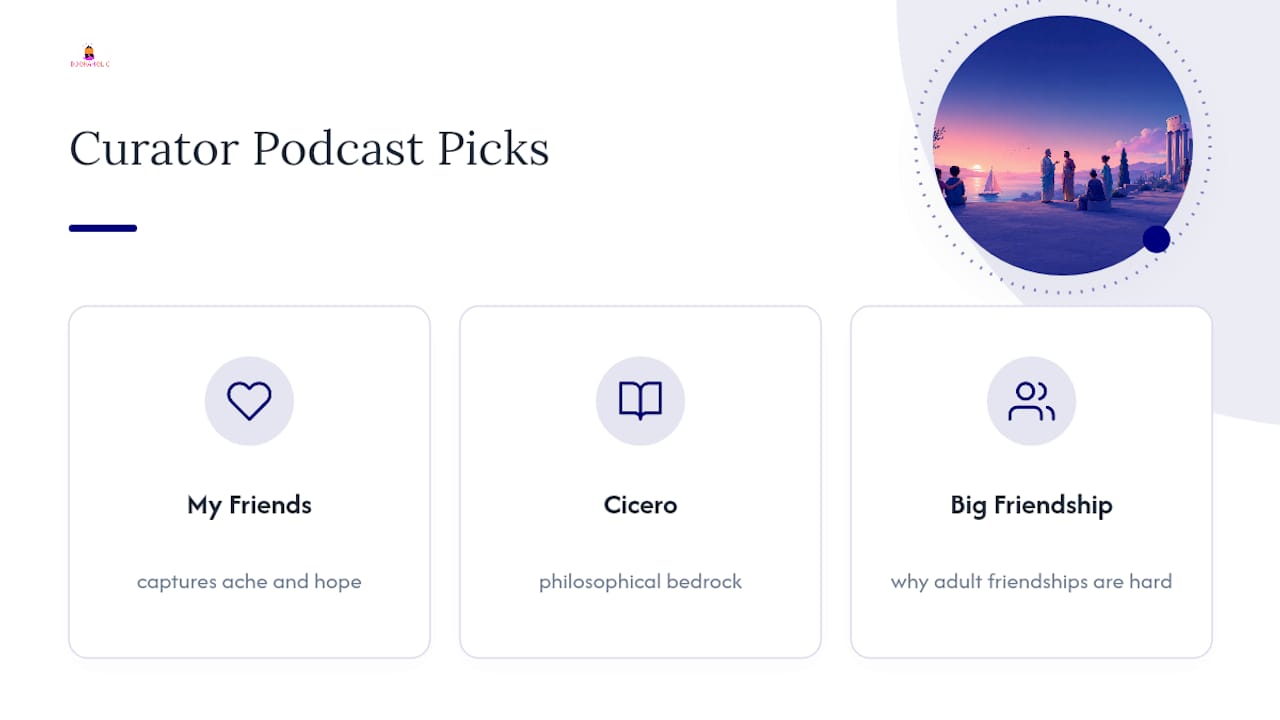
Every list on this page draws from what actually gets discussed on The Bookaholic Podcast, where friendship keeps surfacing as one of the themes listeners return to most, alongside mental health and the writing life. Our top three recurring picks: My Friends for its ache and its hope, Cicero for readers who want the philosophical bedrock, and Big Friendship for anyone trying to figure out why adult friendships are so hard to maintain.
For more curated reading, browse Bookaholic's book club category or the creative nonfiction roundup.
Where to Find These Titles and Read Further
- Princeton University Press's Cicero page gives the fullest publisher description of How to Be a Friend.
- NYPL's friendship novel list offers librarian-vetted picks for group reading.
- Literary Hub's essay digs into friendship's messier literary side.
- Publisher pages for My Friends and Best of Friends offer authoritative plot summaries.
Why These Friendship Stories Stay With Me
I keep coming back to friendship books because they do something romance novels rarely attempt: they show love with no clear finish line, no wedding, no fixed shape. That's harder to write well, which is why the good ones, like My Friends or Cicero's two-thousand-year-old letters, feel so rare. If you want to go deeper on any of these, come find the conversation over at The Bookaholic Podcast and check out our literary merchandise while you're there.
— Deirdre
Sources
- How to Be a Friend | Princeton University Press
- 15 Novels About Friendship To Read With Your Bestie | NYPL
- Seven novels that explore friendship — Literary Hub
- My Friends — Simon & Schuster
- Best of Friends — PenguinRandomHouse
FAQ
What Is the 11-3-6 Rule of Friendship?
The 11-3-6 rule is a popular social theory suggesting a rough timeline for moving from acquaintance to close friend. It's not a scientifically fixed timeline but rather emphasizes how consistency, not just chemistry, builds real friendship.
What Is the Hardest Age to Make Friends?
Many people report their late twenties through forties as the hardest stretch for making friends, since careers, parenting, and moving away from old social circles all narrow the time and opportunity for new connections. Books like Big Friendship and essays on building friendships later in life speak directly to this gap.
What Are the 5 C's of Friendship?
Definitions of the "C's of friendship" vary depending on the source, and there's no single agreed-upon list. Common versions tend to include qualities like communication, consistency, care, commitment, and compromise, though you'll find slightly different framings elsewhere.
What Is the 7-Year Friend Rule?
The idea behind the "rule" is that friendships tend to naturally shift or get tested over time, often because life circumstances, like moving, marriage, or career changes, pull people in different directions. It's more folk wisdom than fact, but it echoes exactly what novels like Best of Friends dramatize: friendship that survives change usually has to be renegotiated, not just maintained.
What Makes a Good Book About Friendship?
The strongest picks show friendship as something with real stakes, not just warmth, including conflict, sacrifice, and the work of repair. That's why curated lists like NYPL's mix comforting reads with messier, more complicated ones.