
Start with In Cold Blood, The Year of Magical Thinking, I Know Why the Caged Bird Sings, and Silent Spring if you read nothing else on this list. They cover the four backbones of the genre: true crime narrative, grief memoir, coming-of-age memoir, and science writing that reads like a thriller. Below, you'll find twelve annotated picks, a breakdown by form, and reading paths for casual readers, book clubs, and writers studying the craft.
TL;DR:
- Most creative nonfiction blends factual accuracy with compelling storytelling techniques like scene construction, narrative arc, and character development.
- The genre spans many forms, including memoir, personal essay, literary journalism, nature writing, and lyric experimentation, often overlapping within a single work.
- Key texts demonstrate different craft strengths: Capote's pacing, Didion's restraint, Carson's research storytelling, and Gay's lyric brevity.
- Browsing by voice, scope, research depth, and length helps readers and writers choose works aligned with their interests or craft study goals.
- Foundational techniques include scene reconstruction, immersive storytelling, braided timelines, and research integration, all used flexibly across the genre.
Table of Contents
- What counts as creative nonfiction books worth reading
- Top picks: the essential shortlist
- Creative nonfiction by form
- How to choose which creative nonfiction book to read next
- Authors and voices to follow
- Reading pathways for different goals
- Why the Bookaholic podcast recommends these reads
- What creative nonfiction actually means
- Why these books matter
- How creative nonfiction became its own genre
- The techniques that make creative nonfiction work
- Creative nonfiction versus other nonfiction genres
- The ethical line writers and readers both have to watch
- Where to keep exploring
- An editor's honest take on this list
- Sources
What counts as creative nonfiction books worth reading
Creative nonfiction takes techniques normally reserved for fiction, narrative arcs, character development, vivid scene setting, and applies them to true events. It's not journalism with better sentences, and it's not memoir with looser fact checking. It's a discipline that demands both accuracy and story architecture at the same time.
The category is bigger than most readers realize. Goodreads catalogs more than 5,600 titles under the creative nonfiction tag, spanning memoir, personal essay, literary journalism, and nature writing. That range is exactly why a shortlist matters. Walk into any bookstore's nonfiction section and you'll find war reporting shelved next to grief memoirs and next to essay collections about birds. Nothing tells you where to start.
Here are twelve books that earn their place on any serious reading list, whether you're picking up creative nonfiction for the first time or building a syllabus for your own writing practice.
Top picks: the essential shortlist
1. In Cold Blood by Truman Capote
Capote spent six years reporting the 1959 murder of a Kansas farm family and turned the result into what he called a "nonfiction novel." The book teaches structure. Notice how he opens with pastoral calm before the violence, then never rushes the aftermath. Writers studying pacing should track how long Capote lingers in a single scene versus how quickly he jumps months ahead.
2. The Year of Magical Thinking by Joan Didion
Didion wrote this account of her husband's sudden death and her daughter's simultaneous hospitalization in a single unbroken year of grief. The prose is clinical on the surface and devastating underneath. It's the clearest example in the genre of restraint doing more emotional work than description ever could.
3. I Know Why the Caged Bird Sings by Maya Angelou
Angelou's memoir of her childhood in the segregated South remains one of the most cited exemplars of memoir craft for its lyrical voice and emotional candor. Read it for how she handles trauma without flattening herself into a victim narrative. The voice stays curious and alive even in the darkest chapters.
4. Silent Spring by Rachel Carson
Carson combined hard scientific research with narrative storytelling to build a case against pesticide overuse, and the book is widely credited with sparking the modern environmental movement. It's proof that literary nonfiction can move policy, not just win prizes. Few books on this list have a measurable body count of laws changed because of them.
5. World of Wonders by Aimee Nezhukumatathil
A collection of lyrical essays pairing memoir with nature writing, World of Wonders earned significant recognition including from NPR and the New York Times and has become a modern touchstone for the nature essay. Nezhukumatathil uses animals and plants as mirrors for immigrant identity and belonging, never as decoration.
6. The Book of Delights by Ross Gay
Gay wrote one short essay a day for a year, each one finding real weight in something small: a stranger's kindness, a garden weed, a moment of public tenderness. It's a widely cited example of short-form lyric nonfiction and the best model on this list for writers who think they need a dramatic subject to write something meaningful.
7. The Best Creative Nonfiction, Volume 1
This anthology, curated through the journal Creative Nonfiction, collects diverse essays across style and subject to expose readers to voices they won't find on a bestseller table. If the other eleven books here feel like a syllabus, this one feels like the reading list behind the reading list.
8. Being Mortal by Atul Gawande
Gawande, a surgeon, turns end-of-life medical care into a book that argues for dignity over intervention. The reporting depth is unusual: interviews with dying patients, their families, and the doctors who often fail them. Study it for how a writer earns trust before delivering hard conclusions.
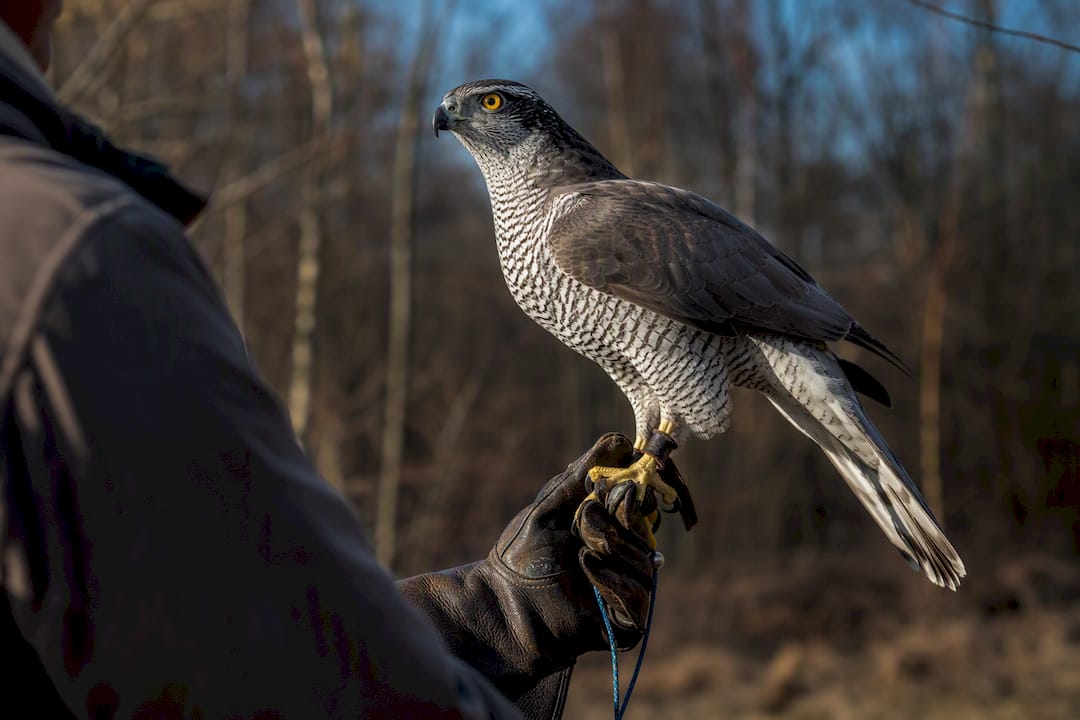
9. H Is for Hawk by Helen Macdonald
Macdonald trains a goshawk while grieving her father, and the two threads braid into something closer to nature writing than pure memoir. It's a strong companion to World of Wonders for readers who want the nature essay pushed toward obsession and grief rather than wonder.
10. The Immortal Life of Henrietta Lacks by Rebecca Skloot
Skloot spent a decade tracking the story behind the HeLa cell line and the family who never consented to its use. This is literary journalism at full stretch: archival research, courtroom records, and years of relationship building with sources who had every reason not to trust her.
11. Wild by Cheryl Strayed
A solo hike along the Pacific Crest Trail becomes a structure for processing a mother's death and a marriage's collapse. Strayed's control of the physical journey as a metaphor without ever forcing the metaphor is the craft lesson here.

12. The Empathy Exams by Leslie Jamison
Jamison's essay collection moves between personal experience and reported subjects, moot court witnesses, medical actors, ultramarathon runners, to interrogate what empathy actually requires. It's the sharpest recent example of the essay collection as intellectual argument rather than loosely connected memories.
Creative nonfiction by form
Every book above fits somewhere on a map of five overlapping forms, and knowing which one you're in the mood for saves a lot of wrong purchases.
- Memoir: a sustained, chronological account of the author's own life. I Know Why the Caged Bird Sings and The Year of Magical Thinking anchor this category. Study voice and emotional arc.
- Personal essay: shorter, often standalone pieces that use a single incident to reach a larger idea. The Empathy Exams and The Book of Delights live here. Study compression, how much meaning fits in a small space.
- Literary journalism: reported, researched work about subjects outside the author's own life, told with narrative technique. In Cold Blood and The Immortal Life of Henrietta Lacks define this. Study scene reconstruction from interviews and records.
- Nature writing: observation of the natural world used to explore identity, loss, or meaning. Silent Spring and World of Wonders both belong here, decades apart. Study how physical detail carries emotional freight.
- Lyric and experimental nonfiction: fragmented, image-driven, resistant to strict chronology. Gay's essays qualify. Study white space, association, and restraint.
Fiction techniques carry across all five forms, but the boundaries between memoir, personal essay, literary journalism, and nature writing stay porous by design. A memoir writer researches archives. A nature writer confesses grief. That overlap is a feature, not a flaw.
How to choose which creative nonfiction book to read next
Match the book to what you actually want out of the hour you're about to spend reading. A few criteria make that decision faster:
- Voice and tone: Do you want Didion's cool restraint or Gay's warm exuberance? Read the first page before committing to the whole book.
- Narrative scope: A single year (The Year of Magical Thinking) reads differently than a decade of reporting (The Immortal Life of Henrietta Lacks).
- Research depth: If you want journalism's rigor, look for books built on interviews and documents, not just recollection.
- Emotional range: Grief memoirs cluster together for a reason; pace yourself if you're reading several in a row.
- Length: Essay collections let you stop between pieces. Memoirs and long-form journalism ask for sustained attention.
If you're reading for pleasure, prioritize voice. If you're studying craft, prioritize structure and research method, since that's where the technique actually lives.
Pro Tip: When you're reading to learn craft, annotate the opening scene of each chapter, note where the author brings in outside research versus personal memory, and sketch the narrative arc on a single page after you finish. That one page will teach you more about structure than three books read passively.
Authors and voices to follow
- Joan Didion: unmatched control of restraint; start with The Year of Magical Thinking.
- Maya Angelou: voice that survives trauma without losing curiosity; start with I Know Why the Caged Bird Sings.
- Rachel Carson: science writing with narrative stakes; start with Silent Spring.
- Aimee Nezhukumatathil: lyric essay meets nature writing; start with World of Wonders.
- Ross Gay: compression and daily attention; start with The Book of Delights.
- Rebecca Skloot: decade-long investigative patience; start with The Immortal Life of Henrietta Lacks.
- Leslie Jamison: essay as argument; start with The Empathy Exams.
- Atul Gawande: reporting from inside a profession; start with Being Mortal.
- Helen Macdonald: obsession as narrative engine; start with H Is for Hawk.
Gay and Nezhukumatathil excel at the lyric essay. Skloot and Capote excel at long-form narrative reporting. If you only have time to read two authors this year, pick one from each camp.
Reading pathways for different goals
- Casual readers: I Know Why the Caged Bird Sings → Wild → The Book of Delights. Each moves faster and lighter than the last, easing you from memoir into essay.
- Book clubs: The Year of Magical Thinking → Being Mortal → The Immortal Life of Henrietta Lacks. All three raise questions about mortality and consent that discussion groups can chew on for hours. Ask: whose voice is missing from this story, and why?
- Aspiring writers: In Cold Blood → The Empathy Exams → The Best Creative Nonfiction, Volume 1. Study Capote for scene construction, Jamison for essay argument, then read the anthology to hear ten more voices doing it differently. Try annotating one scene from each book, then write a 500 word flash piece imitating the author's sentence rhythm.
Why the Bookaholic podcast recommends these reads
Deirdre Pippins hosts the Bookaholic Podcast to connect readers with authors and pull back the curtain on how books like these actually get written. Several of the picks above got their fullest treatment on episodes built around nonfiction craft and the writing life.
- The podcast's nonfiction episode archive covers memoir structure, essay collections, and the emotional cost of writing about your own life.
- An interview with a debut author on finding a writing identity from fairytale ambitions to publishing reality shaped how this list frames the aspiring writer pathway above.
- A conversation with journalist Carol Lin about moving from breaking news into personal narrative informed the literary journalism entries here.
Listener questions about mental health and the writing process come up constantly on the show, and they're a big part of why grief memoirs and craft-focused picks anchor this list.
What creative nonfiction actually means
Creative nonfiction is nonfiction written with fiction's narrative tools, arc, character, scene, pacing, applied to real people and real events. The definition sounds simple, but the discipline it demands is not. A memoirist can't invent a conversation to make a scene work. A literary journalist can't compress a six month investigation into a tidier week for narrative convenience.
Lee Gutkind, longtime editor of the journal Creative Nonfiction and often called the genre's godfather, frames the balance as factual accuracy paired with the emotive power of story. That pairing is what separates the genre from straight journalism, which reports facts without necessarily building them into a shaped narrative, and from pure memoir, which can lean on impression over documented accuracy. Creative nonfiction sits in the tension between the two, and the best writers never let either side win completely.
Why these books matter
Each title on this list did something beyond entertain. Silent Spring changed environmental policy. I Know Why the Caged Bird Sings became one of the first mainstream memoirs by a Black woman to reach a massive white readership and reshaped what publishers thought memoir could sell. In Cold Blood essentially invented a hybrid genre that journalists and novelists are still arguing about sixty years later.
Cultural impact isn't the only measure, though. The Book of Delights never tried to change a law or launch a movement. Its impact is quieter: it gave permission to an entire generation of essayists to write about small joys without apologizing for the smallness. That permission mattered as much to the genre's development as any bestseller list ranking.
Craft impact runs in parallel. Writers study The Year of Magical Thinking not because it sold well, though it did, but because Didion solved a technical problem: how do you write about grief without either wallowing or going numb. Every memoirist writing about loss since 2005 is working in the shadow of that solution, whether they know it or not.
How creative nonfiction became its own genre
The term itself is relatively recent, gaining real traction in university writing programs and literary magazines starting in the 1970s and 1980s, even though writers had been blending narrative technique with fact for much longer. Capote's In Cold Blood in 1966 is often cited as an early landmark, proof that reported fact could carry a novel's structural ambition.
The genre found an institutional home when Creative Nonfiction launched as a dedicated journal, giving the form a name and a curated space separate from both literary fiction magazines and straight journalism outlets. That journal, built around anthologies collecting diverse pieces across style and subject, helped formalize what had been a loose, informal category into something MFA programs could teach with a syllabus.
Memoir's boom in the 1990s and 2000s, driven by titles like Angelou's earlier work and later joined by writers like Mary Karr, pushed the genre further into commercial visibility. Nature writing followed a parallel but separate track, with Carson's influence stretching from the 1960s straight through to contemporary voices like Nezhukumatathil. The lyric essay, meanwhile, gained ground more recently as writers like Gay proved short, image-driven pieces could carry as much weight as longer narratives.
The techniques that make creative nonfiction work
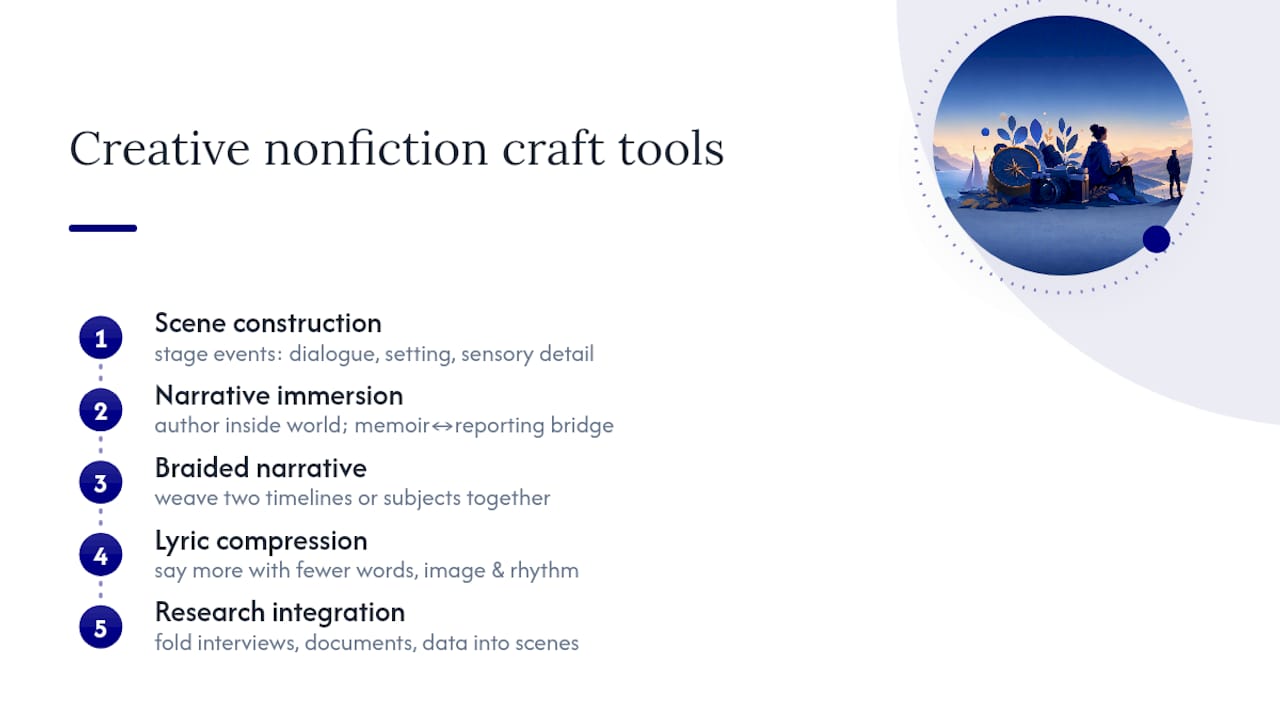
Scene construction is the foundational tool. Instead of summarizing what happened, the writer stages it: dialogue, setting, sensory detail, the way a novelist would build a chapter. Capote's reconstruction of the Clutter family's final hours, built entirely from interviews and records, is the clearest demonstration of this technique on the shortlist above.
Narrative immersion works differently. It places the author physically inside the world they're documenting, and functions as a craft bridge between memoir and investigative journalism, letting writers move between subjective experience and outside reporting without breaking the reader's trust. Macdonald training her own hawk while grieving is immersion at its most literal.
Other recurring devices include the braided narrative, weaving two timelines or subjects together (grief and a bird, illness and a hike), lyric compression, saying more with fewer words through image and rhythm, and research integration, folding interviews, documents, and data into scenes without turning the prose into a report. The best writers rotate between these tools within a single book rather than picking one and sticking to it.
Creative nonfiction versus other nonfiction genres
Straight journalism reports facts with minimal narrative shaping and strict objectivity standards; creative nonfiction shapes those same facts into scene and arc while still answering for their accuracy. A newspaper article about a hurricane and a literary journalism piece about the same storm might share every fact, but only one of them builds toward an emotional or thematic payoff.
Autobiography differs from memoir in scope: autobiography tends toward a full chronological life account, while memoir narrows to a theme or period, which is why I Know Why the Caged Bird Sings covers childhood specifically rather than Angelou's entire life. Self-help and popular science books often explain ideas directly to the reader; creative nonfiction, even when covering science like Silent Spring, tends to dramatize rather than explain, trusting the story to deliver the argument.
Academic and technical writing prioritizes precision and citation format over voice. Creative nonfiction borrows research rigor from that world but discards its detachment, which is exactly the tension Gutkind's definition points to above.
The ethical line writers and readers both have to watch
Memory is not a transcript, and every memoirist reconstructs dialogue and scenes they can't perfectly recall. That's an accepted convention of the form, but it becomes an ethical problem the moment a writer invents events rather than reconstructing remembered ones. Readers should stay alert to books that blur that line without saying so.
Writing about family members and former partners raises a separate problem: consent. A memoirist's story is also, unavoidably, someone else's story. Some writers change names or composite minor characters to protect privacy; others don't, and the fallout can strain real relationships long after publication. Readers weighing a memoir's honesty should ask whose version of events they're actually getting.
Literary journalism carries its own risk: the temptation to smooth a messy, contradictory subject into a cleaner narrative than reality supports. Skloot spent years earning the Lacks family's trust specifically because that shortcut, taking data without consent, was the same ethical failure her book documents. Writers reporting on real people owe those people the same rigor they'd want turned on themselves.
Where to keep exploring
- The Best Creative Nonfiction, Volume 1: curated anthology for discovering contemporary voices beyond the bestseller table.
- Open Bay Path's ENG134 chapter: a clear academic breakdown of the genre's boundaries and history.
- Memoir meaning and definition: useful for readers sorting out how memoir differs from autobiography.
- Writing prompts for building creative nonfiction skills: practical exercises for imitation and close reading.
- 12 essential books about books: a companion list for readers who love meta-narratives about reading itself.
An editor's honest take on this list
The conventional advice for approaching creative nonfiction treats it like medicine: read the important ones because they're important. That framing kills curiosity fast. The books that actually stick with readers, The Book of Delights especially, succeed because they trust small, specific attention over grand subject matter.
Where most reading lists fail is treating memoir, journalism, and lyric essay as interchangeable just because they share a nonfiction label. They demand different reading postures. You read In Cold Blood for architecture and The Book of Delights for rhythm, and conflating the two leaves readers disappointed by both.
If you take one thing from this list, prioritize range over reverence. Read one long narrative, several short essays, and one anthology before deciding which corner of this genre is actually yours. That sequence, drawn straight from how anthologies function as discovery tools, teaches more in a month than working straight down any single "greatest hits" ranking ever will.
— Deirdre
Sources
- What is creative nonfiction? — Open Bay Path (ENG134)
- Silent Spring — LitCharts
- The Best Creative Nonfiction, Volume 1 — Creative Nonfiction