
Use a short, several-question pack built around one genre-specific prompt, and follow two rules: pick fewer questions than you think you need, and never ask two in a row without a follow-up. That combination is what separates a book club meeting people remember from one where everyone stares at their wine glass. The full shortlists, genre packs, and printable sources below give you everything to build that pack in under five minutes.
TL;DR:
- Using only a few well-chosen questions focused on genre specifics can deepen engagement and prevent discussion fatigue during book club meetings.
- For virtual groups, dropping questions into chat and using breakout rooms or rotating facilitators keeps everyone involved, especially quieter members.
- Short passages read aloud before discussion start help reset focus and often produce more thoughtful comments than prepared prompts alone.
- Addressing sensitive topics with prior warnings and focusing questions on the book’s portrayal rather than personal disclosures create a respectful atmosphere.
- Well-structured, genre-tailored questions about character motivation, plot mechanics, and world-building enable more meaningful discussions and help select books that generate lively debate.
Table of Contents
- Ready-to-Copy Book Club Discussion Questions for Your Next Meeting
- A Bigger Bank of Universal Book Club Questions, Organized by Category
- Genre-Specific Book Club Questions That Get to the Good Stuff
- Running the Meeting: In-Person, Virtual, and Hybrid Formats
- Facilitation Tips That Keep the Conversation From Feeling Like an Interrogation
- Where to Find Free Printable Book Club Question Lists
- Two Copy-Ready Question Packs: 25 and 30 Prompts
- Why You Can Trust This List of Book Club Discussion Questions
- Adjusting Questions for Small Groups, Large Groups, and Mixed Personalities
- Getting Quiet Members to Actually Talk
- Handling Sensitive or Triggering Content With Care
- Bringing the Author's Story Into the Conversation
- How to Actually Prepare for a Book Club Meeting
- What Fifteen Years of Book Talk Taught Me About Good Questions
- Try Bookaholic for Your Next Book Club Pick
- Sources
Ready-to-Copy Book Club Discussion Questions for Your Next Meeting
You don't need forty questions. You need the right eight, asked in the right order. Here are three small packs you can copy straight into a text message or meeting agenda, organized by where you are in the conversation.
Starter pack: five questions to break the ice
These work in the first ten minutes, before anyone has committed to a real opinion yet.
- What's the first word you'd use to describe this book, and why that word? It's fast, low stakes, and gives you a read on the room's overall mood before you dig in.
- Did you finish it, and how did that feel compared to when you started? This surfaces pacing problems or slow starts without putting anyone on the defensive.
- What almost made you put the book down, if anything? Honest, and it often uncovers the exact scene worth discussing later.
- Who would you recommend this to, and who should absolutely avoid it? Gets people thinking about the book's actual audience, not just their personal reaction.
- If you had to describe this book to someone in one sentence, what would you say? Forces a summary that reveals what each person actually took away.
Deep dive pack: eight questions for sustained conversation
Once the room warms up, this is where the real discussion happens. Pick three or four from this list rather than working through all eight in order.
- Which character's decision would you have made differently, and what would that have changed?
- What did the author want you to feel by the end, and did it work on you personally?
- Is there a scene you keep thinking about, and what makes it stick?
- Did your opinion of any character shift by the last page? Where exactly did that happen?
- What does this book assume you already know or believe, and did that assumption hold up?
- If the story were told from a different character's point of view, what would change?
- What's one thing the book got right about being human that most books miss?
- Where did the author take a risk, and did it pay off?
Wrap-up pack: five reflection and next-read prompts
Save these for the last ten minutes. They close the loop and set up your next pick.
- Would you reread this book in five years, or was one read enough?
- What's the one thing you'll remember about this book a year from now?
- Did this book change how you think about anything outside the story itself?
- On a scale of "forget it by dinner" to "still thinking about it next week," where does this land?
- What kind of book do you want next, based on how this one made you feel?
That's several questions total across three packs, more than enough for a typical ninety-minute meeting with room to spare. The trick is restraint: pick four or five, not eighteen.
A Bigger Bank of Universal Book Club Questions, Organized by Category
The starter packs above cover a single meeting. This section is your reference library, the place you come back to when you want fresh discussion prompts for readers without reinventing the wheel every month. Every question here works for both fiction and nonfiction, with small tweaks noted where needed.
Character-focused prompts work whether you're discussing a novelist's protagonist or a real person profiled in a memoir. For fiction, ask what the character wanted versus what they actually got. For nonfiction, swap "character" for "subject" and ask what the author's proximity to that person (biographer, journalist, family member) changed about how the story got told.
- What does this person or character want most, and what's actually stopping them from getting it?
- Whose side of the story is missing, and how would the book read differently with it included?
- Did you like this person by the end, and does liking them even matter to how you judge the book?
- What's one choice this person made that you understood completely, even if you disagreed with it?
Theme and meaning prompts push a group past plot summary into interpretation, which is where book club conversation actually gets interesting. These work best as open questions with no single right answer:
- What is this book really about, underneath the plot? Does that match what the title or cover promises?
- What would change about this story if it were set today instead of when it was written?
- Is there a line or passage that feels like the emotional center of the whole book?
Structure, pacing, and craft prompts get skipped by a lot of groups because they sound like an English class assignment. They shouldn't be skipped. Ask why the author chose to open where they did, or why a particular chapter runs long when the rest move fast. For nonfiction, ask what the author included that felt unnecessary and what they left out that you wanted more of. Facing History and Ourselves notes that mixing question types (analysis, personal response, craft) keeps a discussion accessible to both close readers and people who just want to talk about how a book made them feel.
Pro Tip: Keep one craft question in your back pocket for the night everyone loved the book but nobody has much to say. "Why do you think the author structured it this way?" almost always produces a longer answer than "Did you like it?"
Genre-Specific Book Club Questions That Get to the Good Stuff
Generic book club questions work fine for a general conversation, but the best meetings zero in on what makes a specific genre tick. A thriller lives or dies on pacing. A fantasy lives or dies on its rules. Ask genre-blind questions and you'll miss what actually made the book work, or fail.
Mystery
Mystery readers show up wanting to talk about the puzzle, not just the resolution. Give them that space before moving to theme.
- Did you guess the ending, and at what point did you know (or think you knew)?
- Which clue, looking back, was the most fairly planted? Which felt like cheating?
- Did the red herrings feel earned, or did they exist only to pad the mystery?
- Would the book still work if you already knew the ending going in? Why or why not?
- Whose perspective would have made the mystery harder to solve, and whose would have made it too easy?
- Did the detective (or amateur sleuth) solve this case through skill, luck, or the author simply revealing information on schedule?
Thriller and horror
These genres run on tension and physical reaction. Ask about the machinery of fear, not just whether the book was scary.
- Where in the book did your pulse actually pick up? What specifically caused that?
- Did the threat feel real and grounded, or did it need you to suspend a lot of disbelief?
- Is there a moment where a character makes an obviously bad decision just to keep the plot moving? Did it bother you?
- How did the author control pacing? Short chapters, cliffhangers, withheld information?
- Did the ending resolve the tension in a satisfying way, or did it feel rushed to hit a page count?
- What's your honest reaction to how violence or fear was used? Necessary, gratuitous, or somewhere in between?
Historical fiction
Historical fiction asks a specific question of readers: does the past feel real, or does it feel like a costume on a modern story?
- Did the historical setting feel essential to the plot, or could this story happen in any era with minor changes?
- Where did you notice the author's research most clearly? Where did it feel thin?
- How did the characters' values differ from ours today, and did the author handle that gap honestly or did it feel sanitized?
- What surprised you about daily life in this period that you hadn't considered before?
- Did any part of the story feel anachronistic, like a modern sensibility dropped into a historical setting?
- What's the difference between how this book portrays the era and how you'd expect a history textbook to portray it?
Romance
Romance readers care about believability and chemistry, and about whether the emotional stakes feel earned rather than manufactured through miscommunication.
- Did you believe these two people actually wanted to be together, beyond the plot requiring it?
- Where did the central conflict come from? Real incompatibility, external circumstance, or a misunderstanding that a five-minute conversation could have solved?
- How did the book handle consent and communication between the leads? Did it feel realistic for the relationship shown?
- Which secondary character deserved more page time, and what would their version of this story look like?
- Did the ending feel like an earned resolution or a convenient one?
- What's one moment of genuine emotional honesty between the leads that stuck with you?
Fantasy
Fantasy discussions live or die on whether the world's internal logic holds. A magic system without consistent rules is a plot convenience, not a world.
- Did the magic system have real rules, real costs, and real limits? Where did the author bend those rules to solve a problem?
- Which part of the worldbuilding felt the most lived-in, like the author knew far more than they told you?
- What are the actual stakes if the protagonist fails? Are they personal, political, or world-ending, and did that scale feel earned?
- Did any part of the world's history or politics feel like it existed only to explain the plot, rather than existing on its own terms?
- Would you want to live in this world, or is its appeal purely as a place to visit through the page?
- How does the magic or fantastical element mirror something real, power, grief, identity, and does that parallel land?
Science fiction
Sci-fi asks readers to judge plausibility against ethics, often at the same time. The best discussions dig into both.
- Did the science or technology feel plausible enough to accept, even if you knew it wasn't strictly accurate?
- What technology in this book already exists in some early form today, and does that change how you read it?
- Is the central piece of technology treated like a tool, a character, or a threat? Does that framing shift as the book goes on?
- What ethical question is this book actually asking, underneath the plot? Who in the book represents each side of that question?
- If this future came true, would you want to live in it?
- Did the ending resolve the technological or ethical dilemma, or did it dodge the hardest question the book raised?
Running the Meeting: In-Person, Virtual, and Hybrid Formats
The questions matter less than how you deploy them if your format is working against you. A 60-minute virtual call needs a different rhythm than a 90-minute living room meeting, and pretending otherwise is why so many book clubs quietly dissolve after month four.
- For a shorter meeting, use the starter pack plus a few deep dive questions. That typically suffices to maintain focus.
- For a longer meeting, run the full starter pack, several deep dive questions, and the wrap-up pack. This length suits many groups for real conversation.
- For virtual meetings, drop a few discussion questions into the chat before anyone speaks, so quieter members can draft a thought instead of composing on the fly. A quick poll also works well to kick off a segment before opening the floor.
- For larger virtual groups, use breakout rooms on a single question for several minutes, then bring everyone back to report one takeaway each. This solves the problem of ten people on a video call where three dominate and the rest go quiet.
- For in-person meetings, write your deep dive questions on index cards and pass them around instead of announcing them from the head of the table. Letting each person read their own card out loud slows the pace just enough to make room for a real answer, and it's a simple way to rotate who's driving the conversation without anyone having to volunteer.
Facilitation Tips That Keep the Conversation From Feeling Like an Interrogation
The single biggest facilitation mistake is treating your question list like a checklist to get through. Facilitators who race from question one to question ten produce shallow answers, because nobody has time to actually think before the next prompt lands. Facing History and Ourselves recommends prioritizing depth over breadth, picking a small number of resonant questions rather than working through a long list end to end.
In practice, that means walking into your meeting with three or four principal questions and one backup, not eight. When a question lands well, follow it. Don't abandon a good conversation just because you haven't gotten to question six yet.
- Pick 3 to 4 main questions plus one backup, and let the group's energy decide how long you stay on each one.
- Rotate who facilitates each meeting, and give that person one job: keep time and ask the follow-up, not run the whole show alone.
- Assign a note-taker for five minutes at the start, jotting down one line or metaphor each person noticed, which doubles as material for later questions.
- Invite members to bring one index-card question of their own each meeting, so the prompts don't always come from the same source.
- When a discussion stalls, ask something concrete and small: "What's one sentence you loved or hated, and why?" That kind of specific prompt restarts conversation far more reliably than introducing a brand-new top-level question.
Facilitation primers on running group discussions also recommend tossing one question at a time and rotating who answers first, rather than firing off the next prompt the second one person finishes talking. That single pause, waiting a beat before moving on, is often the difference between a discussion and a Q&A session.
Pro Tip: Replace "What did you think?" with "What surprised you most?" every time you're tempted to ask the first one. The second version assumes engagement and gets a more specific answer almost every time.
Where to Find Free Printable Book Club Question Lists
You don't have to build every handout from scratch. Library systems and reader-focused organizations maintain some of the most reliable free resources for this exact purpose, and they're worth bookmarking before you resort to a random blog PDF of unknown origin.
- The American Library Association's book club resources offer downloadable discussion guides that pair question lists with author background and activity ideas, useful when you want a themed meeting rather than a bare question sheet.
- Local library branches frequently maintain their own reading guides and LibGuides pages tailored to specific titles, especially for popular book club picks and award winners.
- Commercial prompt decks, like the TableTopics Book Club deck, work as a physical fallback if your group prefers pulling a card over scrolling a phone during discussion.
To turn any shortlist on this page into a one-page handout, copy your chosen five to eight questions into a blank document, format them as a numbered list with extra spacing between each one for notes, add your meeting date and book title at the top, and export to PDF. That's the whole process. Skip the temptation to paste in every question you've ever seen; a crowded page is harder to use mid-conversation than a clean one with room to write.
Two Copy-Ready Question Packs: 25 and 30 Prompts
If you want a persistent list you can return to for any book, without customizing per genre, these two packs cover the ground most groups need.
The 25-question pack, organized for a structured 90-minute meeting:
- What was your overall reaction upon finishing the book?
- Which character did you relate to most, and why?
- What was the turning point of the story for you?
- Did the pacing work, or did parts drag?
- What's the central conflict, and was it resolved satisfyingly?
- Which relationship in the book felt the most authentic?
- What surprised you the most?
- Where did the author take the biggest risk?
- What's a theme you noticed that we haven't discussed yet?
- Did the setting shape the story, or could it happen anywhere?
- What's one line or passage you highlighted or remembered?
- Who would you cast in a film adaptation, and why?
- Did the ending feel earned?
- What did the title mean to you by the end?
- Would you read another book by this author?
- What's one criticism you have, even if you loved the book overall?
- How did this book compare to the last one your group read?
- What question would you ask the author if you could?
- Did any character's arc feel incomplete?
- What's a moment you wish had been explored further?
- Who should read this book next, based on your own circle?
- What mood were you in while reading, and did it affect your experience?
- Did the book change your opinion on anything?
- What would you change about the book's structure or format?
- On reflection, what's this book really about?
The 30-question pack adds five creative and reflective prompts to the 25 above:
- If you could rewrite the ending, what would you change?
- What song or piece of music captures this book's mood?
- What's a scene you'd want to see illustrated or filmed exactly as written?
- If this book had a sequel, what would you want to happen?
- What's one thing this book taught you about yourself as a reader?
Why You Can Trust This List of Book Club Discussion Questions
These prompts come from the same place a lot of good book conversation starts: the Bookaholic Podcast, hosted by Deirdre Pippins, where author interviews and genre-spanning book reviews run week after week. The show has built its focus around making literary discussion feel accessible rather than academic, whether the topic is a debut novelist's process or the emotional weight of a memoir.
If you're looking for related reading, Book-a-holic's blog covers everything from building a reading list you'll actually finish to genre-specific picks that pair naturally with the discussion prompts above.
Adjusting Questions for Small Groups, Large Groups, and Mixed Personalities
A four-person book club and a fourteen-person book club need different tools entirely. Small groups (four to six people) can handle open, sprawling questions because everyone gets airtime naturally, there's no risk of three people never speaking. Lean into the deep dive pack and let one question run for fifteen minutes if it's working.
Larger groups (ten or more) need structure or they fragment into side conversations. Break into pairs or trios for five minutes on one specific question, then reconvene and have each small group share one takeaway. This "think, pair, share" approach, borrowed from classroom facilitation, keeps everyone engaged instead of half the room checking phones while two people debate the ending.
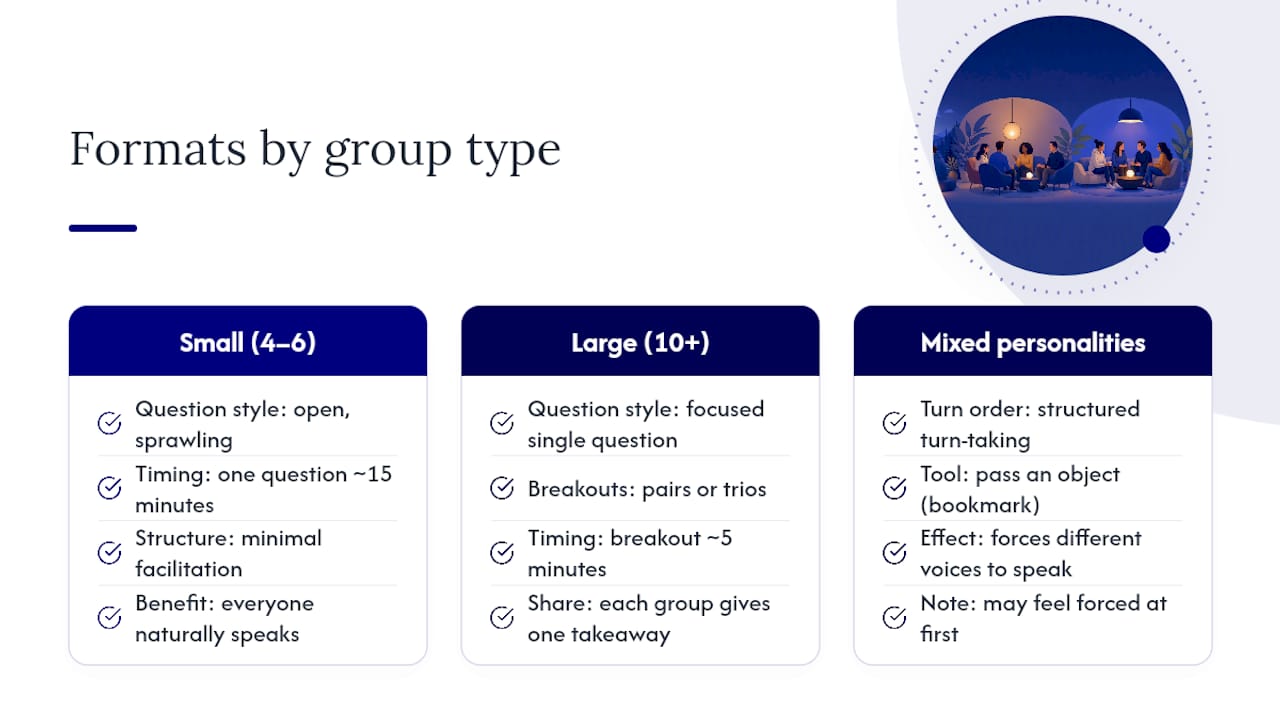
Mixed-personality groups, the kind with one person who talks for six minutes straight and three people who never volunteer, benefit most from structured turn-taking. Pass an object (a bookmark works fine) around the circle and whoever holds it answers first, then passes it on. It sounds a little forced the first time you try it. It works.
Watch for groups where the same two or three people answer every single question. That's not a personality problem you need to fix; it's a facilitation gap. The rotating facilitator habit mentioned earlier solves a good chunk of this automatically, because a new person running the show tends to call on different voices than the usual default.
Getting Quiet Members to Actually Talk
Quiet members usually aren't disengaged. They're often just waiting for a lower-pressure entry point than "So, what did everyone think?"
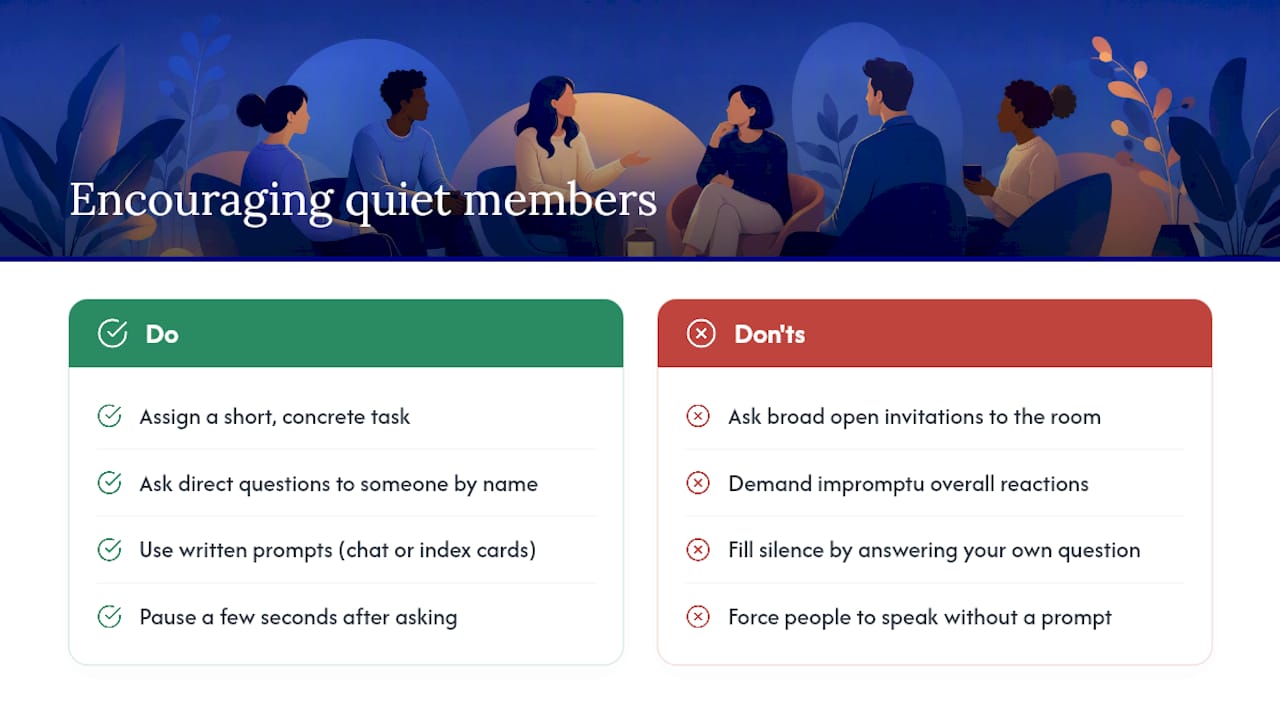
Give people something concrete to prepare instead of something abstract to improvise. Assigning a small breakout task, like asking each person to jot down one image or metaphor that stuck with them during a two or three minute window, gives quieter readers a specific, low-stakes contribution ready before the group turns to them. That's a much easier ask than "share your overall thoughts on the book" cold.
Direct, specific questions aimed at a person by name work better than open invitations to the room. "Sam, what did you think of the ending?" gets an answer. "Does anyone have thoughts on the ending?" gets silence, because nobody wants to be first.
Written prompts help too. In a virtual meeting, dropping a question in the chat lets quieter members type a few words before speaking them out loud, which for a lot of people removes the anxiety of composing a thought live. In person, index cards do the same job: reading someone else's question off a card is a much smaller ask than volunteering your own opinion unprompted.
Resist the urge to fill every silence yourself. A three-second pause after a question feels like an eternity to a facilitator, but it's often exactly the amount of time a quieter person needs to decide to speak. Jumping in to answer your own question trains the group to wait you out instead of participating.
Handling Sensitive or Triggering Content With Care
Books dealing with trauma, violence, addiction, grief, or identity-based struggle come up in nearly every book club eventually, and pretending a title is "just fiction" doesn't make the discussion any less real for someone in the room.
Name the topic before you dive in. A simple heads-up, "tonight's discussion touches on [specific topic], jump in or step back as you need to," gives everyone permission to participate at their own comfort level rather than feeling ambushed mid-conversation.
Ask questions about the book's handling of the topic rather than demanding personal disclosure. "How did the author portray grief in this section?" invites literary discussion. "Have you experienced something similar?" puts a member on the spot in front of a group they may not fully trust. Let people volunteer personal context if they want to; don't require it.
Give members an easy out. "We can skip this one if it doesn't feel useful tonight" is a legitimate facilitator move, not a failure to cover your question list. And if a conversation gets heated over a genuinely divisive theme, politics embedded in a novel, a controversial historical event, redirect toward the text itself: "What does the author seem to want us to take from this?" is almost always a calmer question than "Who's right here?"
Bringing the Author's Story Into the Conversation
A little context about the person who wrote the book often unlocks discussion that the text alone can't. Knowing an author wrote a war novel based on their own family's displacement changes how a group reads every decision in that story.
Spend two minutes at the start of a meeting sharing what you know: where the author is from, what else they've written, whether the book is autobiographical or researched from a distance. You don't need a biography, just enough to answer "why did this person write this particular book?"
Interviews are a rich, underused source here. Author interviews, like those featured on the Bookaholic Podcast, often reveal what the writer intended a scene to do, which can validate or completely upend what your group assumed while reading. If an author has spoken publicly about their intent for an ending your group found frustrating, that context reframes the whole conversation instead of leaving everyone stuck arguing past each other.
Ask directly: "Does knowing this about the author change how you read the book?" It's a simple question, and it almost always produces a more interesting answer than you'd expect.
How to Actually Prepare for a Book Club Meeting
Good discussions start before anyone walks in the door. If you're facilitating, reread the last thirty pages the night before, not the whole book if time is tight, since endings are where most discussion energy concentrates and details fade fastest from memory.
Keep a running note of any passage, line, or scene that made you pause while reading, even a one-word reaction works ("uncomfortable," "beautiful," "confusing"). Those notes become your deep dive questions almost automatically, since the moments that struck you personally are usually the ones worth discussing as a group.
If you're not facilitating, you still benefit from jotting down one question of your own before the meeting. Groups that ask members to bring a single index-card question, as mentioned earlier, get noticeably richer conversation than groups where only the host prepares. Even five minutes of note-taking beats walking in with only a vague memory of "I liked it, I think."
What Fifteen Years of Book Talk Taught Me About Good Questions
The single habit that changes a book club more than any question list is small: read one short passage out loud before you start talking. Not a summary, the actual text, maybe two or three sentences that stuck with someone. It resets the room's attention onto the book itself instead of everyone's half-remembered impression of it, and it almost always produces the first real comment of the night.
I'd also push back on the instinct to prepare more questions "just in case." The groups that struggle most aren't the ones without enough prompts, they're the ones drowning in them, racing through a list instead of sitting with one good question for ten minutes. Fewer questions, asked with patience, beats a long list every time.
Try the read-aloud trick at your next meeting, or require one index-card question per member before anyone opens their mouth about the plot. For more inspiration, check out this Creative Storytelling guide with practical prompts to enrich your book-club exercises. Either one is a small change. Report back on what happens.
— Deirdre
Try Bookaholic for Your Next Book Club Pick
Building the perfect question pack solves half the problem. Picking a book worth that much conversation is the other half, and that's where a lot of hosts get stuck scrolling bestseller lists with no real signal on what will actually generate discussion. The Bookaholic Podcast gives you both: episodes built around author interviews that hand you built-in discussion material, plus book reviews across genres that help you choose titles your group will actually want to argue about.
Every episode digs into the story behind the story, why an author made a specific choice, what inspired a plot twist, how a memoir came together, which is exactly the kind of context that turns a flat meeting into a real conversation. If you want a head start on your next pick, listen to "From Fairytales to Reality: A Young Writer's Dream," an author interview episode packed with the kind of behind-the-book detail that makes for an easy set of ready-made discussion questions. Queue it up before your next meeting and see how much further the conversation goes.
Sources
- American Library Association — book club discussion resources
- Facing History and Ourselves — 25 compelling book-club discussion questions