Ten titles come up again and again when readers talk about the books that broke their brain: The Murder of Roger Ackroyd, Gone Girl, Dark Matter, Fight Club, and Verity lead the pack, with Fingersmith, Recursion, Invisible Monsters, The Nickel Boys, and The Last House on Needless Street right behind them. This roundup covers a spoiler-safe shortlist, what separates a great twist from a cheap trick, and how to read (and reread) these books to get the full payoff.
TL;DR:
- The best twist books often use unreliable narrators, structural misdirection, or genre-bending reveals to deepen the story's impact.
- A well-earned twist recontextualizes the story and remains logical upon rereading, unlike cheap tricks that fall apart the second time.
- To avoid spoilers, it is advised to skip detailed synopses and look for subtle clues during rereads, especially from unreliable narrators.
- These books span genres, from mysteries and thrillers to horror and sci-fi, all sharing a focus on surprise that prompts multiple rereads.
- Cultures shifts and historical influences, like Agatha Christie's innovations and Greek tragedy origins, underpin modern twist storytelling.
Table of Contents
- The Best Plot Twist Books to Read Right Now
- What Makes a Plot Twist Actually Work
- How to Read Twisty Books Without Ruining Them
- More Reader-Recommended Plot Twist Books
- Why Bookaholic Curates These Lists
- Where Plot Twists Came From, Historically
- Why Twists Hit Readers So Hard
- How Twists Change Shape Across Genres
- Twists That Changed How We Talk About Books
- A Personal Note on Reading for the Twist
- Keep the Twisty Reads Coming
- Sources
The Best Plot Twist Books to Read Right Now
These twelve books show up on nearly every reader-sourced and editorial list of the genre, and each one earns its twist through structure rather than a last-minute trick. Skim the blurbs, not the spoiler threads, and pick whichever description grabs you.
-
The Murder of Roger Ackroyd by Agatha Christie. A classic detective novel that rewrote the rulebook for what a narrator is allowed to hide from you. Best for readers who think they've seen every mystery trick in the book.
-
Gone Girl by Gillian Flynn. A marriage-gone-wrong thriller told through dueling perspectives that flip the entire story halfway through. Best for readers who like their twists to also double as character studies.
-
Dark Matter by Blake Crouch. A speculative thriller that reframes reality itself rather than just a character's motive. Best for sci-fi curious readers who don't normally pick up thrillers.
-
Fight Club by Chuck Palahniuk. An anti-consumerist novel where the narrator's unreliability isn't a twist gimmick, it's the entire point of the book. Best for readers who want the twist to change how they read every page that came before.
-
Verity by Colleen Hoover. A psychological thriller with romance elements built almost entirely around one gut-punch reveal. Best for readers who want their twist wrapped in a slow-burn romance.
-
Fingersmith by Sarah Waters. A Victorian con-artist novel that flips who's conning whom midway through, then flips it again. Best for readers who love layered historical fiction with teeth.
-
The Murder of Roger Ackroyd's structural cousin, Recursion by Blake Crouch, swaps detective-novel misdirection for a memory-and-time-loop premise that keeps redefining what's actually happening. Best for readers who liked Dark Matter and want something even stranger.
-
Invisible Monsters by Chuck Palahniuk. A fragmented, nonlinear novel about identity and beauty culture that only makes full sense once you know the narrator's real situation. Best for readers who don't mind piecing a timeline together themselves.
-
The Nickel Boys by Colson Whitehead. A literary novel grounded in real history whose late reveal recontextualizes everything the reader assumed about its two central characters. Best for readers who want a twist that lands as grief, not shock.
-
The Last House on Needless Street by Catriona Ward. A horror novel that plays with unreliable perspective across multiple narrators, including one you won't expect. Best for horror fans who want dread built from structure, not jump scares.
-
Rounding out the mix, Kobo's editorial team points out that twisty books span mystery, sci-fi, fantasy, and literary fiction alike, which is exactly why this list refuses to stay in one genre.
-
Community threads back the same core group. A Reddit thread on r/suggestmeabook names The Murder of Roger Ackroyd, Fingersmith, Gone Girl, and Invisible Monsters among the most shocking twists readers have encountered, which is a strong signal these picks hold up outside curated media lists.
What Makes a Plot Twist Actually Work
A good twist doesn't come out of nowhere. It recontextualizes the story you already read, forcing you to mentally rewind and reread every earlier scene through a new lens. A cheap twist just surprises you. A well-earned one makes you go, "wait, go back," and then rewards you when you do.
A few devices show up constantly in the books above:
- Unreliable narrators (Fight Club, Invisible Monsters) who withhold or distort information you assumed was straight.
- Structural misdirection (Fingersmith, The Murder of Roger Ackroyd) where the plot's shape itself hides the reveal.
- Genre-bending revelations (Dark Matter, Recursion) that change the rules of reality rather than a character's backstory.
- Dual-timeline or dual-perspective reveals (Gone Girl, Verity) where two accounts of the same events don't match up until the end.
Pro Tip: The tell of a well-earned twist is that it survives a reread. If the seams show once you know the ending, the author cheated. If the earlier scenes get richer, they didn't.
Readers consistently say the strongest twists trigger an immediate urge to reread the book, because the story's earlier scenes read differently once the truth is known. That reread impulse is the clearest sign a twist actually worked.
How to Read Twisty Books Without Ruining Them
The biggest decision with any twist-driven book is whether to go in blind or skim a synopsis first. Going in blind gives you the full gut-punch; skimming a summary can protect you from content you'd rather avoid.
- Skip detailed synopses, spoiler threads, and star-rating reviews that mention "the twist" before you start reading.
- Check Goodreads content warning tags or a quick search for "[book title] content warning" if you're sensitive to violence, self-harm, or sexual content. Verity, for instance, mixes romance and thriller elements and runs spicier than a typical mystery.
- On a reread, watch for small, oddly specific details early on. Authors seed real clues rather than random red herrings, and those details are usually where the "aha" moment hides.
Pro Tip: If you're rereading to spot clues, track who is narrating each scene and what they could plausibly know at that point. Most unreliable-narrator twists collapse the second you notice a detail the narrator shouldn't have.
More Reader-Recommended Plot Twist Books
Once you've worked through the core twelve, this wider net of community and editorial favorites keeps the surprises coming. These come from reader-driven lists rather than a single curated ranking, so tastes and genres vary more here.
- We Were Liars by E. Lockhart — YA mystery with a devastating emotional reveal
- Sharp Objects by Gillian Flynn — psychological thriller, disturbing family secrets
- The Silent Patient by Alex Michaelides — psychological thriller, unreliable narration
- Behind Closed Doors by B.A. Paris — domestic thriller, may be triggering for abuse content
- The Girl on the Train by Paula Hawkins — psychological thriller, alcoholism themes
- The Wife Between Us by Greer Hendricks and Sarah Pekkanen — domestic thriller, assumption-flipping structure
- Room by Emma Donoghue — literary fiction, heavy themes of captivity
- Big Little Lies by Liane Moriarty — literary suspense, domestic violence content
- The Kind Worth Killing by Peter Swanson — crime thriller, morally gray characters
- A Study in Charlotte by Brittany Cavallaro — YA mystery with a genre-bending twist
- My Sister, the Serial Killer by Oyinkan Braithwaite — dark comedy crime, tonal whiplash twist
- The Turn of the Key by Ruth Ware — gothic thriller, unreliable narration
- The Perfect Marriage by Jeneva Rose — legal thriller, spicy content in places
- The Woman in the Window by A.J. Finn — psychological thriller, substance abuse themes
- Verity (again worth noting here for readers who skipped it above) — spicy content flagged by multiple community threads
This spread reflects Goodreads' Best Plot Twist Listopia, which has collected reader votes across genres for years and tends to surface titles editorial roundups miss.
Why Bookaholic Curates These Lists
Deirdre Pippins hosts The Bookaholic Podcast, where author interviews and long-form book conversations are the format, not an afterthought. Recommendations like this one come out of those conversations along with direct listener input, not a generic algorithm. If you want a sense of how those interviews shape the picks, Tracy Abramson's discussion of her thriller Victim Number Eight is a good starting point.
Where Plot Twists Came From, Historically
Twists aren't a modern invention. Greek tragedy used anagnorisis, the moment a character recognizes a hidden truth, as far back as Oedipus Rex, where the protagonist discovers he's the very killer he's been hunting. That structure, discovery reshaping everything prior, is still the backbone of most twists today.
The 19th and early 20th centuries pushed the form into mystery fiction. Agatha Christie built an entire career on twists that respected the reader's intelligence while still hiding the truth in plain sight, and The Murder of Roger Ackroyd remains a landmark specifically because it broke an assumed rule: that the narrator wouldn't lie to you by omission.
Mid-century fiction expanded twists beyond whodunits into psychological territory. Then the late 20th and early 21st centuries brought the unreliable-narrator boom, Fight Club in 1996, followed roughly fifteen years later by Gone Girl, which took the device mainstream and helped spark the domestic-thriller wave that still dominates bestseller lists. Speculative fiction picked up the baton next, with writers like Blake Crouch using twists to question reality itself rather than just character motive, proof the technique keeps finding new genres to reshape.
Why Twists Hit Readers So Hard
A great twist produces a physical reaction. Readers describe it as a jolt, a need to flip back a few pages, sometimes an audible gasp. That response isn't accidental. It comes from the gap between what you believed and what's suddenly true, and the bigger that gap, the stronger the reaction.
This is also why the reread impulse matters so much. Once a twist recontextualizes the story, your brain wants to go back and reprocess everything with the new information. That's not just enjoyment, it's a kind of active engagement most fiction doesn't ask of readers. A subplot you barely noticed the first time suddenly looks loaded with meaning.
There's a trust dynamic at play too. Books like Fight Club and Invisible Monsters ask you to trust a narrator who, it turns out, wasn't giving you the full picture. When that's revealed well, readers often feel more connected to the book, not betrayed by it, because the unreliability was in service of the story rather than a cheap gotcha. When it's handled badly, readers feel tricked instead of rewarded, which is the fastest way to sink a book's reputation even if the prose is otherwise strong.
The strongest reactions tend to cluster around books where the twist changes the emotional meaning of the ending, not just the facts. The Nickel Boys is a clear example: the reveal doesn't just surprise you, it reframes the entire book as an act of memory and mourning.
How Twists Change Shape Across Genres
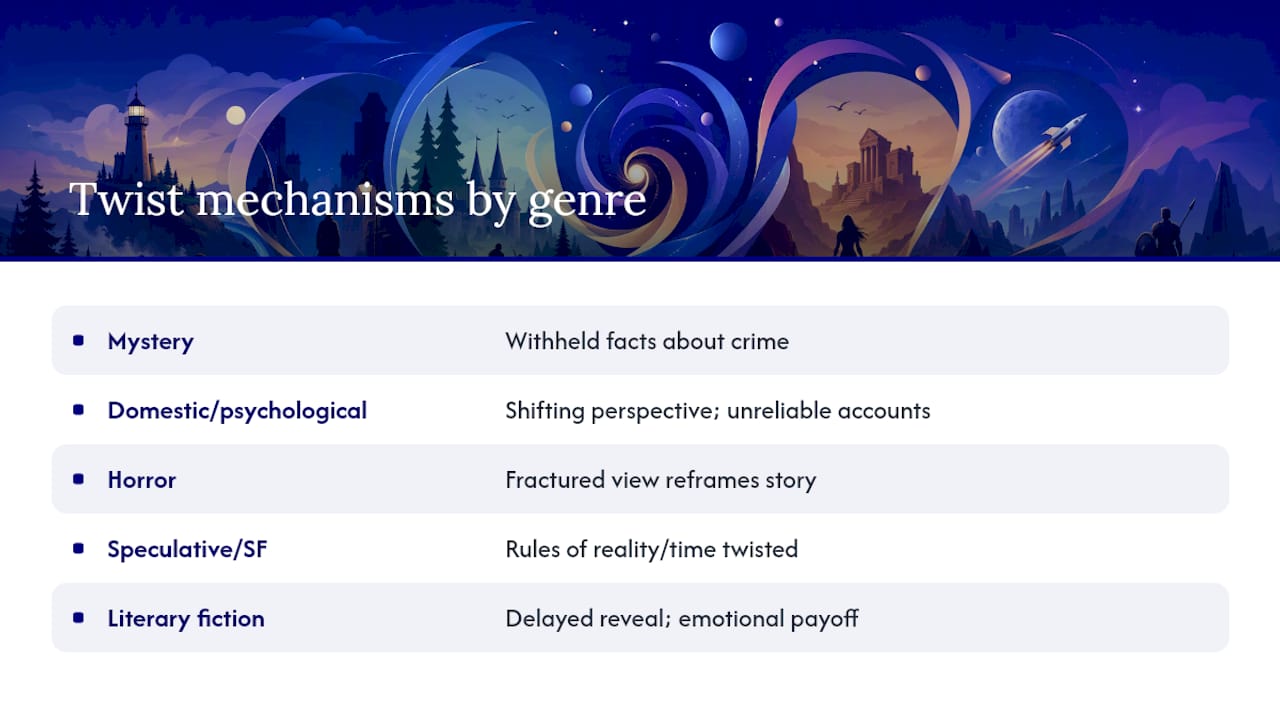
Mystery novels build twists around withheld information: who did it, how, or why. The Murder of Roger Ackroyd is the textbook case, the entire genre's rules bend around what a detective story is allowed to conceal from its reader.
Domestic and psychological thrillers, meanwhile, lean on shifting perspective and unreliable memory. Gone Girl and Verity both use dueling accounts of the same relationship, and the twist lands when you realize which account was lying. Horror uses twists differently again. The Last House on Needless Street builds dread through fractured perspective, where the reveal isn't just a fact but a reframing of what kind of story you've been reading.
Speculative and science fiction take the biggest swing. Instead of twisting a character's motive, books like Dark Matter and Recursion twist the rules of reality itself, memory, time, or the multiverse, which tends to produce the most disorienting reactions because there's no familiar genre logic to fall back on. Literary fiction plays a longer game. The Nickel Boys holds its reveal until the emotional stakes are fully built, so the twist reads as devastating rather than shocking. Across every genre, the mechanism differs, but the goal stays the same: make the reader reassess everything that came before.
Twists That Changed How We Talk About Books
Some twists escape their books entirely and become cultural shorthand. "Pulling a Gone Girl" is understood shorthand for a story built around an unreliable narrator's staged disappearance, even by people who've never read the novel. Fight Club's reveal became so widely referenced it's practically retired from spoiler territory, a rare case where a twist got absorbed into pop culture faster than the book could stay ahead of it.
The Murder of Roger Ackroyd still gets cited in writing classes and mystery criticism nearly a century later as the moment detective fiction learned narrators could lie by omission and still play fair with readers. That single structural choice influenced generations of mystery writers who followed. These aren't just twists that surprised readers once. They're twists that changed what writers felt permitted to attempt, which is a rarer and more lasting kind of impact than a single viral reaction.
A Personal Note on Reading for the Twist
My own rule is simple: go in blind whenever possible, and save the rereads for books that earned one. The twists that stick with me longest aren't the loudest, they're the ones where I put the book down and immediately wanted to start it over. If you want more conversations like this, our writers' workshop episodes dig into how authors actually build these moments.
— Deirdre
Keep the Twisty Reads Coming
If this list filled up your to-be-read pile, the podcast is where these recommendations actually come from. Book-a-holic gives you what a static list can't: the author's own account of how a twist got built, straight from the person who wrote it. Our episode "From Fairytales to Reality: A Young Writer's Dream" is a good entry point if you want to hear a writer talk through their own plotting choices in their words.

Members also get access to a reading community built around exactly this kind of discussion, where listeners swap their own twist-driven recommendations between episodes. If you want writing-craft context on how thriller twists get engineered in the first place, this breakdown of psychological thriller tropes is worth a read too. Hit play on the latest episode and see what your next favorite twist might be.
Sources
- Penguinrandomhouse
- Verity by Colleen Hoover | Hachette Book Group
- 35 Books With Plot Twists That Left Readers Speechless
- 9 books with the best plot twists | Kobo Books Blog