
Choose short, meaty books, under 300 pages and often under 200, and your group finishes more titles and talks longer about each one. The reads below deliver dense themes in a small page count, which is exactly what tired schedules and lagging attendance need. Pair any pick with a two or four week timeline and a handful of sharp questions, and your next meeting runs itself.
TL;DR:
- Shorter books under 200 pages tend to have more intense themes and ambiguous endings that foster lively group discussions.
- Choosing books with built-in unresolved questions, accessible prose, and thematic depth increases the likelihood of completion and engagement.
- A two-week timeline suits titles under 200 pages, while up to 300 pages may require four weeks and midpoint check-ins for optimal participation.
- Confirming edition page counts and filtering for books that prompt debate over plot twists ensures meaningful conversations.
- Supplementing readings with podcasts and discussion questions streamlines preparation and enhances the quality of book club meetings.
Table of Contents
- The Best Short Book Club Books, Grouped by Length
- Why Short Books Boost Completion and Conversation
- How to Choose a Short Book Your Club Will Actually Finish
- Meeting Formats That Keep Short Reads on Track
- Bookaholic Resources to Run a Richer Short-Book Season
- Why I Switched My Club to Short Books First
- Let Bookaholic Podcast Handle the Discussion Prep
- Quick Links for Verifying Your Next Short Pick
- Sources
The Best Short Book Club Books, Grouped by Length
Not every slim volume earns a spot on a club's calendar. The titles below made the cut because they pack ambiguity, tension, or a genuinely debatable ending into a small footprint, and every one is easy to find in paperback, ebook, or at your local library. We've split them by page count because the calculus for a 150 page novella is different from a 280 page novel. Both categories qualify as short book club books, but the shorter tier works especially well when your group is rebuilding momentum after a slog through something too long.
Very short: under 200 pages
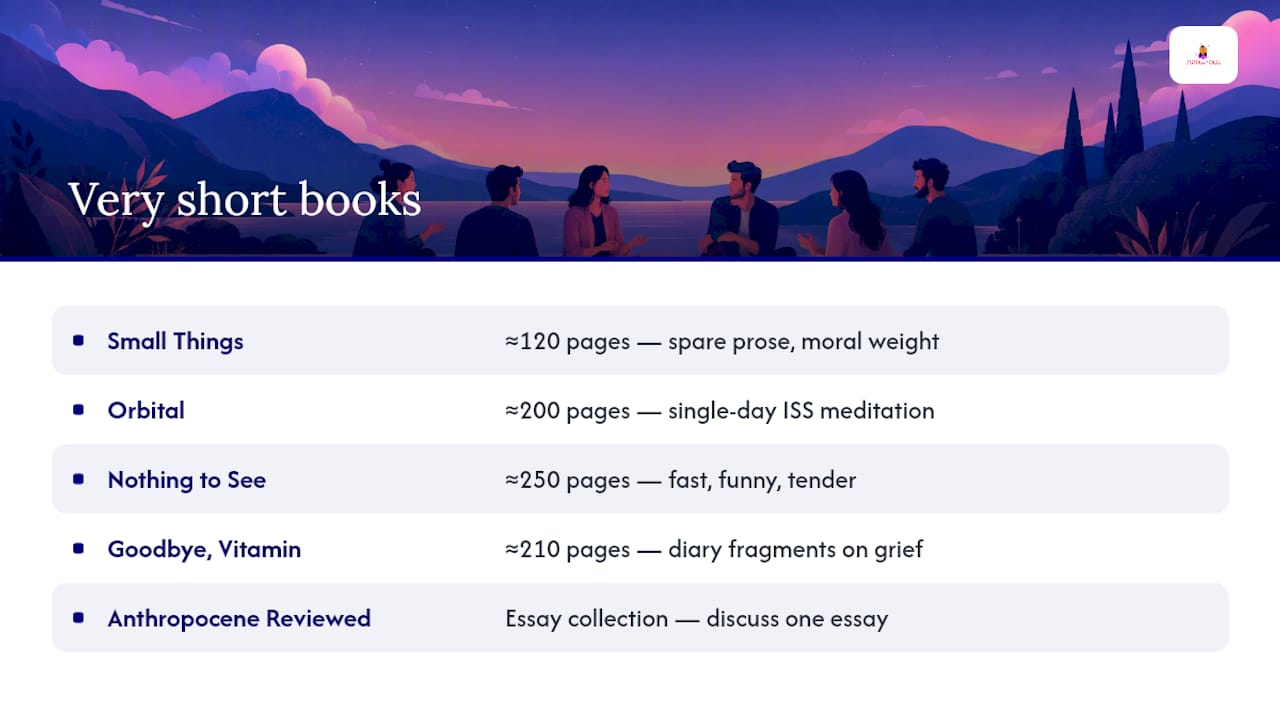
Small Things Like These by Claire Keegan runs just under 120 pages and still manages to indict an entire institution. Set in 1980s Ireland, it follows a coal merchant who stumbles onto the abuses of a Magdalene laundry and has to decide what he owes strangers versus his own family's safety. The prose is spare enough to read in one sitting, but the moral weight lingers for days. Starter question: What would you have done in Bill Furlong's position, and what did it cost him to choose differently?
Orbital by Samantha Harvey clocks in around 200 pages and won the 2024 Booker Prize for turning a single day aboard the International Space Station into a meditation on distance, home, and the fragility of the planet below. Nothing "happens" in the conventional sense, which makes it a great test of whether your group can talk about mood and structure instead of plot twists. Starter question: Does the lack of traditional plot make the book more or less memorable to you?
Nothing to See Here by Kevin Wilson is a fast, funny, oddly tender novel about two children who catch fire when they get upset, and the woman who agrees to care for them anyway. At around 250 pages it sits at the upper edge of this category, but the pacing reads much shorter. It's an easy sell for members wary of "literary" fiction. Starter question: Is Lillian a good caretaker, and does the book even want you to answer that clearly?
Goodbye, Vitamin by Rachel Khong is a slim, fragmentary novel told through a year of diary entries about a woman moving home to help care for her father as his memory fails. It runs about 210 pages and handles grief with a lightness that surprises readers expecting a heavier read. Starter question: How does the fragmented, diary-style structure change how you experience the father's decline?
The Anthropocene Reviewed by John Green collects short essays, each one "reviewing" something from Diet Dr Pepper to the Taco Bell breakfast menu on a five-star scale, and each one turning into a meditation on mortality or hope. Because it's essay-based, your group doesn't have to finish the whole book to discuss it well. Starter question: Which single essay hit you hardest, and why do you think Green paired that subject with that particular reflection?
Short: 200 to 300 pages
The Nickel Boys by Colson Whitehead runs close to 220 pages and fictionalizes the real horrors of a Florida reform school through two boys who respond to institutional cruelty in opposite ways. It's a harder read emotionally than most on this list, but the length keeps the devastation focused rather than exhausting. Starter question: Whitehead reveals a key plot twist late in the book. Did it change how you read everything before it?
Quick fact: Editors at the Booker Prizes treat under 300 pages as the working definition of "short" fiction worth spotlighting, with many of the strongest picks landing under 200.
These six titles are pulled from the same pool of books that keep resurfacing across editorial short-fiction lists, which is a decent proxy for reliability. If a book keeps getting recommended by different outlets for different reasons, it usually means the material holds up under group scrutiny, not just solo reading.
Why Short Books Boost Completion and Conversation
A short book is not a lesser book. It's often a more concentrated one, and that concentration is precisely what makes it work better for a group setting.
"Short" for club purposes generally means under 300 pages, and the Booker Prizes' own short-books feature puts many of its best recommendations under 200 pages. This threshold is based on typical reading pace for busy adults.
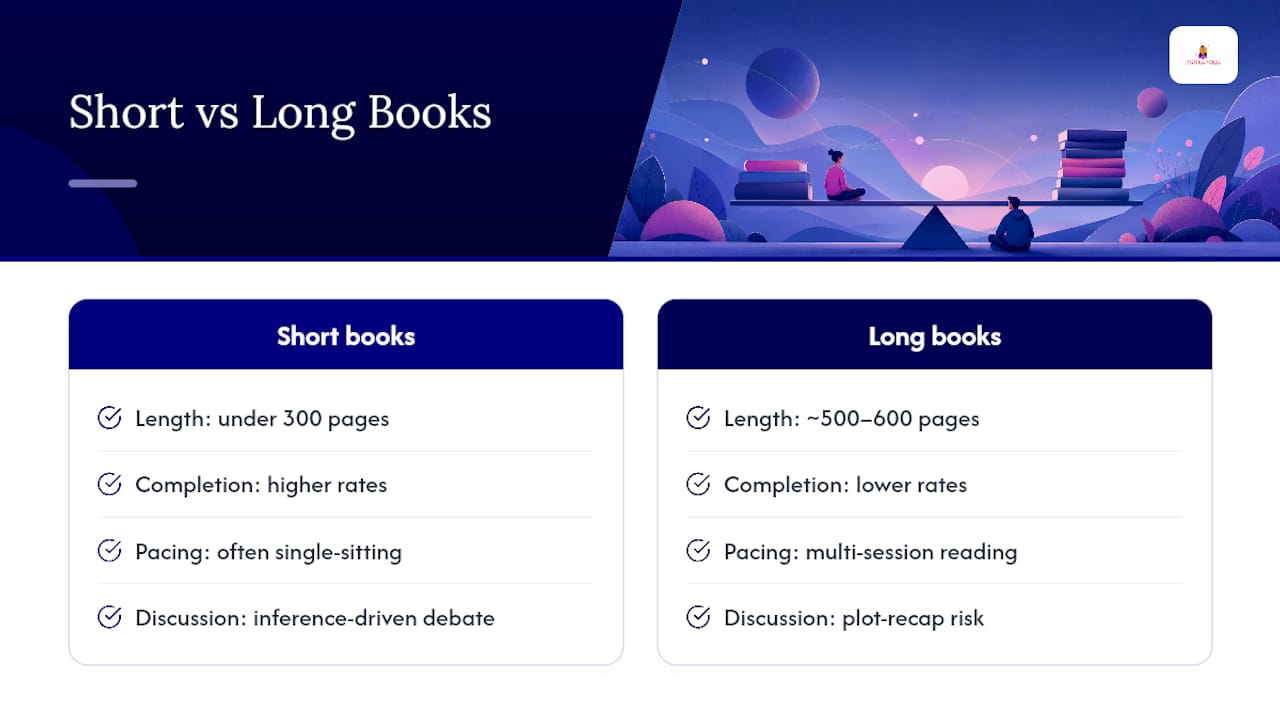
The completion data backs this up. Groups that swap oversized novels for shorter ones report higher completion rates and livelier meeting participation, largely because the "guilt factor" of an unfinished 500-page book quietly kills attendance long before anyone admits it out loud.
There's a literary reason this works too, not just a scheduling one.
"Novellas and short novels create an intimate reading experience, often finished in a single sitting, which sharpens a reader's immediate reflection," argues a New York Times opinion piece on short fiction, making the case that brevity forces both writer and reader into closer attention.
Tighter prose leaves more implied than stated, and that gap between what's written and what's meant is where the best discussions live. A 600-page novel can explain a character's motivation across three chapters. A 150-page novella has to trust you to infer it, and that trust is what fuels an hour of genuine debate instead of plot recap.
How to Choose a Short Book Your Club Will Actually Finish
Picking a short book isn't just about page count. Plenty of thin books are thin on substance too, and those tend to produce a ten-minute meeting followed by an early exit to the wine. Run any candidate through these four filters before you commit.
- Thematic richness. Does the book wrestle with something genuinely contestable, like guilt, complicity, memory, or identity, rather than just moving a plot from point A to point B?
- Built-in ambiguity. Strong short-book club books tend to leave something unresolved. An ending that splits the room is worth more than one that wraps everything up neatly.
- Accessible prose. Short doesn't help if the sentences are dense enough to require rereading every paragraph. Look for clarity, not just brevity.
- A reasonable edition page count. Always check the actual paperback or library edition rather than trusting a bookstore blurb; page counts vary by printing, and publisher lists like Penguin Random House's are a fast way to confirm.
Watch for red flags too. A book that's overwhelmingly plot-driven, with a twist ending and little else to chew on, will get you a fun fifteen-minute chat and then silence. Green flags include a divisive narrator, an unresolved moral question, or a structure (diary entries, linked essays, alternating timelines) that naturally invites "what did you make of this part?" conversation.
Before you lock in a pick, answer three questions: Is it easily available at your library or local bookstore? Realistically, will most of the group finish it in your timeline? And can you already think of two or three angles worth debating? If you can't answer that third one, keep looking.
Pro Tip: Read the last page before you assign a book to the group. If the ending resolves too cleanly, the discussion probably will too.
Meeting Formats That Keep Short Reads on Track
The book choice only does half the work. Pacing and structure decide whether that discussion-ready novella actually gets read.
- A two-week read suits anything under 200 pages and works well for groups that meet twice a month.
- A four-week read with a midpoint check-in fits books in the 250 to 300 page range, especially for groups juggling work travel or family schedules.
- 60-minute discussion blocks keep meetings from sprawling into tangents. Set a timer if your group tends to wander.
- Short-story or essay collections can be split by individual piece rather than by page count, so a member who only finished three of ten essays in The Anthropocene Reviewed can still contribute meaningfully.
- For virtual meetings, send two or three discussion prompts 48 hours ahead so quieter members arrive with something to say.
- For in-person meetings, try breakout pairs for the first ten minutes before opening to full-group discussion. It loosens people up before the bigger conversation starts.
Library systems already run this playbook. Quick Reads programs at public libraries structure entire seasons around short titles with predictable monthly cadence, which is worth borrowing even if your club meets in someone's living room.
Bookaholic Resources to Run a Richer Short-Book Season
Running a short-book season gets easier when you're not building every discussion guide from scratch. Bookaholic Podcast keeps a running library of book club discussion questions you can copy in under five minutes, built specifically to pair with fast reads that don't leave much runway for prep.
A simple workflow: pick a short title from the shortlist above, pull matching questions from that discussion-prompt post, then queue up a relevant Podcast episode clips to open your meeting. Author interviews often surface an angle your group hasn't considered yet.
For groups still fighting the "we never finish anything" problem, the Finish a Book in Two Weeks guide targets exactly that friction, and the Book Clubs category page collects every related resource in one place, including themed reading guides for groups that want a season with a throughline rather than a grab bag of unrelated titles.
Why I Switched My Club to Short Books First
I used to default to the acclaimed 400-page doorstopper every season, and attendance quietly thinned every time. The month we picked something under 200 pages instead, nearly everyone showed up having actually finished it, and the conversation ran twenty minutes past our usual cutoff. That wasn't a fluke. A shorter book removes the excuse to skim the ending and fake your way through the meeting.
Short books also force better questions, because there's less plot to hide behind and more theme to actually argue about. If your club has been limping along, don't reach for something longer to prove you're serious readers. Reach for something shorter and sharper. Try one pick from this list this month and watch what happens to your turnout.
— Deirdre
Let Bookaholic Podcast Handle the Discussion Prep
Podcasts can be a resource for clubs that want richer conversation without spending a weekend building a discussion guide from scratch. Some short picks can pair with an author interview, a themed episode, or a ready-made prompt sheet, so your meeting has material beyond "did everyone like it?"
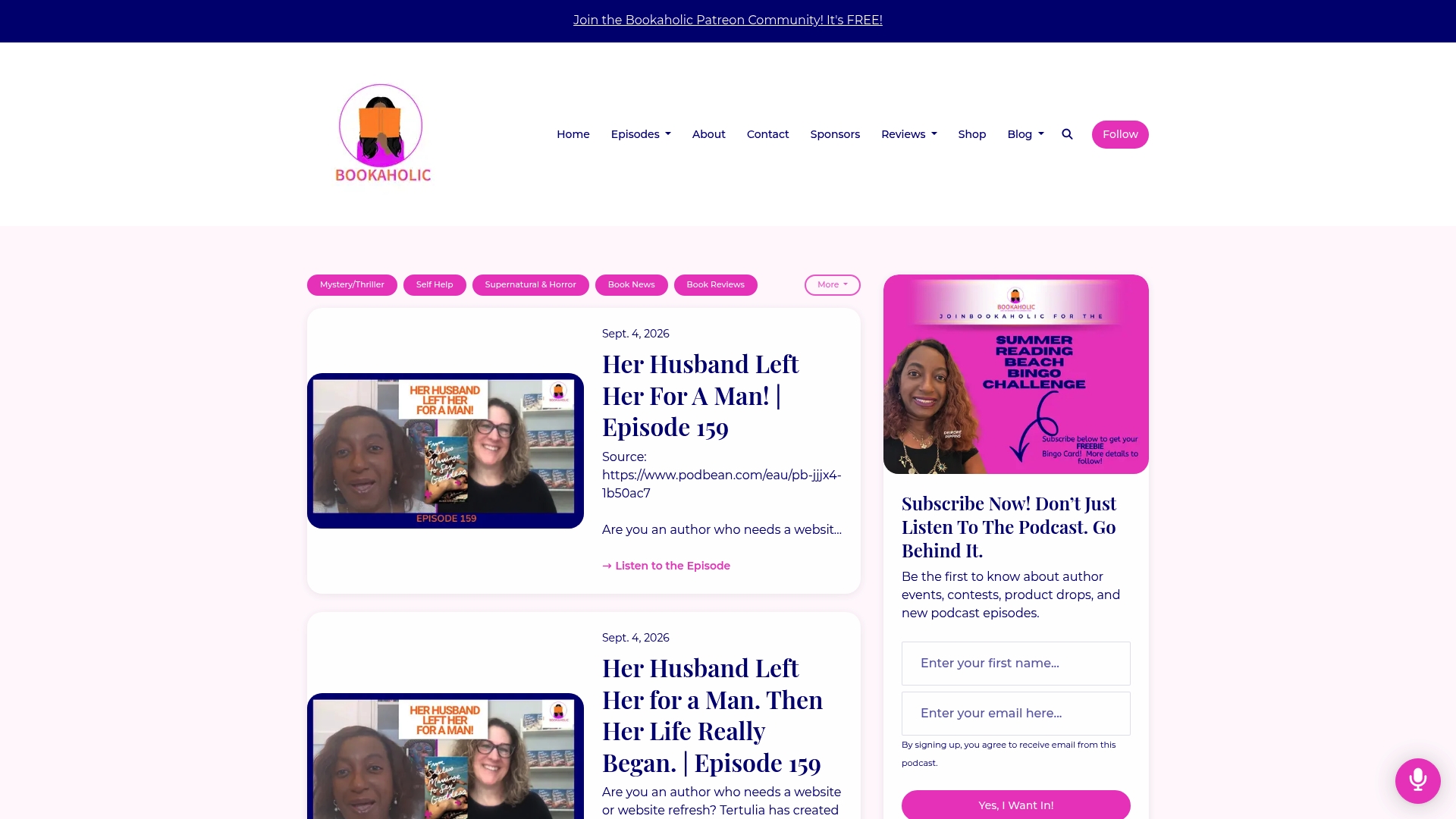
Start with an author conversation like "From Fairytales to Reality: A Young Writer's Dream", which works well as a five-minute clip to open a meeting and gets quieter members talking before the formal discussion even starts. For hosting mechanics beyond the reading list, the partner guide on how to host a book club that actually sticks covers the logistics side well. Queue up your next short pick, pull a matching episode from Bookaholic Podcast, and give your group something worth showing up for.
Quick Links for Verifying Your Next Short Pick
- Booker Prizes' short-books library: best for curated, prize-caliber short fiction with confirmed page counts.
- Penguin Random House's short-read list: best for checking edition-specific page counts before you commit a title to the calendar.
- AARP's short-novel club recommendations: best for club-tested picks aimed at busy adult readers.
- Local library Quick Reads programs: best for a ready-made monthly cadence and community events built around short titles.
Always confirm the page count of your specific edition before locking in a meeting date. Paperback reprints and library copies sometimes run longer or shorter than the original hardcover.
Sources
- The best short books: novels from the Booker Prizes library
- 11 Short Novels Your Book Club Will Actually Read
- Opinion | Short Books Are Perfect for Our Distracted Age
- Short Books To Read in a Weekend | Penguin Random House