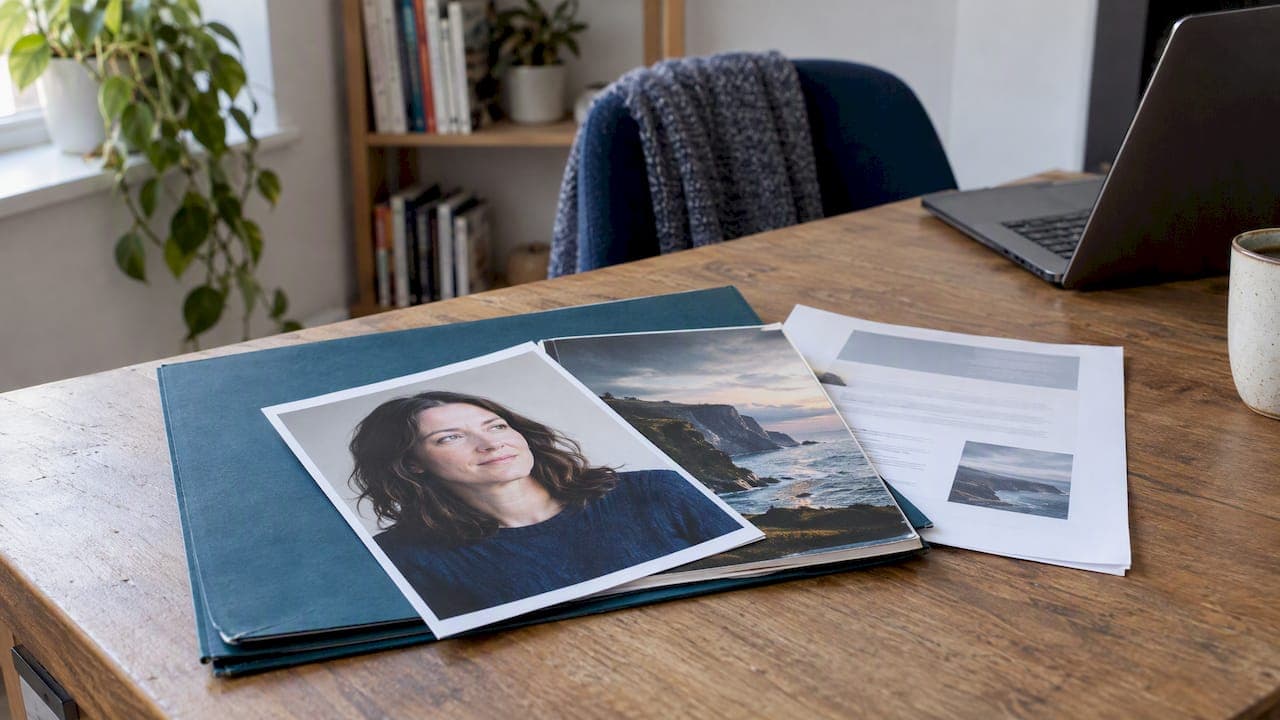
An author media kit is one page, or one folder, that gives a podcast host, journalist, bookseller or event organizer everything they need to feature you without writing back to ask for anything. It holds your bio, headshot, book details, talking points and contact information, all ready to copy. Build it well and a busy host can say yes in five minutes.
We talk with authors on the Bookaholic Podcast, so we know which kits make a booking easy and which ones leave a host digging through a website at 11 p.m. This guide covers what to put in yours, how to format it, and a bio template and sample questions to start from.
TL;DR
- A media kit is a toolbox for the people covering your current book. It is not an archive of everything you have ever done.
- Core pieces: a short third-person bio, licensable headshots, book details with buy links, talking points, sample interview questions, social links and past coverage.
- Put it on a web page that can be copied from. Use a cloud folder only for heavy files such as full-resolution covers.
- Start about six months before launch and update it whenever something new happens.
- Keep it scannable. Five strong talking points beat a long synopsis.
Table of Contents
- What an author media kit is (and how it differs from a press kit)
- What to put in your author media kit
- A bio template you can adapt
- Sample Q&A for hosts
- Format: web page first, PDF second
- Where to put it and when to start
- How to use the kit once it exists
- Our perspective: make the host's job easy
- Hear how authors talk about their work
- Common mistakes to avoid
- FAQ
- Sources
What an author media kit is (and how it differs from a press kit)
The two terms get used interchangeably, and in everyday conversation that is fine. Jane Friedman notes that people also call it a press kit, one-page promotional kit, pitch sheet or one sheet. If you are asked for any of those, you are being asked for the same thing: the material that makes it easy to write about you.
There is a useful distinction, though. Scribe Media's guide describes a press kit as more of a historical record of past appearances, while a media kit is a proactive toolbox built to help journalists, podcast hosts and event organizers produce good coverage of your current project. Think of it that way and your editing decisions get easier. Every item either helps someone cover your book now, or it goes.
An author one sheet is the compact version: a single page with the cover, a short description, your bio, a headshot and ways to reach you. It is the version you attach to a cold pitch. The full media kit sits behind it for anyone who wants more.
What to put in your author media kit
Here is the checklist. Selfpublishing.com's 2026 guidance lists a 50 to 100 word third-person bio, high-resolution licensable headshots, book details with purchase links, one-sentence and full-length descriptions, social links with follower counts, three to five media talking points, suggested interview questions and links to past coverage. We would add a few notes from the host's side of the microphone.
1. A bio in three lengths
Write one factual core and cut it three ways: a single sentence, a short paragraph of 50 to 100 words, and a longer version for programs and websites. Use third person so a host can paste it straight into show notes. Reedsy describes an author bio as a short third-person paragraph covering who you are, what you write and why you are worth reading. That is the whole brief.
2. Headshots and cover images
Offer at least two headshots, one formal and one relaxed, and state clearly that hosts and outlets may use them. Make sure the files are high quality. Canva's media kit guide says images should be at least 300 DPI to stay print-ready. Include the book cover as a high-resolution file too.

3. Book details
Give the title, subtitle, genre, publisher or imprint, publication date, page count, formats, ISBN and one clean link where people can buy it. Add the one-sentence pitch and a full description of a paragraph or two. If you have an advance reader copy available, say how a reviewer can request it.
4. Talking points and a sample Q&A
This is the section authors skip and hosts love. Scribe Media points out that handing over seven to ten ready-to-use questions does part of the host's prep for them, which makes agreeing to the interview easier. Reedsy's kit advice leans the other way on volume: keep your key ideas to five focused talking points tied to problems your book addresses, not a generic synopsis. Both can be true. Five talking points, then a handful of questions that unlock them.
5. Social links and reach
List the platforms where you are active with current follower or subscriber counts, plus your newsletter if you have one. Be accurate. Hosts check, and a rounded-up number costs more trust than a small honest one.
6. Past coverage and praise
Link to previous interviews, reviews, podcast episodes and a few blurbs. Keep it to the strongest, most recent items. Early on, this section may be thin. That is fine. Fill it as you go.
7. Contact details
One name, one email address, one person who replies. If a publicist or agent handles requests, say so and put their details first.
A bio template you can adapt
Most searches for an author bio template end in the same frustration: the examples are too generic. This structure works for fiction and nonfiction alike. Fill each bracket with something specific.
[Name] is the author of [Title] ([Publisher], [Month Year]), a [genre] about [what the book is about in plain words]. [One credential or detail that explains why you wrote it.] [One piece of proof: a prior book, award, publication, profession or relevant experience.] [Name] lives in [place] with [optional personal detail]. Learn more at [website].
A few rules keep it honest and useful:
- Lead with the book, not your biography.
- Pick proof that matters to this audience. A hospice nurse writing a grief memoir should say so. A software job likely does not belong.
- Keep the factual core the same in every version so that no two outlets print contradictory details.
- Include one personal detail at most. Journalists want concise, scannable material, and Reedsy's guidance names too much personal information and cluttered design as the most common pitfall.
Sample Q&A for hosts
Your questions should sound like something a curious host would actually ask, and each answer should be a bit you are happy to say aloud ten times. A starter set for a novel, which you can adapt:
- What sparked the idea for this book, and how long did it take to write?
- Which scene was hardest to write, and why?
- What did you cut that you still miss?
- What do you hope a reader feels when they close the last page?
- Which books or authors were on your desk while you wrote it?
- What would you tell someone who has a half-finished manuscript in a drawer?
- What are you working on next?
For nonfiction, swap in questions about the problem the book solves, the research behind it, a story that did not fit the manuscript, and one thing a reader can try this week. Questions about the writing journey also travel well. They suit shows aimed at aspiring writers, and they give hosts something warm to open with.
Format: web page first, PDF second
The design instinct is to build a beautiful PDF. Resist it for your primary kit. Jane Friedman's guidance on online press kits explains that journalists and producers prefer HTML pages because PDFs often paste badly and carry compressed images that are hard to extract. A plain page on your website, with copy buttons or plain selectable text, solves both.
Here is a setup that works:
| Piece | Best format | Why |
|---|---|---|
| Bio (short, medium, long) | Plain text on a web page | Easy to copy into show notes |
| Headshots and covers | Downloadable image files, high resolution | Hosts and editors need print-ready files |
| Heavy files (trailer, full-size covers) | Cloud folder link set to view-only | Prevents accidental edits to your originals |
| Sample Q&A | Web text, plus a one-page download | Hosts read it on screen or print it |
| One sheet | Single-page PDF | Attach to pitches and give to event organizers |
The same Jane Friedman guidance recommends cloud folder links with viewer permission, not editor, for large files. Check the link in a private browser window before you send it.
A quick test: ask a friend who is not an author to find your headshot, your buy link and your bio within thirty seconds. If they cannot, a host will not either.
Where to put it and when to start
Give your kit its own page and link it from your site's main navigation or footer, with a name like "Media" or "Press." Susan Neal, a former radio host quoted by Author Media, described visiting an author's website for a press kit page before scheduling interviews. If hosts look for it, make it easy to find. It also differs from an About page: the About page speaks to readers, while the kit speaks to the people who might introduce you to them.
On timing, the selfpublishing.com guidance suggests preparing six months before launch and starting outreach three to four months ahead. If your launch is closer, build a lean version first: bio, headshot, cover, buy link, five talking points. Then expand. Our 12 week book launch checklist shows where the kit fits among the other launch tasks.
Once live, treat it as a living document. PublishDrive's advice is to refresh it with new materials, major mentions and current figures, so it stays relevant when new requests arrive.
How to use the kit once it exists
A media kit does nothing sitting on a page. Here is how it earns its place:
- In pitches. Send a short personal email, link the kit, and attach the one sheet. Do not paste the entire kit into the message.
- With podcasts. Tailor one line to the show: mention an episode you enjoyed and why your book fits its listeners. Then point to the Q&A.
- With local media and bookstores. Lead with the local angle, your town or a place in the book.
- With events and book clubs. Include your speaking topics, and our book club discussion questions guide is a good model for the kind of reader materials you might offer.
If you want to go further into publicity itself, this overview of modern press relations covers how outreach and coverage fit together. Whatever route you choose, keep your own list. As we explain in our 90 day book marketing piece, owning your email list is what makes every appearance compound.
If you are still before the publishing stage, a clear query letter and our guide to finding literary agents safely come first. The kit can wait until you have a deal or a release date.
Our perspective: make the host's job easy
We sit on the other side of this. On the Bookaholic Podcast we meet authors who are generous, funny and thoughtful, and a good number of them reach us because they made it simple to say yes. A clear bio, a cover image that opens on the first click, a few real questions: that is often the difference between a conversation and a missed one.
Here is what we would tell any author building a kit:
- Write for a stranger with ten minutes. The host may not have read your book yet. Give them the spark of it quickly.
- Offer stories, not only credentials. Our listeners, aspiring writers especially, connect with the honest parts of the writing journey: the false starts, the doubt, the day it finally clicked. If your book touches mental health, say so plainly and with care. Those conversations resonate.
- Let your questions show your personality. A question you love answering will produce your best audio.
- Be a good guest after the booking. Share the episode, thank the host, and add the link to your kit.
The authors who stand out are not the ones with the flashiest design. They are the ones who treat the host as a collaborator.
— Deirdre
Hear how authors talk about their work
If you want to hear what makes a conversation land, listen to a few episodes of the Bookaholic Podcast before you pitch any show. You will notice how authors frame their books, which stories they choose and how hosts steer the talk. Start at our home page, where you can find episodes, reviews and the reader and writer community. One example from our archive is a conversation with the publisher behind Envelope Books, a good look at how a book's story becomes its pitch. If you are weighing how to get your book out into the world at all, our comparison of self-publishing and traditional publishing will help.
Common mistakes to avoid
- Too much, too cluttered. If it takes a scroll marathon to find your bio, cut.
- Only a PDF. Hosts cannot copy from it cleanly.
- Low-resolution photos. A blurry headshot makes a host hesitate.
- Generic synopsis in place of talking points. Show what questions you can answer.
- Stale links. Test every link each time you update.
- Missing rights information. If you want the headshot used, say it can be.
- No contact line. It sounds obvious. It happens often.
FAQ
What is a media kit for an author?
It is a collection of materials that helps journalists, podcast hosts, bloggers and event organizers feature you and your book. It usually includes a bio, headshots, book details, talking points, sample questions and contact information. Its job is to save the other person time.
What is the difference between an author media kit and a one sheet?
A one sheet is a single page summarizing your book and you, ideal for attaching to a pitch. A media kit is the fuller set behind it, with multiple bio lengths, images, a Q&A and past coverage. Most authors need both, and the one sheet can be built from the kit.
How long should an author bio be?
Prepare three lengths: one sentence, a short paragraph and a longer version. The selfpublishing.com guidance suggests 50 to 100 words for the main third-person bio. Write the facts once and trim from there.
Do I need a media kit if I have not published yet?
You can start a lean version before launch, and it is worth doing early. Industry guidance suggests preparing it around six months before publication. Before that, focus on the manuscript and the submission or publishing path.
Should my media kit be a PDF or a web page?
Make the web page your main kit, since hosts can copy from it and extract images easily. Offer a PDF one sheet for attachments. Use a view-only cloud folder for large files.
Sources
- To Get on Podcasts, Create a Media Kit, Jane Friedman
- How to Create a Professional Author Media Kit for Your Book, Scribe Media
- 9 Media Kit Examples to Inspire Your Own, Selfpublishing.com
- How to Write a Killer Author Bio, Reedsy
- How to Build a Rocking Author Media Kit, Reedsy
- What is a media kit, Canva
- Set Up the Perfect Online Press Kit, Jane Friedman
- How to Create an Author Press Kit with Susan Neal, Author Media
- How to Create an Author Media Kit, PublishDrive