
Getting a book published means turning your finished manuscript into a professionally produced book available to readers through traditional publishing, self-publishing, or hybrid methods. The path you choose shapes everything: your timeline, your royalties, and how much creative control you keep. Over 4 million books were published in the U.S. in 2025, with self-published titles accounting for 87.5% of that total. That figure tells you the market is wide open. Knowing how to get a book published the right way still separates authors who build real readerships from those who publish into silence.
How to get a book published: what you must prepare first
Publishing success starts long before you upload a file or send a query letter. The manuscript must be complete and polished. A rough draft is not a publishable manuscript. Agents reject incomplete work, and readers leave harsh reviews when a book feels unfinished.
Professional editing is the single most impactful investment you can make before publishing. A hybrid editing approach using beta readers alongside a professional copy editor delivers roughly 80% of the editing value at about 30% of the cost of full professional editing. Beta readers catch plot holes and pacing issues for free. A copy editor then handles grammar, consistency, and style at a fraction of the cost of a full developmental edit.

Knowing your reader is equally foundational. Target audience identification should begin during the writing process, not after the book is finished. When you know who you are writing for, you make better decisions about genre, tone, and length. That clarity also shapes your marketing copy.
Your book description is a marketing asset, not an afterthought. Draft it before you publish. A strong description follows the Hook, Setup, Escalation, and Call to Action formula. Readers decide within seconds whether to buy, so your description must earn that decision fast.
Pro Tip: Write three versions of your book description: a 50-word version for social media, a 150-word version for retail pages, and a 300-word version for your website. Having all three ready before launch saves you from scrambling at the worst possible moment.
How does traditional publishing work?
Traditional publishing is the process of signing with a major or independent publisher through a literary agent, who pitches your manuscript on your behalf. The publisher handles editing, design, distribution, and retail placement. You receive an advance against future royalties, then earn 10–15% royalties on sales after the advance is recouped.
The process follows a clear sequence:
- Complete your manuscript. Agents do not consider partial fiction manuscripts from debut authors.
- Write a query letter. This is a one-page pitch that summarizes your book, your credentials, and why you are querying that specific agent.
- Prepare a synopsis and sample chapters. Most agents request the first 10–50 pages alongside the query.
- Research and query agents. Use databases like QueryTracker or Publishers Marketplace to find agents who represent your genre.
- Receive an offer of representation. A strong manuscript and query letter are the two non-negotiable requirements for landing an agent.
- Agent submits to publishers. Your agent pitches to acquisitions editors at publishing houses.
- Negotiate and sign a publishing contract. Agents protect authors from bad deals through contract negotiation and legal review.
- Move through editorial, design, and production. This phase alone takes 12–18 months after a deal is signed.
The full timeline from your first query letter to a book on a bookstore shelf runs 18–36 months. That is not a flaw in the system. It reflects the depth of editorial, design, and distribution work publishers provide. The tradeoff is real: you give up a significant share of royalties and some creative control in exchange for professional infrastructure and retail credibility.
Key materials for a traditional submission package:
- A polished query letter (one page, no exceptions)
- A one-to-two page synopsis covering the full plot, including the ending
- Sample chapters, typically the first three or the first 50 pages
- A brief author bio highlighting relevant credentials or platform
What are the steps to self-publish a book?
Self-publishing gives you full creative control, faster time to market, and significantly higher royalties. Self-published authors earn 35–70% royalties depending on the platform and pricing. The tradeoff is that every production decision falls on you.
The self-publishing process runs in this order:
- Finalize and edit your manuscript. Professional editing is not optional, even without a publisher requiring it.
- Design a professional cover. Cover design is the single biggest factor in whether a reader clicks on your book online.
- Format your interior. Use tools like Vellum, Atticus, or hire a formatter for print and ebook files.
- Choose your platforms. Amazon KDP reaches the widest audience. IngramSpark provides access to bookstores and libraries. Books.by offers additional distribution options for authors building a direct sales channel.
- Set your metadata. Choose two categories and seven keywords on Amazon KDP. These determine where your book appears in search results.
- Price your book. Research comparable titles in your genre. Pricing too low signals low quality; pricing too high reduces impulse buys.
- Upload and publish. Review your proof copy carefully before going live.
The typical self-publishing timeline runs 3–6 months from a finished manuscript to a live book. That speed advantage is real, but it only helps if the book is genuinely ready.
Pro Tip: Set your book to "pre-order" on Amazon KDP at least two weeks before your launch date. Pre-order sales count toward your launch-week rank, which directly affects how visible your book becomes on the platform.
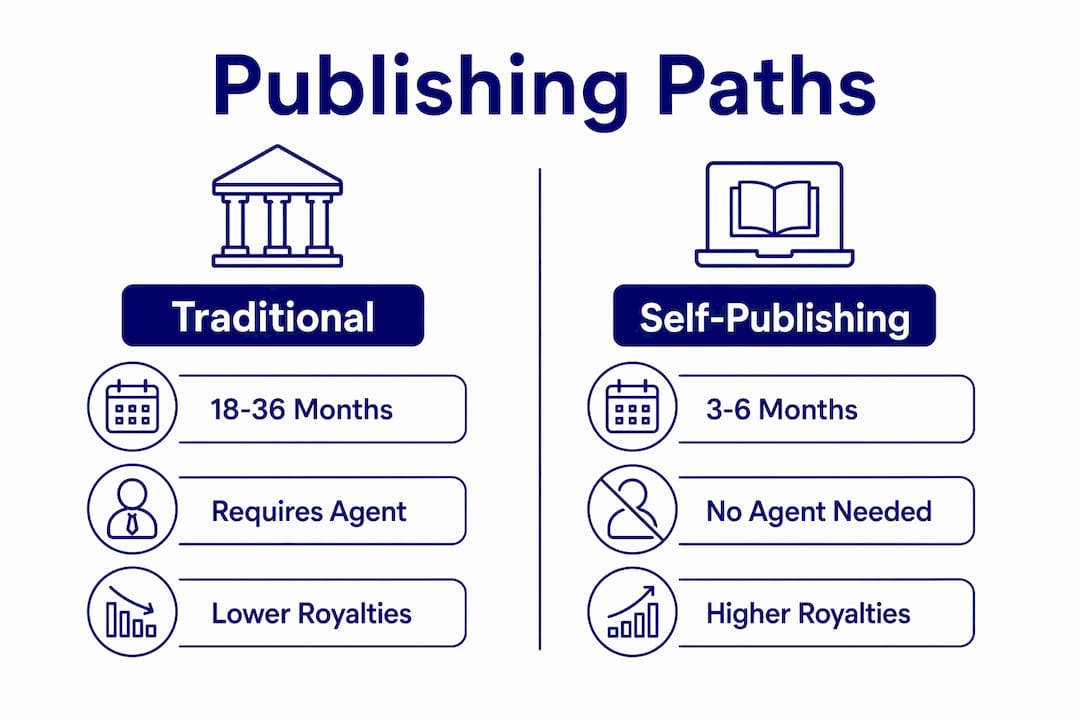
| Factor | Traditional publishing | Self-publishing |
|---|---|---|
| Timeline | 18–36 months | 3–6 months |
| Royalties | 10–15% | 35–70% |
| Creative control | Limited | Full |
| Upfront cost | None | Author pays |
| Distribution | Wide, retail-focused | Platform-dependent |
Which publishing path is right for you?
Choosing a publishing path should align with your personal goals around credibility, speed, and creative control. There is no universally correct answer. The right path depends on what you want your publishing career to look like.
Traditional publishing fits authors who want institutional credibility, bookstore placement, and the backing of an editorial team. It also suits authors who are comfortable with a long timeline and limited control over cover design and pricing. The advance provides upfront income, but most debut authors receive modest advances that do not replace a salary.
Self-publishing fits authors who want speed, higher royalties, and full ownership of their work. It suits authors who are willing to manage production, marketing, and distribution themselves or hire professionals to do so. The financial upside is higher, but so is the financial risk.
Hybrid publishing sits between the two. Hybrid publishers offer editorial and distribution services in exchange for a fee from the author, rather than an advance. The quality of hybrid publishers varies widely. Vet any hybrid publisher carefully before signing a contract.
Common mistakes first-time authors make when choosing a path:
- Querying agents before the manuscript is fully edited
- Self-publishing too quickly to avoid the traditional timeline
- Choosing hybrid publishing without researching the publisher's distribution reach
- Ignoring metadata and category selection, which kills discoverability
- Treating the book description as a last-minute task
What marketing do new authors need before launch?
Marketing is not something you start after your book goes live. The authors who sell consistently build their audience before the book is available. Building an email list before launch is the single most effective pre-launch step. Even 50 subscribers before launch day create a real sales mechanism and generate early reviews that feed platform algorithms.
Early reviews matter more than most new authors realize. Retail algorithms on Amazon and other platforms reward books that receive reviews quickly after launch. A book with 20 reviews in its first week ranks higher than a book with 20 reviews spread over six months.
A compelling book description using the Hook, Setup, Escalation, and Call to Action formula directly improves conversion on retail pages. Write it early and test it with readers before launch.
Pro Tip: Offer your first 10–20 email subscribers an advance reader copy (ARC) in exchange for an honest review on launch day. This is legal, ethical, and one of the most effective ways to build early social proof.
Ongoing promotion after launch should include consistent social media presence in spaces where your readers gather, guest appearances on podcasts that serve your genre's audience, and regular email communication with your list. Visibility compounds over time.
Key Takeaways
Getting a book published successfully requires choosing the right path, preparing a polished manuscript, and building your reader audience before launch day.
| Point | Details |
|---|---|
| Choose your path deliberately | Align your publishing method with your goals around speed, royalties, and creative control. |
| Edit before everything else | A hybrid approach using beta readers and a copy editor delivers quality without breaking your budget. |
| Traditional publishing takes time | Expect 18–36 months from query to shelf; use that time to build your platform. |
| Self-publishing pays more | Authors earn 35–70% royalties versus 10–15% through traditional publishers. |
| Market before you launch | An email list of even 50 subscribers before launch drives early sales and critical reviews. |
What I've learned after talking to hundreds of authors
The most common mistake I see aspiring authors make is treating publishing as the finish line. It is not. Publishing is the starting line. The authors who build lasting careers treat their book launch as the beginning of a relationship with readers, not the end of a writing project.
I have interviewed authors on the Book-a-holic podcast who spent three years in the traditional query trenches and came out with major deals. I have also talked to self-published authors who outsold those traditionally published peers by building a direct relationship with their readers through email and social media. Neither path is superior. Both require persistence and professionalism.
The piece of advice I give most often is this: do not let the fear of choosing the wrong path stop you from moving forward. The authors who succeed are the ones who make a decision, commit to it fully, and adjust when the data tells them to. Paralysis dressed up as research is still paralysis.
Agents and editors are not gatekeepers to fear. They are professionals who want to find good books. A polished manuscript and a clear understanding of your reader are your best credentials, regardless of which path you choose.
— Deirdre
Book-a-holic is here for every stage of your writing life
The gap between finishing a manuscript and holding a published book in your hands is real, and it can feel isolating. Book-a-holic exists to close that gap for aspiring authors.
The Book-a-holic podcast features author interviews, honest book reviews and news, and conversations about the writing life that go beyond surface-level advice. Deirdre Pippins talks with authors at every stage, from debut writers navigating their first query letter to seasoned authors who have published across multiple formats. Whether you are weighing traditional versus self-publishing or trying to figure out your first marketing step, the Book-a-holic community has been through it. Come find your people at Book-a-holic.
FAQ
How long does it take to get a book published?
Traditional publishing takes 18–36 months from your first query to a book on shelves. Self-publishing can move a finished manuscript to market in 3–6 months.
Do I need a literary agent to publish a book?
You need a literary agent to access most major traditional publishers. Self-publishing requires no agent, and you retain full rights to your work.
How much do authors earn from book sales?
Traditional publishers pay 10–15% royalties after an advance is recouped. Self-published authors earn 35–70% depending on the platform and pricing.
What is the first step to publishing a novel?
Complete and professionally edit your manuscript before anything else. Agents reject unpolished work, and readers leave negative reviews when a book feels unready.
Is self-publishing a legitimate path for serious authors?
Self-publishing is a fully legitimate path. In 2025, self-published books accounted for 87.5% of all books published in the U.S., and many self-published authors build substantial, profitable readerships.