
Start at least eight to twelve weeks before your release date and work through this phase by phase: finalize your book and its assets, build your audience and ARC team, lock metadata and preorder details, then concentrate your marketing into a tight three-day launch window. Every step below exists to make that final push land harder.
TL;DR:
- Building an ARC team of 20-50 readers and growing your email list before finalizing your ads and press outreach greatly improves your launch momentum.
- Locking metadata, formatting, and final assets at least eight weeks before release ensures a smooth launch and prevents last-minute complications.
- Concentrating sales into a three-day window significantly boosts algorithmic visibility, making timing and review coordination crucial.
- Technical checks on links, pricing, and review timing should be completed within the week before launch to avoid losing sales or credibility.
- Ongoing marketing efforts after launch, including seasonal promotions and regular content updates, help sustain sales beyond the initial spike.
Table of Contents
- Phase 1: Finalize Your Book And Prepare Your Assets
- Setting Up Metadata, Preorders, And Your ARC Team
- Building Buzz In The Final Weeks Before Launch
- Launch Week: The Exact Sequence That Concentrates Sales
- Keeping Sales Alive After Launch Week Ends
- A Copy-Paste 12-Week Calendar You Can Use Today
- What Bookaholic Has Learned From Watching Authors Launch
- How To Get Press Coverage And Media Attention For Your Book
- Should You Host A Launch Party, Virtual Or In Person?
- Working With Influencers And Bookish Creators
- Planning Your Marketing Beyond The First Three Months
- Why Executable Beats Aspirational
- Sources
- FAQ
Phase 1: Finalize Your Book And Prepare Your Assets
Everything else on this book launch checklist depends on this phase, so give it the full ten to twelve weeks if you can. A launch built on a shaky manuscript or rushed cover is a launch that fights itself. Treat your book like a project with real dependencies: editing has to finish before you touch ads, and your metadata has to be locked before preorder setup starts. Skip that order and something breaks later, usually the week you can least afford it.
Your manuscript needs to be genuinely done, not "done except for that one chapter." Professional editing and a full proofread come first, because every asset you build after this point (blurb, excerpt, ARC copies) get built on top of the final text.
- Complete developmental or line editing, then a separate proofreading pass, before locking your interior file.
- Finalize trim size, formatting, and ISBN decisions so your files don't change again.
- Write a blurb that opens with a hook, not a summary. Readers decide whether to click "buy" in the first two lines.
- Prepare your sample pages, author bio, and any front or back matter.
- Set specific, measurable goals: a launch-week copy count, a review target, and a benchmark for sustained monthly sales.
- Pick your launch date with intention. Avoid stacking your release against a major title in your genre or a holiday week when inboxes go quiet.
- Start an author website and a simple reader magnet (a short story, a deleted chapter, a resource guide) to begin growing your email list now, not the week before launch.
That email list matters more than almost anything else on this list. It's the one channel an algorithm can't throttle. If you're picking your launch window and want a sense of what release timing looks like elsewhere in the industry, browsing curated seasonal release calendars can help you avoid an accidentally crowded month.
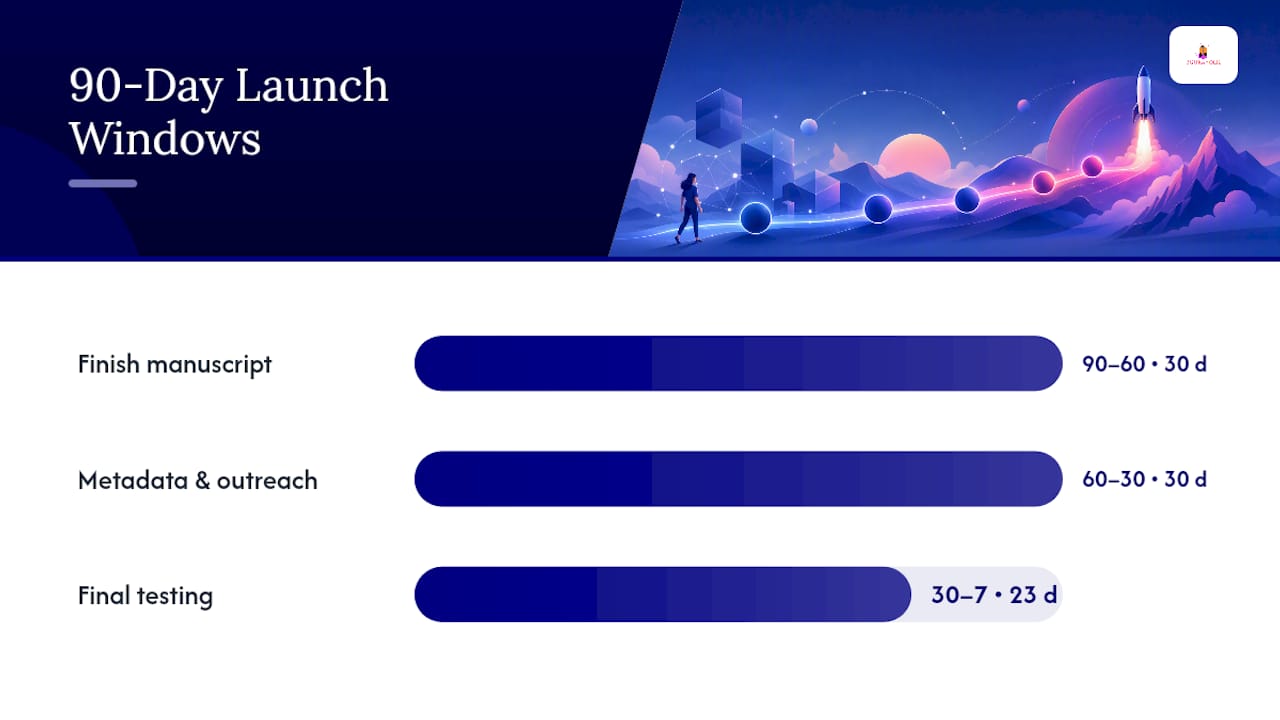
A 90-day book launch timeline breaks this stretch into three windows: days 90 to 60 for finishing the manuscript and assets, days 60 to 30 for metadata and outreach, and days 30 to 7 for final testing and momentum-building. If ninety days feel generous, that's the point. This phase is where most self-published authors either build a real foundation or quietly set themselves up for a launch that fizzles.
Pro Tip: Write your blurb before you finish editing. Drafting the pitch early forces you to identify your book's actual hook, and that clarity tends to improve the manuscript itself.
Setting Up Metadata, Preorders, And Your ARC Team
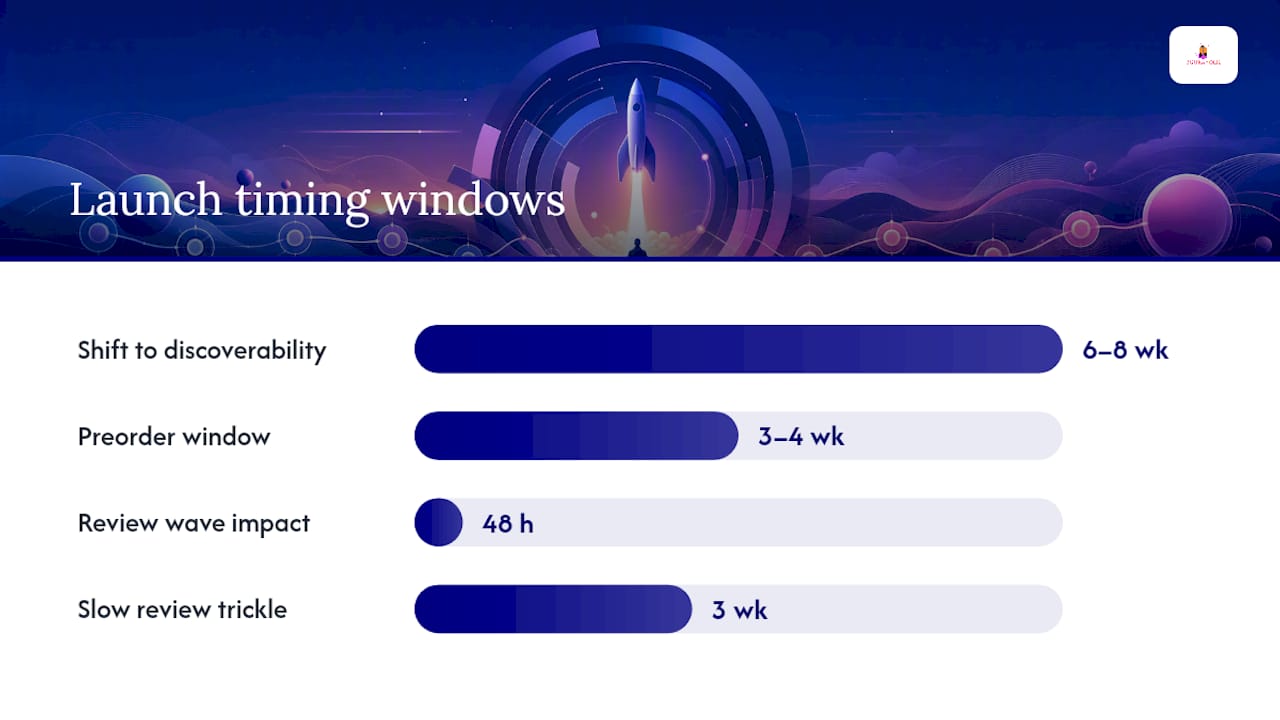
Roughly six to eight weeks out, your job shifts from "finish the book" to "make the book findable and reviewed." This is the least glamorous part of any book launch plan, and it's also where most first-time authors lose the most preventable ground.
- Pick your keywords and categories deliberately. Use search terms readers actually type, not the words you'd use to describe your own book. On Amazon KDP, choose categories specific enough that you can realistically rank in the top 20, rather than broad categories where you're buried on page twelve.
- Set your pricing with a purpose. Ebook pricing is a velocity lever. Many authors launch between $0.99 and $4.99 depending on whether the goal is maximum downloads or maximum revenue per copy. Paperback pricing usually follows print cost plus a margin that still looks competitive against genre comparables.
- Decide on a preorder strategy. Amazon KDP reports preorder sales on release day itself, which means every copy sold in the weeks before launch stacks into your day-one ranking instead of trickling out separately. KDP lets you upload a placeholder manuscript and swap the final file up to 72 hours before release, so a preorder doesn't lock you into an unfinished book. Other retailers vary in how (and whether) they credit preorder sales to launch-day numbers, so check each platform's own policy before assuming Amazon's behavior applies everywhere.
- Recruit your ARC team now. A launch team of 20 to 50 advance readers is a workable range for most debut and midlist releases. Give them a clear deadline, a short set of formatting guidelines for where to post, and a direct, personal ask (not a mass email) for why their honest review matters to you.
- Create your final files and claim your author pages. Set up or update your Amazon Author Central profile and your Goodreads author page well before launch, since both can take days to process changes.
Pro Tip: Ask your ARC team to hold their reviews until launch day rather than posting as they finish. A wave of reviews arriving in the first 48 hours does more for your category ranking than the same number trickling in over three weeks.
Preorders and ARC timing work best in tandem: line up your preorder window for three to four weeks before release, and brief your launch team on that same date so their reviews are ready to post the moment the book goes live.
Building Buzz In The Final Weeks Before Launch
Four weeks out, your book launch checklist becomes a visibility and reliability problem. You need people talking about the book before it exists on shelves, and you need every technical piece tested so launch day doesn't derail on a broken link.
Start your content cadence with a cover reveal, then layer in excerpt drops, teaser posts, and a scheduled email sequence that builds anticipation without exhausting your list. A sample rhythm that works for most self-published authors:
| Timing before launch | Email or content focus |
|---|---|
| 4 weeks out | Cover reveal + preorder announcement |
| 3 weeks out | Behind-the-scenes story or excerpt |
| 2 weeks out | ARC team recruitment push / reader Q&A |
| 1 week out | Countdown reminder + final preorder call |
| Launch day | "It's here" email with direct buy links |
| Launch day +3 | Thank-you note + review request |
| Launch day +7 | Recap, reader shoutouts, next steps |
Media and promo outreach need lead time most authors underestimate. Podcasts often book guests four to six weeks out. Book bloggers and promo sites frequently require submissions two to three weeks before your requested feature date. Send your pitch, wait about a week, then send one polite follow-up. If you hear nothing after that, move on rather than chasing.
Before launch week arrives, run through a technical gauntlet:
- Test every buy link on both mobile and desktop, not just your own browser.
- Order a physical proof copy if you're publishing print, and actually read it cover to cover.
- Double-check your metadata (title, subtitle, categories, keywords) matches exactly what you intended.
- Verify tracking codes on every link so you know which channel is actually driving sales.
- Confirm pricing is correct across every retailer and format, since a mismatched price can quietly kill conversion.
Lock your ARC team's timing here too. You want their reviews landing inside the 48-hour launch window, not spread across the following month.
Launch Week: The Exact Sequence That Concentrates Sales
Launch day runs on a checklist, not a feeling. Here's the sequence that gets the most out of the momentum you've spent weeks building:
- Confirm every listing is live. Check ebook, paperback, and any audiobook links the moment they go active, on every retailer you're using.
- Send your launch email immediately. Your list has been waiting. Don't let the announcement sit in drafts.
- Activate your ARC team. Send a direct reminder asking them to post their reviews today, with a link to make it as easy as possible.
- Post across every platform you use, adapting the message to each one rather than copy-pasting the same line everywhere.
- Stack your borrowed audience placements. Newsletter swaps, podcast drops, and guest posts should all land inside the same three-day window, not spread across a month.
That last point is the single biggest lever most first-time authors miss. Concentrating sales into a three-day push generates far more algorithmic attention on retailer platforms than the same number of sales spread evenly across four weeks. Retailers reward velocity, and velocity only shows up when the buying happens close together.
Watch your numbers daily, but resist over-reacting to hourly swings. A small paid boost, even $20 to $50 in Amazon ads once you clear the review threshold most retailers use to unlock advertising, can help extend the visibility your launch week already earned.
For days two through seven, vary your content instead of repeating the same "buy my book" message. Share a reader's early reaction, post an excerpt you held back, do a short Q&A on your platform of choice, or highlight a review that captured something specific about the story. Momentum needs new material to feed on.
Keeping Sales Alive After Launch Week Ends
The launch spike always fades. What separates a book that keeps selling from one that quietly disappears is what you build in weeks two through twelve.
Your review engine needs to keep running long after your ARC team's initial wave. Add a request in your back matter, send a timed email to buyers two weeks after their purchase, and keep recruiting new ARC readers on a rolling basis rather than treating that team as a one-time launch asset.
- Turn on Amazon ads once you've cleared roughly 15 reviews, which tends to be the point where paid traffic starts converting instead of just spending.
- Book recurring promo site placements every 60 to 90 days to remind lapsed browsers your book exists.
- Run a periodic price promotion tied to a seasonal moment or a milestone (100 reviews, a sequel announcement) rather than randomly.
- Track sales rank, review count, and email list growth monthly so you know which lever is actually moving the needle.
Pro Tip: Set a recurring 30/60/90-day check-in on your calendar right now. Authors who revisit their numbers on a schedule catch a stalling launch early enough to fix it. Authors who don't usually notice six months later, when it's harder to recover momentum.
If sales have gone flat, a small relaunch, a new cover, a limited-time price drop, a fresh round of ARC reviews for an anniversary edition, can revive a backlist title without the cost of a full launch cycle.
A Copy-Paste 12-Week Calendar You Can Use Today
Here's a condensed version of the full book release timeline, built so you can drop it straight into a planner or project tool.
| Week | Primary focus |
|---|---|
| 12–8 | Finish editing, lock formatting, set launch goals and date |
| 9–8 | Write blurb, build author website, launch email list magnet |
| 7–6 | Choose keywords/categories, set pricing, open preorder |
| 5–4 | Recruit ARC team, brief them, claim author pages |
| 3 | Cover reveal, begin content and email cadence, start media outreach |
| 2 | Continue outreach, run technical tests, confirm ARC timing |
| 1 | Final proof checks, countdown emails, confirm all links |
| Launch | Execute day-one checklist, activate ARC team, stack placements |
| +1 | Vary content daily, monitor sales, thank readers |
If twelve weeks isn't realistic, a compressed four-week emergency version still works, just with more risk if a dependency slips: week one for final editing and metadata, week two for ARC recruitment and preorder, week three for outreach and technical testing, week four for launch execution. Fiction authors should weight extra time toward ARC reviews and reader-magnet content; nonfiction authors often get more traction shifting that same time toward podcast and media outreach instead.
Export either version into whatever calendar or checklist app you already use. Google Calendar, Trello, or a plain spreadsheet all work. The format matters far less than actually looking at it every week.
What Bookaholic Has Learned From Watching Authors Launch
The most common launch pitfall isn't a bad book. It's a good book with no one lined up to talk about it on day one. Authors spend months polishing a manuscript and then build their launch team in the final two weeks, which is backwards. Start your ARC recruitment the same week you finalize your cover, not after.
If you're still working out the earlier publishing steps, our guide on how to get a book published covers the ground that comes before this checklist even starts. We've also featured publishing guests across our podcast episodes who talk candidly about what surprised them most during their own launches, worth a listen while you're building your own plan.
How To Get Press Coverage And Media Attention For Your Book
Press coverage rarely comes from a single dramatic pitch. It comes from a well-timed release sent to the right handful of contacts with enough lead time to actually plan coverage.
A press release for a book launch should lead with the strongest angle, not a summary of the plot. Local news outlets often care more about the fact that a hometown author released a book than about the genre itself, so lead with the human story when you're pitching local media. Trade and genre-specific outlets want the opposite: a clear sense of where your book fits in the category and why it's timely.
Build a short list of realistic targets rather than blasting a generic release to hundreds of addresses. Local newspapers, genre-specific blogs, niche podcasts, and regional radio segments tend to be far more responsive to independent authors than national outlets, which usually reserve space for established names or major publisher pushes.
Send your release and any pitch at least four to six weeks before launch, since editorial calendars fill up early. Follow up once, about a week later, with something new to offer, an early review, an excerpt, a specific angle you didn't mention the first time. A second identical email rarely moves anyone.
Should You Host A Launch Party, Virtual Or In Person?
A launch event isn't required, but a well-run one gives your ARC readers and email list a reason to show up and talk about your book in a shared moment, which itself feeds the concentration effect your launch week depends on.
In-person events work best at independent bookstores, libraries, or community spaces where the venue already has a built-in audience that trusts its programming. Reach out to the venue eight to ten weeks ahead, since bookstore event calendars fill quickly, especially in fall and around the holidays.
Virtual launch events cost less and travel further. A live video Q&A, a reading followed by audience questions, or even a scheduled Instagram or Facebook Live session can pull in readers who'd never make it to a physical event. Keep it under 45 minutes. Attention drops fast on virtual formats, and a tight, well-paced event outperforms a long, meandering one every time.
Whichever format you choose, give attendees a specific reason to buy that day: a signed copy, a bonus short story, or a limited window to ask questions directly. A local example worth studying is how a brunch-format book event turned a simple gathering into a genuine promotional moment instead of just a reading.
Working With Influencers And Bookish Creators
Bookstagram accounts, BookTok creators, and niche newsletter writers can put your book in front of exactly the readers who buy in your genre, often more efficiently than a broad ad campaign.
Look for creators whose audience size is modest but whose engagement is real. A creator with 8,000 followers who gets genuine comments and shares usually outperforms one with 80,000 followers and a quiet comment section. Reach out with a specific ask (a review, a cover reveal feature, an ARC copy) rather than a vague "would you be interested in my book?" message.
Give creators lead time similar to media outreach, ideally four to six weeks before your release, since many run their own content calendars and batch-schedule posts. Offer a finished ARC or a polished excerpt rather than a rough draft. Creators are more likely to say yes, and to produce better content, when you make their job easy.
Newsletter swaps with authors in adjacent genres belong in this same category. A swap timed into your three-day launch window adds directly to the concentration effect that drives algorithmic visibility on release day.
Planning Your Marketing Beyond The First Three Months
A launch checklist gets you through the first ninety days. After that, your book needs a marketing rhythm that doesn't depend on constant new effort.
Build a simple content calendar that revisits your book every few months rather than only during launch season: a themed promotion around a holiday relevant to your genre, an anniversary post on your release date, or a tie-in when a sequel or related title comes out. Backlist titles that get this periodic attention tend to hold steadier sales rank than titles left untouched after week one.
Keep your email list active with more than launch announcements. Share writing updates, recommend other authors' books, or run occasional reader polls. A list that only hears from you during launches tends to unsubscribe or go cold between books.
Revisit your keywords and categories every six months. Reader search behavior shifts, and a category that made sense at launch may not be the best fit a year later.
Why Executable Beats Aspirational
Most launch advice fails authors not because it's wrong, but because it's abstract. "Build buzz" and "engage your audience" tell you nothing about what to do on a Tuesday six weeks before release. The guidance that actually works is boring in the best way: a dated task list, a recruitment deadline, a preorder window measured in exact days.
The three-day concentration window is the piece conventional advice underplays most. Authors are told to "promote consistently," which sounds sensible but actively works against how retailer algorithms reward velocity. Spreading fifty sales across a month does less for your ranking than the same fifty sales landing in three days.
If you take one thing from this checklist, make it this: build your ARC team and your email list before you touch ads or press outreach. Everything else, the reviews, the media pickups, the influencer posts, converts better when there's already an audience primed to act the moment your book goes live.
— Deirdre
Sources
For a closer look at the reasoning behind this checklist, these guides go deeper on specific pieces:
- How to Launch a Book Successfully in 2026 🚀 | Chapter Blog
- Book Launch Marketing Timeline: 90-Day Plan (2026)
- Selfpublishing
FAQ
How Do I Prepare For A Book Launch?
Start eight to twelve weeks before release by finalizing your manuscript, building your email list, and recruiting an ARC team of 20 to 50 readers. Work through metadata, pricing, and preorder setup next, then spend the final weeks testing technical details and building buzz before concentrating your marketing into a three-day launch window.
Is Selling 5,000 Copies Of A Book Considered Good?
For most self-published and first-time authors, selling several thousand copies is a strong result that puts a title well ahead of typical debut sales. Context matters, though. A tightly launched genre novel might hit that number in its first few months, while a niche nonfiction title reaching similar totals over a year or two can be just as successful for its category.
How Much Does An Author Make On A $20 Book?
It depends entirely on the publishing route and format. Self-published print books through platforms like KDP typically pay authors a royalty after printing costs are deducted, often landing in a modest range per copy, while ebooks at lower price points can pay a higher percentage of a smaller list price. There's no single universal figure, since royalty structures vary by retailer, format, and whether the book is traditionally or independently published.
How Long Should My Book Launch Timeline Be?
Most successful launches run on roughly a 90-day timeline, though a compressed 12-week or even 4-week version can work if you're tight on time. The trade-off with a shorter timeline is risk: fewer weeks to recruit ARC readers, build your list, and catch technical problems before they become launch-day surprises.
When Should I Set Up My Book's Preorder?
Set your preorder up three to four weeks before your release date so it has enough time to gather momentum. Amazon KDP counts preorder sales toward your release-day ranking, and the platform allows you to upload a placeholder file and swap in your final manuscript up to 72 hours before launch.