
Dark academia is a moody, campus-centered literary aesthetic built on obsessive intellectual pursuit, elite institutions, and a whiff of moral rot beneath all that ivy. Start with Donna Tartt's The Secret History, M.L. Rio's If We Were Villains, Leigh Bardugo's Ninth House, Mona Awad's Bunny, and Olivie Blake's The Atlas Six. Those five will tell you fast whether you want the tweed-and-tragedy version of this genre or the fantasy-tinged, satirical cousins appearing a few sections down.
TL;DR:
- Dark academia primarily involves elite institutions and obsessive pursuits that lead to moral decay and tragedy, with specific books like Bunny and Babel exploring themes of cultishness and colonialism.
- Readers should consider whether they prefer atmosphere-driven stories like The Secret History or plot-driven mysteries like The Likeness to find their best match within the genre.
- The genre's rise is closely tied to social media aesthetics, which popularized the visual mood that now influences book discovery and online communities.
- The genre borrows gothic mood and literary prose but emphasizes inner danger and moral rot rather than external supernatural threats or traditional gothic horror.
- Novels with slow pacing and dark themes like Bunny and Black Chalk often require patience, as their impact becomes clear after initial disorientation.
Table of Contents
- The Best Dark Academia Books to Start With
- Dark Academia by Subgenre and Mood
- What Actually Makes a Book Dark Academia
- How to Pick Your Next Dark Academia Read
- Why Book-a-holic Curated This List
- Where the Dark Academia Aesthetic Actually Came From
- How Dark Academia Took Over Social Media
- Dark Academia vs. Gothic and Classic Literature
- A Curator's Note on Reading Dark Academia Well
- Keep the Conversation Going With The Bookaholic Podcast
- Sources
- FAQ
The Best Dark Academia Books to Start With
If you read only one book from this list, make it The Secret History. Donna Tartt's 1992 novel is widely treated as the founding text of the genre, and nearly every publisher roundup and Goodreads shelf traces back to it. A group of classics students at a small Vermont college commit a murder in the first chapter, and the rest of the book slowly reveals why. It is patient, literary, and unhurried, so go in expecting a slow burn rather than a thriller's pace.
From there, the list branches into books that riff on Tartt's template rather than copy it. Here are the ten titles worth putting on your shelf first.
- The Secret History (Donna Tartt). The template for the entire genre. Best for readers who want atmosphere first and don't mind knowing the ending before the middle.
- If We Were Villains (M.L. Rio). A troupe of Shakespearean acting students, one murder, and a plot practically built out of stage directions. Best for theater kids and anyone who wants dialogue that sounds like verse.
- Ninth House (Leigh Bardugo). Yale's secret societies actually practice magic, and a scholarship student with the ability to see ghosts gets pulled into their politics. Best for fantasy readers who want the aesthetic without giving up plot momentum, since it uses supernatural secret societies to dig into institutional power.
- Bunny (Mona Awad). A lonely MFA student gets absorbed into a cultish clique of classmates who call each other "Bunny" and may or may not be conjuring actual creatures in the woods. Best for readers who like their dark academia surreal, funny, and a little unhinged. It opens slowly, so give it room before deciding it's not for you.
- The Atlas Six (Olivie Blake). Six magicians compete for a spot in a secret society, and only some of them will survive the selection. Best for readers who want dark academia crossed with a competition thriller and a heavy dose of romance-adjacent tension.
- A Deadly Education (Naomi Novik). A magic school so dangerous it kills a fraction of its students every year, told through the sharp, sarcastic voice of a girl everyone assumes will turn evil. Best for readers who want the magic-school setup with real stakes and body count.
- Babel (R.F. Kuang). Oxford's translation program hides an empire built on magical silver, and a group of students starts to realize their education is complicity. Best for readers who want dark academia with a direct argument about colonialism and language, not just vibes.
- Never Let Me Go (Kazuo Ishiguro). A quietly devastating boarding school novel that reveals its horror sideways, one understated detail at a time. Best for readers who want literary restraint over gothic drama, and a gut punch you don't see coming.
- The Likeness (Tana French). A detective infiltrates a group of graduate students by posing as a dead woman who looked exactly like her. Best for mystery readers who want investigative mechanics, not just mood.
- Black Chalk (Christopher J. Yates). Six Oxford students play an escalating game that ruins lives over the following decades. Best for readers who want a slow-building thriller with a real payoff at the end.
A quick warning on tone: several of these books carry mature content, including on-page violence, substance abuse, and psychological unraveling. Bunny and Babel in particular ask for patience. Both start with disorientation before the plot clicks into place, so don't judge them by page fifty.
Dark Academia by Subgenre and Mood
Not every reader wants the same flavor of gloom. Publisher-curated lists from Penguin Random House treat dark academia as a big tent, mixing canonical texts with modern variations that lean fantasy, mystery, satire, and romance. Picking by mood, rather than by "best of" ranking, tends to get you a better match faster.
Fantasy-tinged dark academia adds magic to the elite-institution formula, usually to explore power rather than escapism.
- Ninth House (Leigh Bardugo): Yale plus real magic plus real consequences.
- A Deadly Education (Naomi Novik): a magic school that wants its students dead.
- Babel (R.F. Kuang): Oxford, translation magic, and imperial guilt.
- The Atlas Six (Olivie Blake): a competition for a spot among magical elites.
Mystery and thriller dark academia trades atmosphere for plot mechanics and a body to solve.
- If We Were Villains (M.L. Rio): a Shakespeare troupe with a killer among them.
- The Likeness (Tana French): an undercover detective and a stolen identity.
- Black Chalk (Christopher J. Yates): a game that turns lethal over years.
Satire and surreal dark academia subverts the genre's solemnity on purpose, favoring dark humor and disorientation over straight gothic drama.
- Bunny (Mona Awad): cultish MFA classmates and possible witchcraft.
Romance and sapphic dark academia folds obsession and longing into the campus setting.
- The romantasy space often overlaps here, especially in books where a secret society doubles as a slow-burn romantic entanglement.
Classic campus gothic sticks closest to Tartt's original blueprint: literary prose, a slow reveal, and an ending you already suspect.
- The Secret History (Donna Tartt) and Never Let Me Go (Kazuo Ishiguro) both belong here, even though Ishiguro's book barely mentions academia directly. Its boarding school setting and creeping dread earn it a permanent spot on dark academia lists anyway.
What Actually Makes a Book Dark Academia
Dark academia gets defined as a subgenre of the campus novel built around obsessive intellectual pursuit, atmospheric settings like old libraries and elite universities, and what one Penguin guide calls "beautiful rot" : the idea that the pursuit of knowledge curdles into something tragic or morbid. That last part is the real test. A book with tweed jackets and a library isn't automatically dark academia. It needs the rot.
Pro Tip: If a book gives you an elite school and gorgeous prose but nobody's ambition ever turns destructive, you're probably reading a campus novel or a coming-of-age story, not dark academia.
Look for these recurring tropes when you're deciding whether a new title earns the label:
- An elite or insular institution (a university, boarding school, or secret society).
- Characters obsessed with a subject, a mentor, or each other, past the point of health.
- Secrecy, rituals, or exclusivity that separates insiders from outsiders.
- A library, archive, or old academic building that functions almost as a character.
- A crime, death, or cover-up that the "beautiful rot" eventually produces.
- Moral decay disguised as intellectual sophistication.
That distinction also separates dark academia from lighter magic-school stories. Harry Potter has the school and the secrets, but its stakes resolve around heroism and coming-of-age growth rather than moral collapse. Commentary on the genre draws that line clearly: dark academia usually carries adult stakes and genuine moral rot, not a young hero's triumph.
How to Pick Your Next Dark Academia Read
Start with mood before plot. Ask yourself whether you want to sit inside a feeling (Tartt, Awad) or follow a mystery to its solution (French, Rio). That single question eliminates half the list immediately.
- Decide what you're actually craving. Atmosphere-first books reward patience and prose; plot-first books reward attention to clues and timelines.
- Check the narrator. First-person confessional narrators (Tartt, Rio) pull you into complicity. Close-third narrators (Bardugo, Novik) give you more distance and more plot mechanics.
- Sample before committing. Read the first chapter, or push through fifty pages, before deciding a book isn't for you. Dark academia often front-loads mood and saves its plot turns for later.
- Mix your reading list. Library curators suggest pairing atmosphere-heavy books like The Secret History or Bunny with plot-driven campus thrillers like The Likeness or Black Chalk, so your reading doesn't turn into one long, moody blur.
Pro Tip: Give Bunny and Black Chalk real runway before judging them. Readers consistently note that Bunny's slow, strange opening pays off once its surreal logic clicks into place, and Black Chalk's game only turns menacing well after the setup.
Why Book-a-holic Curated This List
Deirdre Pippins hosts The Bookaholic Podcast, where author interviews and genre deep dives meet listener book club energy every week. This list draws on that same curation approach.
- Editorial selection cross-checked against publisher pages and library recommendations, not just trending hashtags.
- Canonical titles pulled from Penguin Random House's own dark academia roundup, which pairs classics with contemporary variations.
- Listener suggestions folded in from ongoing podcast conversations about genre and craft.
- Related curation you can browse further, including plot twist favorites and books about books for readers who want to keep pulling the thread.
Where the Dark Academia Aesthetic Actually Came From
The look predates the label. Gothic novels of the eighteenth and nineteenth centuries gave readers crumbling architecture, secret pasts, and characters undone by their own obsessions, long before anyone had a name for the mood. Boarding school and campus novels picked up that thread through the twentieth century, but The Secret History in 1992 is the book that fused it all into something recognizable as its own subgenre: elite institution, classical education, murder, guilt.
The aesthetic label itself is newer, and it spread through image and film culture before it spread through books. Tumblr users in the early 2010s started tagging moodboards of tweed, candlelight, and old libraries as "dark academia," borrowing visual cues from films like Dead Poets Society and The Secret History's own gothic New England setting. Readers went looking for books that matched the pictures, and publishers noticed. That's part of why so many contemporary entries, from Ninth House to The Atlas Six, arrived once the aesthetic already had an audience waiting for them.
What started as a visual mood board became a reading category with actual literary lineage, stretching back through gothic fiction and campus novels to arrive at the shelf you're browsing now.
How Dark Academia Took Over Social Media
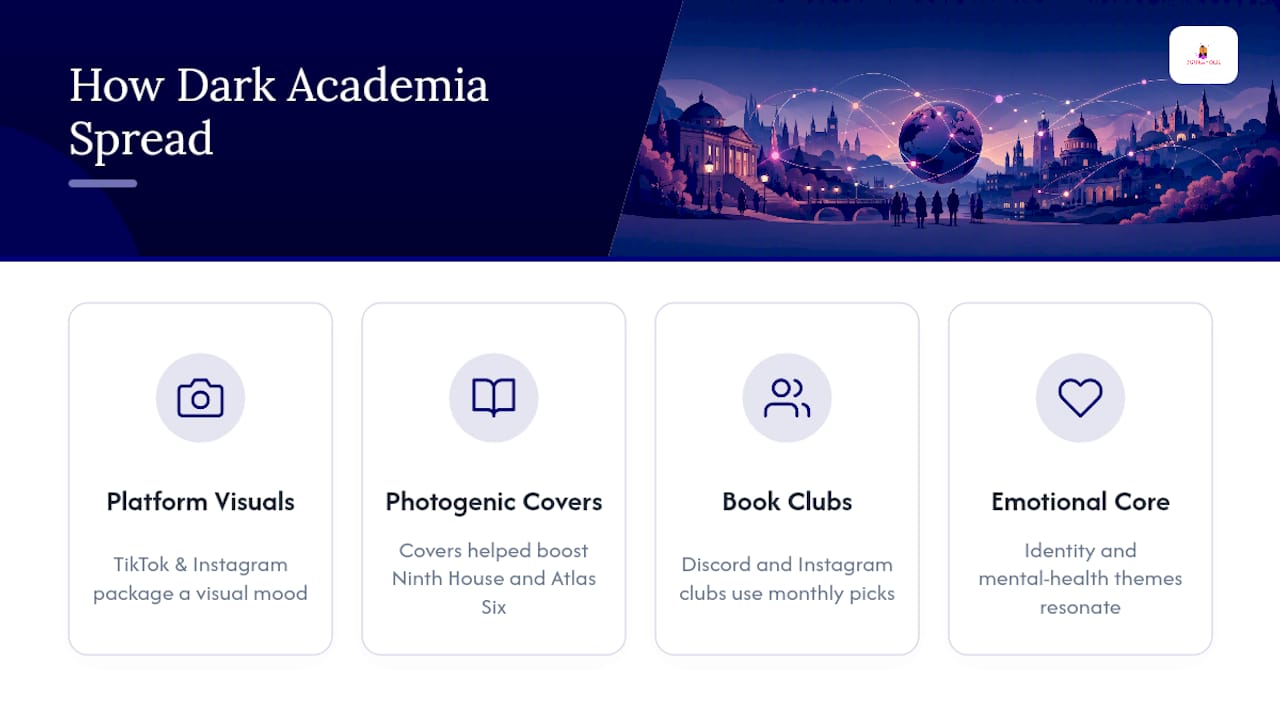
Dark academia's rise as an online aesthetic runs almost parallel to its rise as a book category, and each fed the other. TikTok and Instagram turned the look, tweed blazers, oxford shoes, stacks of worn paperbacks, into a lifestyle brand that book recommendations rode alongside. A BookTok video about The Secret History or Bunny doesn't just recommend a plot. It sells a whole visual mood, and that packaging pulled in readers who might never have picked up a literary campus novel otherwise.
That crossover changed which books get discovered. Ninth House and The Atlas Six built substantial online followings partly because they photographed well, with covers and settings that fit the aesthetic's visual language. Dark academia book clubs, both formal and informal, sprang up on Discord and Instagram, often organized around monthly picks that alternate between canonical texts and newer fantasy hybrids.
The genre's popularity with younger readers also pulled mental health and identity themes into sharper focus. Many dark academia protagonists are outsiders desperate to belong, a dynamic that resonates with readers navigating their own institutions, real or imagined. That emotional throughline, more than the tweed, is probably why the aesthetic has outlasted several other short-lived online reading trends.
Dark Academia vs. Gothic and Classic Literature
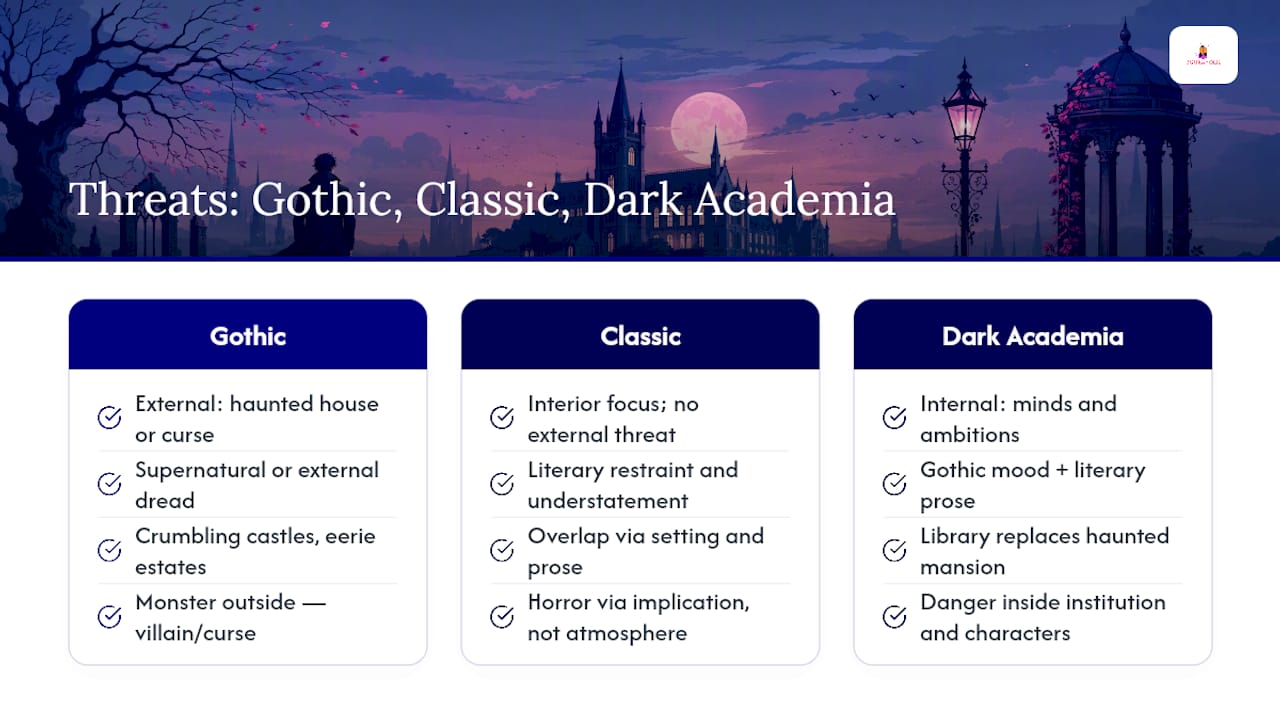
Dark academia owes an obvious debt to gothic literature, but the two aren't interchangeable. Classic gothic fiction, think crumbling castles, family curses, and supernatural dread, usually locates its horror somewhere external: a haunted house, a monstrous villain, a curse from the past. Dark academia relocates that horror inward, into the minds and ambitions of its characters. The library replaces the haunted mansion, and the "monster" is usually a student's own obsession.
Classic literature intersects with dark academia more through setting and prose style than through plot mechanics. A novel like Never Let Me Go borrows literary restraint and understatement from the broader tradition of quiet, devastating British fiction, rather than from gothic convention specifically. Its horror unfolds through implication, not atmosphere.
The clearest dividing line is stakes and tone. Gothic fiction tends toward supernatural or external threat; classic literary fiction often prioritizes character interiority without any darkness at all; dark academia sits in between, borrowing gothic mood and literary prose but insisting that the real danger comes from inside the institution, and inside the characters who love it too much.
A Curator's Note on Reading Dark Academia Well
The mistake most new readers make with dark academia is treating it as one flavor. Read The Secret History, decide you've got the genre figured out, and skip everything that doesn't sound exactly like it. That's how you miss Babel's argument about empire, or Bunny's strange comic menace, or A Deadly Education's sharp teenage voice.
Try reading against type on purpose. If you loved the slow gothic solemnity of Tartt, follow it with something that carooms off the template, like Bunny or Babel, rather than another book chasing the same mood. That contrast tends to reveal what you actually love about the genre, rather than just what you loved about one book.
Come tell us what you're reading. The Bookaholic Podcast digs into exactly this kind of genre conversation, and we'd love to know which dark academia book converted you, or which one you couldn't finish.
— Deirdre
Keep the Conversation Going With The Bookaholic Podcast
A reading list tells you what to pick up next. Author interviews tell you why the book works, and that's the gap The Bookaholic Podcast fills for readers who finish The Secret History or Babel and want to keep talking about it. If you want the industry side of that conversation, the interview with Audiofile Magazine's editor and founder Robin Whitten digs into how editors and critics actually evaluate books like these, which is a useful lens for anyone building their own dark academia shelf.

For readers drawn to the craft side of these dark, obsessive campus stories, the episode on "From Fairytales to Reality: A Young Writer's Dream" follows a writer's own path into fiction, useful listening if these books have you itching to write your own secret society plot. Press play on either one, and you'll walk away with your next three reads before the episode ends.
Sources
- Essential dark academia books — Penguin Random House
- Dark academia — NYPL blog
- Ninth House — Macmillan
FAQ
What is a dark academia book?
A dark academia book is a campus or elite-institution novel built around obsessive intellectual pursuit and a moral rot that develops from that obsession, often ending in tragedy or crime.
What is a good dark academia book to start with?
The Secret History by Donna Tartt is the genre's most commonly recommended starting point, followed closely by If We Were Villains and Ninth House for readers who want more plot momentum.
Is Harry Potter light or dark academia?
Harry Potter is light academia at most. It has the school and secrecy of dark academia but resolves around heroism and growth rather than the moral collapse that defines the darker subgenre.
Is dark academia LGBTQ?
Dark academia includes a range of queer and sapphic representation, particularly in newer entries and romance-leaning titles, though the genre as a whole spans many different identities and relationship dynamics rather than one single focus.