
Fourth Wing is a popular romantasy novel, The Hating Game is well-known for workplace banter, The Cruel Prince is favored in dark fae fantasy, and Beach Read appeals to readers who prefer lower stakes with emotional depth. For slow-burn political tension, many recommend Fourth Wing, and for laugh-out-loud rivalry, The Hating Game is a good choice. Book-a-holic's Deirdre Pippins has explored these various styles to build this shortlist.
TL;DR:
- Truly enemies-to-lovers stories require genuine conflict rooted in ideological, familial, or faction opposition, not just prickly personalities or forced proximity.
- Slow-burn romances like Fourth Wing rely on political stakes and series commitment, while standalone books like The Hating Game focus on intense workplace banter.
- Spicy adult romances often feature explicit scenes and focus on consent, with titles like Ice Planet Barbarians and The Kiss Quotient appealing to thrill-seekers.
- Effective arcs develop conflict before turning to romance, ensuring both characters’ internal growth and perspective shifts feel earned and believable.
- The strongest enemies-to-lovers narratives balance internal monologue, logical resolution of ideological differences, and sustained tension over time.
Table of Contents
- 12 Best Enemies-to-Lovers Books, Ranked
- Best Enemies-to-Lovers Books by Subgenre and Mood
- How to Choose the Right Enemies-to-Lovers Book for Your Mood
- What Actually Makes a Book Enemies to Lovers
- How Book-a-holic Curates This List
- Plot Pitfalls That Ruin an Enemies-to-Lovers Arc
- How Authors Make Enemies to Lovers Believable
- Why This Trope Keeps Pulling Readers Back In
- Want More Curated Book Lists and Author Interviews?
- Where to Find More Enemies-to-Lovers Recommendations
- Sources
12 Best Enemies-to-Lovers Books, Ranked
Enemies to lovers books work when the conflict feels earned, not decorative, and the twelve titles below cover the full range of that tension, from war rooms to office cubicles. Each entry gives you the "why" fast, so you can pick based on setting, heat level, and how much patience you have for a slow burn.
1. Fourth Wing by Rebecca Yarros. This romantasy throws a physically fragile cadet into a dragon-riding war college where the boy assigned to kill her becomes the one she can't stop watching. Best for readers who want their enemies-to-lovers wrapped in political stakes and dragon fire. Sequels continue the arc, so go in ready to commit to a series.
2. The Hating Game by Sally Thorne. Two executive assistants at a merged publishing company despise each other across a shared desk, and every meeting turns into verbal sparring. Best for readers who want office banter without a single dragon in sight. The whole book takes place over one workplace power struggle, which keeps the tension tight.
3. The Cruel Prince by Holly Black. A mortal girl raised in the fae court trades barbed insults and outright cruelty with the prince who wants her gone, until the animosity curdles into something harder to name. Best for readers who like their romance dangerous and their morality gray. This one kicks off a trilogy, and the payoff builds across all three books.
4. Beach Read by Emily Henry. A romance writer with writer's block and a literary novelist next door swap genres for the summer, sniping at each other the whole way. Best for readers who want contemporary heartbreak alongside the bickering. It's a standalone, so you get the full arc in one sitting.
5. Ice Planet Barbarians by Ruby Dixon. A human woman stranded on an alien planet clashes with a wary alien warrior before the forced proximity of survival wears down both their guards. Best for readers who want sci-fi spice with zero subtlety about the heat level.
6. Twisted Love by Ana Huang. A guarded, emotionally shut-down man and his best friend's sister spend the whole book circling hostility that's really unresolved longing. Best for readers who want New Adult drama with a brooding hero. Part of a loosely connected series, but readable on its own.
7. A Court of Thorns and Roses by Sarah J. Maas. A huntress taken captive by a fae lord she blames for her sister's death spends months in his court, resentment slowly rerouting into obsession. Best for readers who want the enemies-to-lovers arc stretched across an entire high-fantasy series.
8. Red, White & Royal Blue by Casey McQuiston. The son of the U.S. president and a British prince stage a public friendship to cover a very real feud, and the cover story becomes the real story. Best for readers who want LGBTQ+ romance with political stakes and genuinely funny dialogue.
9. The Kiss Quotient by Helen Hoang. A woman on the autism spectrum hires an escort to teach her about physical intimacy, and their prickly initial dynamic dissolves faster than either expects. Best for readers who want a spicier, more character-driven take on hate-to-love chemistry.
10. Powerless by Lauren Roberts. In a kingdom that hunts people with supernatural abilities, a girl without powers falls for the prince tasked with eliminating people like her. Best for readers who want YA stakes with real danger behind the banter. First in a trilogy.
11. Reaper by Sarah Michelle Lin. A young woman bound to a ruthless death god trades hostility for something closer to dependence as their fates tangle together. Best for readers who want darker mythology-driven romantasy with morally complicated leads.
12. The Unhoneymooners by Christina Lauren. Two people who can't stand each other end up on an all-expenses-paid honeymoon after a wedding disaster, stuck faking a relationship they didn't ask for. Best for readers who want a forced-proximity romcom with maximum comedic chaos.
Best Enemies-to-Lovers Books by Subgenre and Mood
Different readers want different flavors of conflict, so here's how the trope splits across the shelves you're most likely to browse.
Romantasy leans on factional loyalty and life-or-death stakes to make the hostility mean something.
- Fourth Wing by Rebecca Yarros, where a war college forces two political rivals into the same dragon-riding squad.
- A Court of Thorns and Roses by Sarah J. Maas, captor and captive locked in an unequal power dynamic.
- Powerless by Lauren Roberts, a hunter and her target circling each other across an entire kingdom.
- Reaper by Sarah Michelle Lin, a mortal bound against her will to a death god.
- For more titles in this vein, 12 Romantasy Books That Match Your Mood rounds up other high-stakes fantasy pairings.
YA keeps the danger real but paces the romance for a younger audience.
- The Cruel Prince by Holly Black, cruelty as currency in a fae court that punishes weakness.
- Powerless by Lauren Roberts, again, for readers who want the hunted-and-hunter dynamic without adult content.
- Serpent & Dove by Shelby Mahurin, a witch and witch hunter forced into marriage.
Spicy and adult romance turns the heat level up considerably, and consent and pacing matter here.
- Twisted Love by Ana Huang, slow-building tension between two people who spend most of the book pretending they don't want each other.
- Ice Planet Barbarians by Ruby Dixon, explicit and unapologetic about it.
- The Kiss Quotient by Helen Hoang, physical intimacy handled with more care than most books in this lane.
- Readers scanning Amazon's enemies-to-lovers best-seller lists will notice how often spicier variants dominate the rankings.
Dark romantasy trades banter for genuine menace, and the moral lines blur on purpose.
- The Cruel Prince fits here too, given how far the cruelty goes before it turns.
- Reaper, where survival and romance are tangled beyond separating.
- Mafia romance and morally gray antihero stories, a category Amazon's sales data shows readers actively seeking out.
Grumpy x sunshine and romcom lean on comedy and warmth instead of danger.
- The Hating Game by Sally Thorne, the gold standard for office rivalry banter.
- Beach Read by Emily Henry, grief and humor braided through the sniping.
- The Unhoneymooners by Christina Lauren, forced proximity played almost entirely for laughs.
- If you'd rather skip the growl and keep the warmth, Cozy Fantasy Books for Coffee Shop or Family covers lower-stakes reads with a similar comfort factor.
How to Choose the Right Enemies-to-Lovers Book for Your Mood
Run your pick through this checklist before you commit to a 400-page fantasy tome or a breezy weekend read.
- Check the pacing. Slow-burn books like The Cruel Prince stretch tension across a series; insta-conflict books like The Unhoneymooners resolve it in one sitting.
- Confirm the heat level. SFW picks like Powerless skip the bedroom scenes; spicy picks like Ice Planet Barbarians do not.
- Match the stakes to your mood. Want comfort? Beach Read. Want danger? A Court of Thorns and Roses.
- Decide on POV. Dual POV, common in romance, lets you feel both characters soften; single POV keeps the mystery of the other person's feelings intact longer.
- Pick series or standalone. Beach Read and The Hating Game wrap in one book; Fourth Wing demands a multi-book commitment.
If you want slow-burn romantasy with political stakes, read Fourth Wing. If you want a one-and-done romcom, read The Hating Game. If you want quiet, literary heartbreak, read Beach Read.
Pro Tip: Retailer tags labeling something "enemies to lovers" often mean mild bickering, not real animosity. Skim the first two chapters of a sample before buying if the description feels vague about what the two characters actually did to each other.
What Actually Makes a Book Enemies to Lovers
A real enemies-to-lovers arc needs three things: genuine animosity, something at stake beyond hurt feelings, and enough tension before intimacy that the eventual turn feels earned. Devoted readers on curated lists like Goodreads Listopia tend to draw a hard line between "true" enemies-to-lovers and softer variations, and that line matters if you're picking books based on the label.
Common variations include:
- Grumpy x sunshine, where one character is closed off and the other relentlessly warm, more temperament clash than real enmity (The Hating Game).
- Rivals by duty, where two people are pitted against each other by circumstance rather than personal history (Fourth Wing).
- Forced proximity, a mechanic publisher roundups point to again and again for converting hostility into intimacy simply by trapping two people together.
The real distinction: true enemies-to-lovers involves ideological conflict, family or faction opposition, or genuine betrayal. Grumpy characters who are just prickly, not actively opposed to each other, belong to a gentler cousin of the trope.
How Book-a-holic Curates This List
Deirdre Pippins, host of the Bookaholic Podcast, built this list by cross-referencing three signals: Goodreads shelf popularity, publisher roundups from outlets like Penguin Random House and HarperCollins, and reader buzz tracked across podcast episodes and author interviews. Titles had to show up consistently across community lists and trope fidelity checks, not just algorithmic recommendation feeds.
Several picks here came directly from author conversations recorded for the podcast, where writers discussed how they built tension into their own enemies-to-lovers arcs. That combination of aggregate data and firsthand author insight is what separates this shortlist from a generic scraped list.
Plot Pitfalls That Ruin an Enemies-to-Lovers Arc
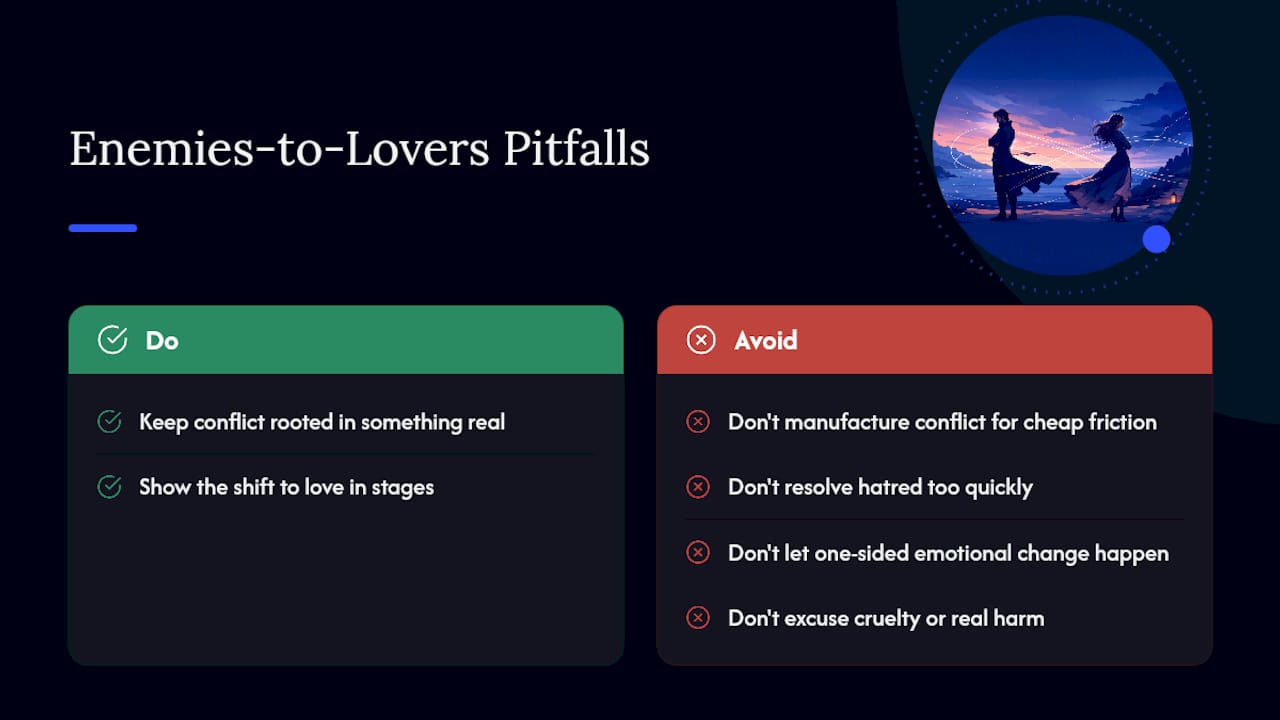
The biggest mistake is manufactured conflict, where the "enemies" part exists only because the author needed friction, not because the characters have a real reason to clash. Readers spot this fast, and it collapses the emotional stakes of everything that follows.
A second common failure is resolving the hatred too quickly. If two characters go from insults to declarations of love in fifty pages, the payoff never lands, because the tension that makes the trope work hasn't had time to build.
Third, watch for a one-sided turn, where only one character actually changes while the other's animosity evaporates without explanation. And fourth, some books lean so hard into cruelty that the eventual romance reads as a red flag rather than a satisfying arc, particularly when the "enemy" behavior crosses from tension into actual harm without narrative acknowledgment.
The best examples avoid all four by keeping the conflict rooted in something real and letting the shift toward love happen in visible stages.
How Authors Make Enemies to Lovers Believable
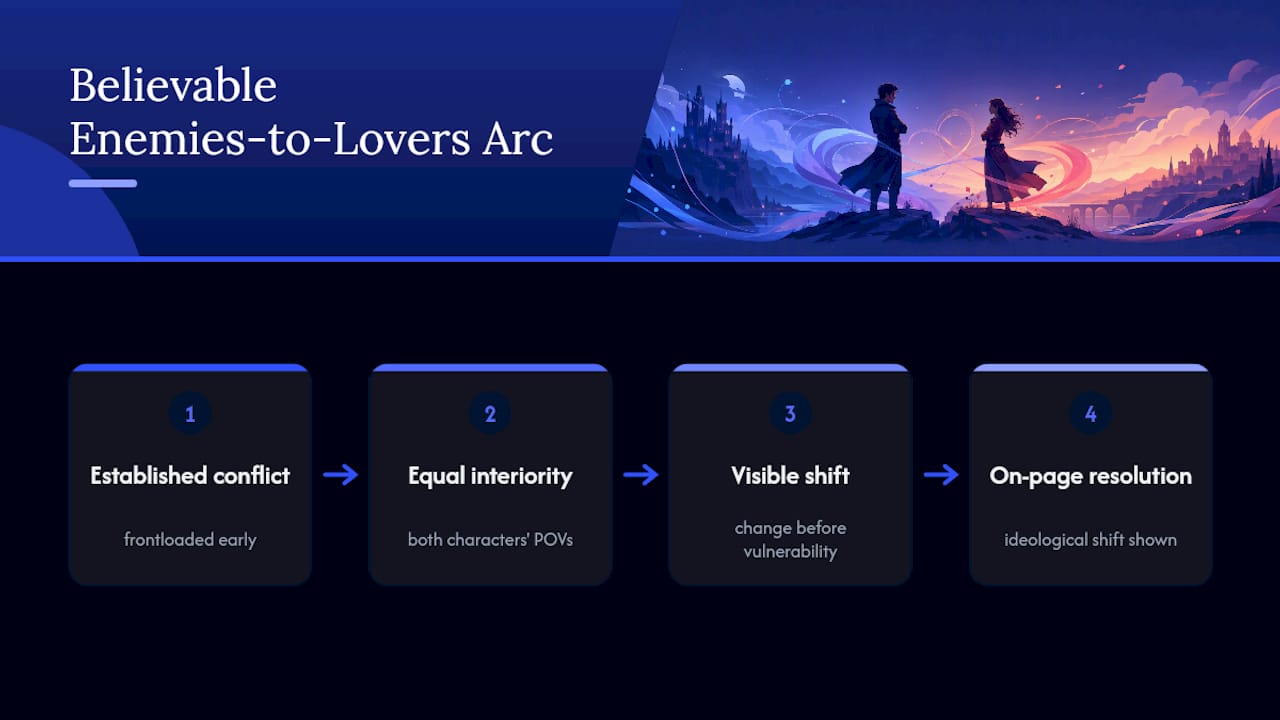
The strongest arcs frontload the conflict and hold back full vulnerability until after a real shift in the character has already happened. That sequencing matters: if a character's walls drop before the reader has seen them actually change, the reconciliation feels unearned, almost like backtracking on their own growth.
Writers who pull this off usually give both characters equal interiority. You need to understand why each person is guarded, not just the protagonist. The Hating Game works because both leads get chapters of internal monologue explaining their own defensiveness, not just their attraction. Reviewer commentary on the trope consistently points to banter and slow-building tension as the actual engine of the best examples, more than any single plot twist.
Conflict resolution has to track logically too. If two characters oppose each other over an ideological difference, that difference needs an actual resolution scene, a moment where one or both perspectives shift on the page, not off it. Skipping that scene is the fastest way to make a reconciliation feel hollow.
Why This Trope Keeps Pulling Readers Back In
I keep coming back to enemies-to-lovers books for the same reason listeners keep requesting them on the podcast: the tension does something a straightforward romance can't. There's a particular kind of pleasure in watching two people insult each other brilliantly and then slowly realize the insults were never really about hate. My personal rotation right now leans toward the romantasy lane, but the grumpy office banter of The Hating Game remains a comfort reread whenever I need something lighter.
— Deirdre
Want More Curated Book Lists and Author Interviews?
If you liked matching books to your mood here, Book-a-holic runs entire episodes built the same way, minus the reading list format. The episode "From Fairytales to Reality: A Young Writer's Dream" features Deirdre Pippins in conversation with a debut author about building believable romantic tension from scratch, including the drafting mistakes that almost sank the manuscript.

Unlike a static list you scroll past once, the podcast gives you the author's actual reasoning behind their character choices, the kind of context you won't get from a back-cover blurb. Listen to the full episode to hear how one writer turned a fairytale premise into a working manuscript, then stick around for the next themed list drop. Press play on episode 132 now and see whether the writing advice changes how you read your next enemies-to-lovers pick.
Where to Find More Enemies-to-Lovers Recommendations
For readers who want to keep browsing beyond this list, a few sources are worth bookmarking:
- The Goodreads enemies-to-lovers shelf aggregates thousands of reader votes across the entire trope.
- Penguin Random House's romance roundup offers curated publisher picks updated with new releases.
- Amazon's best-seller list for enemies-to-lovers romance tracks which titles are actually selling right now.
- For atmospheric, tension-driven reading outside romance, Slow Burn Horror Books breaks down how dread builds using similar pacing principles.
Sources
- Fourth Wing by Rebecca Yarros — Goodreads
- Enemies to Lovers: The Romance Book List — Penguin Random House
- Enemies To Lovers Books — Goodreads shelf
- Best Sellers in Enemies to Lovers Romance — Amazon