
Slow burn romance books build the relationship gradually, through emotional intimacy and delayed romantic milestones, rather than instant attraction. If you want a fast shortlist: Mariana Zapata's catalog is the gold standard for glacial pacing, and The Hating Game, The Love Hypothesis, Fourth Wing, People We Meet on Vacation, Hook, Line & Sinker, Yours Truly, and Powerless each deliver a satisfying, earned payoff. These fit readers who want tension that actually pays off, not just a couple that happens to end up together by the epilogue.
TL;DR:
- Most slow burn romances involve character growth and internal conflicts that develop before romantic milestones occur, often delaying the first kiss until late in the story.
- Entry points like Mariana Zapata's The Wall of Winnipeg and Me and Kulti emphasize extremely gradual pacing designed for readers who prefer deep emotional buildup over quick resolves.
- The "late-kiss metric" and prolonged pining are common indicators of a true slow burn, with external conflicts often used to heighten internal emotional development.
- Series-length slow burns, such as Fourth Wing and Powerless, extend the relationship development over multiple books for readers willing to wait for a longer payoff.
- Reading a sample and checking reviews for pacing signals like page count and tone help determine if a slow burn aligns with your taste and patience level.
Table of Contents
- 8 Slow Burn Romance Books Worth Starting With
- What Is Slow Burn Romance, Exactly?
- Why the Wait Actually Makes the Payoff Better
- How to Pick the Right Slow-Burn Book for You
- Slow Burn Picks by Mood and Subgenre
- Getting the Most Out of a Slow Burn
- Why Trust These Slow Burn Picks
- A Personal Note on Slow Burn
- More Slow Burn Conversations Worth Your Time
- Sources
- FAQ
8 Slow Burn Romance Books Worth Starting With
You don't need to read every slow burn novel published this decade to find the right one. You need a handful of trustworthy entry points, each doing something a little different with pacing, heat, and trope. Here's where to start.
- The Wall of Winnipeg and Me by Mariana Zapata — Best for: readers who want the slowest of the slow. Zapata built her entire career on this pacing style, and this one, about a former NFL player and his no-nonsense assistant, is widely cited as her defining work. Standalone, moderate heat, over 500 pages of patient character work.
- Kulti by Mariana Zapata — Best for: sports romance fans who like a grumpy hero thawing in real time. A retired soccer star and the woman who idolized him as a kid circle each other for hundreds of pages before anything happens. Standalone, sweet-to-moderate heat.
- The Hating Game by Sally Thorne — Best for: office rivals-to-lovers with sharp banter. Lucy and Joshua's workplace warfare simmers for most of the book before tipping into something else entirely. Standalone, moderate heat, a favorite on nearly every Goodreads slow-burn list.
- The Love Hypothesis by Ali Hazelwood — Best for: academic fake-dating with real emotional stakes. A grad student and a notoriously difficult professor fake a relationship that stops feeling fake somewhere around the halfway mark. Standalone, moderate heat.
- Fourth Wing by Rebecca Yarros — Best for: romantasy readers who want dragons and danger alongside their slow burn. Violet and Xaden's animosity curdles into something far more complicated across a full series arc. Series, moderate to high heat depending on the installment.
- People We Meet on Vacation by Emily Henry — Best for: friends-to-lovers fans who want warmth over angst. Poppy and Alex have one weird, unresolved night between them and a decade of near-misses. Standalone, sweet-to-moderate heat.
- Hook, Line & Sinker by Tessa Bailey — Best for: small-town, brother's-best-friend tension with plenty of banter. The chemistry is obvious from page one; the follow-through takes its time. Standalone (companion to It Happened One Summer), high heat.
- Yours Truly by Abby Jimenez — Best for: forced proximity in a hospital setting with genuine emotional weight. Two doctors who despise each other on sight get pushed together by circumstance, and the shift from irritation to something real is handled with real care. Standalone, moderate heat.
- Powerless by Lauren Roberts — Best for: fantasy readers who want forbidden-attraction stakes layered onto the slow build. A powerless girl and a hidden elite soldier can't act on what's growing between them without risking everything. Series, moderate heat.
That's a wide net on purpose. Some of these resolve tension within a single book; others, like Fourth Wing and Powerless, stretch the burn across a series. Both approaches work. The right one depends on whether you want closure now or you're fine waiting for book three.
What Is Slow Burn Romance, Exactly?
Slow burn romance is a structure where the central relationship develops through accumulated emotional intimacy rather than immediate physical or romantic connection. The word "slow" describes the pacing of the relationship, not the plot. A slow burn novel can move at a brisk clip on every other front while the romance itself takes its time.
This is the opposite of "insta-love," where two characters feel an undeniable pull toward each other within the first chapter or two. Slow burn readers tend to actively avoid insta-love; they want the tension to be earned through proximity, conflict, and slowly shifting perception. One character starts out annoyed, indifferent, or even hostile toward the other, and the book spends real page count changing that.
Genre readers use a few informal pacing markers to gauge how "slow" a slow burn actually is. The most common is the "late-kiss metric," basically tracking how far into the book the first kiss happens. Pining is the other tell: prolonged, often one-sided longing where a character notices every small thing about the other person long before either of them acts on it.
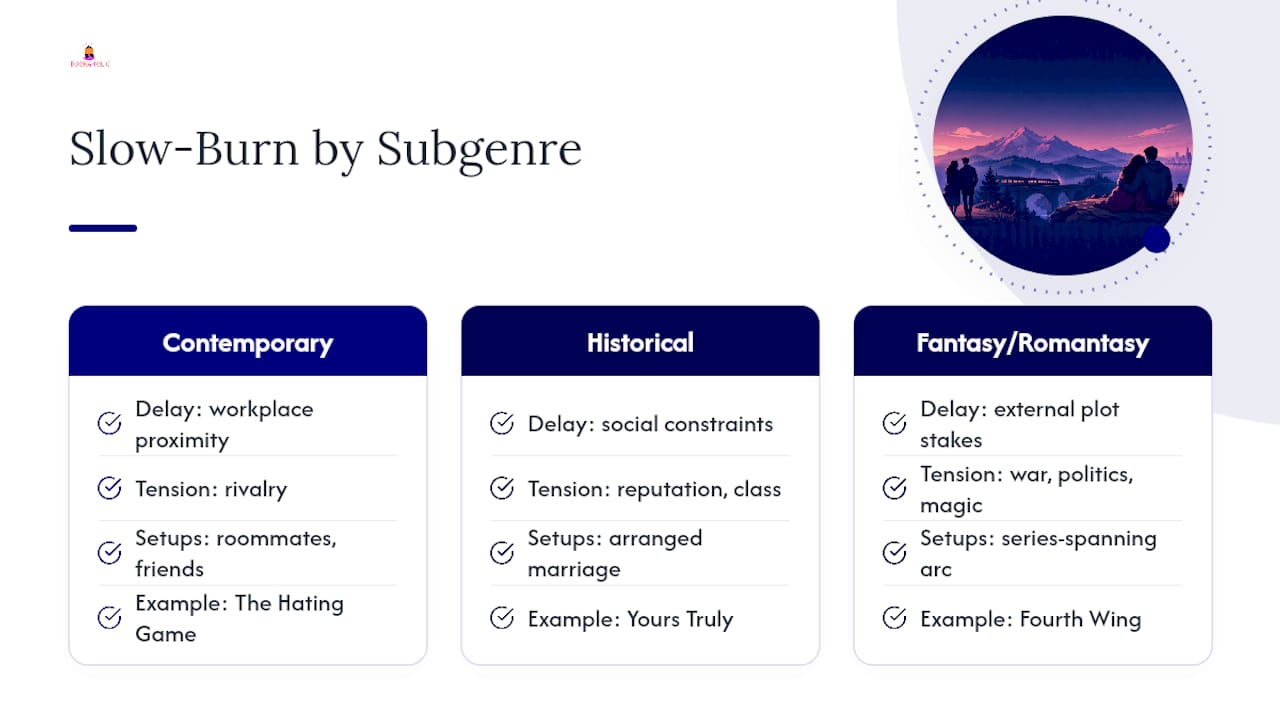
You'll find this trope doing different work across subgenres:
Contemporary romance leans on workplace tension, roommate situations, or long friendships that tip into something else. The Hating Game and Yours Truly both use professional proximity as the pressure cooker.
Historical romance often uses social constraint itself as the slow-burn engine. Characters can't act on attraction because of class, reputation, or arranged circumstances, so the burn is baked into the setting.
Fantasy and romantasy stretch the burn across an entire series, sometimes multiple books, because the romantic arc runs parallel to a larger plot involving war, magic systems, or political stakes. Fourth Wing and Powerless both use this approach, letting external danger slow down what would otherwise be an obvious pairing.
The common thread across all three: something, whether it's rivalry, distance, circumstance, or plot stakes, keeps the characters from acting on their feelings immediately. The Goodreads slow-burn list runs nearly 2,000 titles deep precisely because that "something" can take almost any form.
Why the Wait Actually Makes the Payoff Better
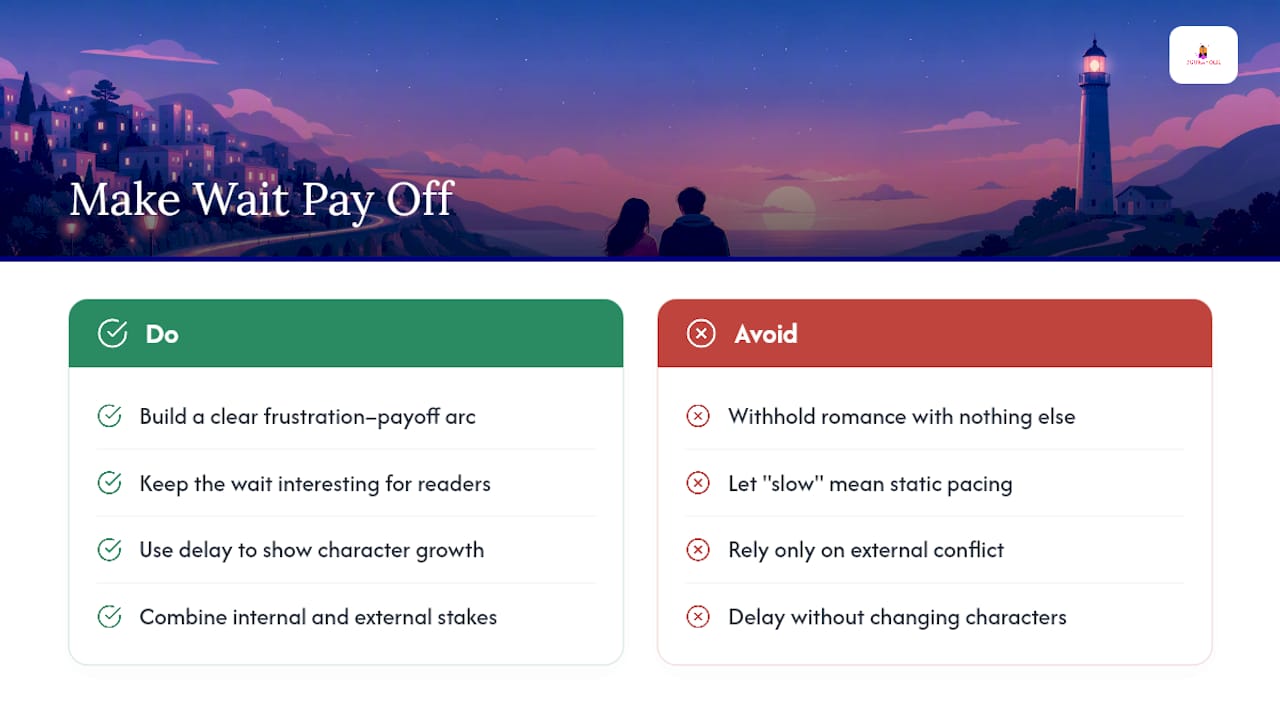
The mechanism here has a name editors actually use: the frustration-payoff dynamic. You spend hundreds of pages wanting two characters to get together, and every chapter that delays it raises the emotional stakes of the moment it finally happens. Penguin Random House's editorial team points to this dynamic as one of the primary reasons readers actively seek out slow burn instead of avoiding it.
Think about it from a craft perspective. A first kiss on page 20 is just a plot event. A first kiss on page 320, after 300 pages of near-misses, misread signals, and one character quietly falling harder than they'll admit, is a release valve. The tension you've been carrying as a reader gets discharged all at once. That's a fundamentally different reading experience, and it's why slow burn fans tend to talk about "earning" a moment rather than just reaching it.
The trade-off: slow burn only works if the wait is interesting. A book that simply withholds romance without giving you anything else to chew on just feels stalled. BookRiot's breakdown of the slowest slow-burns makes this point directly: the books that pull off a truly glacial pace need tighter plotting and richer character work to keep readers engaged while the relationship builds. "Slow" cannot mean "static."
That's where character growth earns its keep. The best slow burns use the delay to actually change the people involved. Zapata's heroes don't just wait around for the plot to let them kiss the heroine. They spend the book confronting their own defensiveness, grief, or pride. When The Wall of Winnipeg and Me's central pairing finally shifts, it lands because both characters are different people than they were at the start, not because enough pages have passed.
Obstacles matter too, but only the right kind. External conflict (a work deadline, a family crisis, a war) can raise stakes without actually developing the romance. Internal conflict (fear of vulnerability, past betrayal, mismatched priorities) does the real work. The strongest slow burns usually combine both, using external pressure to force internal reckonings.
How to Pick the Right Slow-Burn Book for You
Not every slow burn is the same kind of slow, and picking blind is how readers end up either impatient or underwhelmed. Run through this before you commit:
- Check your pacing tolerance. Do you want pining that lasts through 90% of the book, or a moderate build that resolves by the midpoint? These are genuinely different reading experiences, and mismatching expectations is the number one reason readers abandon a slow burn.
- Confirm the heat level. Slow burn describes pacing, not explicitness. A book can be a glacial slow burn and still be entirely closed-door, or it can be a slow burn that turns explicit once the tension finally breaks. Check the book's marketing copy or a retailer's content description before assuming either way.
- Identify the trope you actually want. Friends-to-lovers reads differently than enemies-to-lovers, which reads differently than forced proximity or second chance. Picking the trope first narrows your options fast.
- Weigh the page count and series commitment. A 300-page standalone resolves its burn in one sitting. A series like Fourth Wing or Powerless stretches that burn across multiple books, which is either a feature or a dealbreaker depending on your patience.
- Sample the author's voice before buying. Slow burn lives or dies on internal narration, so a first-chapter sample tells you more than a blurb ever will.
Blurbs are notoriously vague about pacing on purpose (publishers don't want to spoil the slow build), so lean on other signals. Reader ratings and review text on retailer pages often flag exactly how slow a "slow burn" runs. Content warnings, when publishers include them, can also hint at heat level and emotional intensity without giving away plot specifics.
Pro Tip: If you want a high-heat payoff, look for retailer or publisher language around "spice level" or explicit content warnings; a resource like Maroon House Press's guide to erotic romance categories is useful for understanding how heat levels get labeled across the genre. If you want a sweet payoff instead, look for "closed door" or "fade to black" in the book's description, both signal the tension resolves emotionally rather than explicitly.
Slow Burn Picks by Mood and Subgenre
Sometimes the author doesn't matter as much as the feeling you're chasing tonight. Here's the shortlist organized by mood.
Cozy and sweet slow burns, for when you want warmth without heavy angst:
- People We Meet on Vacation by Emily Henry (standalone, sweet-to-moderate heat)
- Kulti by Mariana Zapata (standalone, sweet-to-moderate heat)
Angsty, pining-heavy slow burns, for readers who want the ache to hurt a little:
- The Wall of Winnipeg and Me by Mariana Zapata (standalone, moderate heat)
- Yours Truly by Abby Jimenez (standalone, moderate heat)
Enemies-to-lovers slow burns, for the specific pleasure of hostility turning into something else entirely:
- The Hating Game by Sally Thorne (standalone, moderate heat)
- Hook, Line & Sinker by Tessa Bailey (companion novel, high heat)
If enemies-to-lovers is your favorite trope on its own merits, a dedicated enemies-to-lovers reading list rounds out the picks here with more standalone options.
Fantasy and romantasy slow burns, for readers who want stakes bigger than a single relationship:
- Fourth Wing by Rebecca Yarros (series, moderate to high heat)
- Powerless by Lauren Roberts (series, moderate heat)
Readers building out a full romantasy shelf should also check a broader romantasy recommendation guide for more series-driven slow burns beyond these two.
High-heat slow burns, for when you want the tension to break in a very specific way:
- Hook, Line & Sinker by Tessa Bailey (companion novel, high heat)
- Fourth Wing by Rebecca Yarros (series, moderate to high heat, intensifying in later books)
The overlap here isn't an accident. Several of these titles work across multiple moods at once, which is exactly why they show up on nearly every curated slow-burn list, including Bookshop.
Getting the Most Out of a Slow Burn
Set your expectations around page count before you start. Knowing that going in keeps you from mistaking normal slow-burn pacing for a stalled plot.
Sample chapters and audiobook narration are underrated tools here. A few pages tell you whether the author's internal narration style, the thing you'll be living inside for 300+ pages, actually works for you. If the voice grates in chapter one, it won't improve by chapter twenty.
If the tension is building (glances lingering, dialogue getting sharper, small moments of vulnerability), stick with it. If nothing has shifted in either character's perception of the other by then, the book likely isn't building toward anything, it's just stalling. BookRiot's own analysis of the genre's slowest entries backs this up: the ones that work use every one of those early pages to develop character, not just delay plot.
Why Trust These Slow Burn Picks
These recommendations come from a mix of editorial reading, community consensus, and reader ratings, not a single opinion pulled out of thin air. Titles that show up repeatedly across Goodreads' Listopia slow-burn list, reader threads, and curated retailer collections earned their spot here because multiple independent sources agree on them, not because one list happened to feature them.
The curation leans on a layered approach: editorial reads combined with community signals and ratings history, cross-checked against what genre readers are recommending to each other in real time. If you want to hear authors talk through how they build romantic tension on the page, The Bookaholic Podcast covers exactly that kind of craft conversation in its author interviews.
A Personal Note on Slow Burn
I'll admit it: I'm a pining apologist. Give me two characters who are clearly falling for each other while insisting, loudly, that they're not, and I'm locked in for however many pages it takes. My go-to recommendation when someone asks where to start is almost always The Wall of Winnipeg and Me. It's slow in the way a good simmer is slow, nothing rushed, nothing wasted, and when it finally pays off, you understand exactly why it took that long. That's the whole appeal of this trope, and it's why I keep coming back to it.
— Deirdre
More Slow Burn Conversations Worth Your Time
If these picks got you thinking about how authors actually construct that tension, the craft conversation is worth hearing straight from the source. Book-a-holic's episode "From Fairytales to Reality: A Young Writer's Dream" digs into how a working author builds a romantic arc from scratch, including the pacing decisions that separate a satisfying slow burn from a stalled one.

For a wider industry lens on how editors and critics evaluate pacing and voice across the genre, the "Audiofile Magazine" episode with editor and founder Robin Whitten breaks down what makes narration work for slow, character-driven stories specifically, useful if you're deciding between a physical copy and an audiobook for your next pick. And if you're curious how writers themselves think through the mechanics of delayed romantic tension, the Writers' Workshop episode with international guest Lauca walks through the drafting choices behind a slow-building story. Start with whichever episode matches what you're most curious about, then work your way through the catalog from there.
Sources
- Slow-Burn Romance (1952 books) — Goodreads
- Slow-burn romances to read now — Penguin Random House
- 10 of the slowest slow-burn romances ever written — BookRiot
FAQ
What are some good slow burn romance books?
The Wall of Winnipeg and Me by Mariana Zapata, The Hating Game by Sally Thorne, and The Love Hypothesis by Ali Hazelwood are consistently ranked among the best entry points, alongside Fourth Wing and Yours Truly for readers who want a series or a hospital-set forced-proximity setup.
What is the best slow burn romance series?
Fourth Wing by Rebecca Yarros and Powerless by Lauren Roberts both stretch their central romance across multiple books, using series-length stakes to slow the burn even further than a standalone could.
What are some good slow burn romantic stories?
Beyond the contemporary picks, Kulti and The Wall of Winnipeg and Me by Mariana Zapata are the genre's benchmark for a slow, character-driven build, while People We Meet on Vacation offers a softer, friendship-first version of the same structure.
What is considered slow burn romance?
Slow burn romance is any story where the central couple's relationship develops gradually through emotional intimacy rather than immediate attraction, with romantic milestones like a first kiss often delayed until well past the book's midpoint.