
If you buy one shelf of books on writing, make it these: On Writing for craft-meets-memoir motivation, Writing Down the Bones for building a daily habit, The Elements of Style for sentence-level clarity, Bird by Bird for taming perfectionism, and Story for structure. Building a habit? Start with Goldberg. Chasing cleaner sentences? Start with Strunk and White. Want to understand how plots actually work? Start with McKee.
TL;DR:
- Most writers need a combination of mindset and habit books, like Goldberg's Writing Down the Bones and Cameron's The Artist's Way, to build consistency.
- Sentence-level craft and clarity are best improved with manuals like The Elements of Style and exercises from Steering the Craft by Le Guin.
- Structural understanding benefits from books like McKee's Story, which helps diagnose why scenes or drafts stall, especially for intermediate and advanced writers.
- Active engagement in exercises, immediate application, and revising using reference rules accelerate progress far more than passive reading of entire books.
- Pairing a habit or mindset book with a practical craft manual yields the most comprehensive development and keeps practice aligned with technical improvement.
Table of Contents
- The Best Books on Writing, Organized by What You Actually Need
- Why These Particular Books Keep Showing Up on Every List
- How to Actually Read These Books Without Wasting Them
- Why Trust This List
- Fiction, Memoir, Poetry: Which Books Fit Which Genre
- From Strunk and White to King: How Writing Advice Has Changed
- Where These Books Agree, and Where They Sharply Disagree
- Which Books to Start With at Your Stage
- Beyond the Bookshelf: Workshops, Courses, and Writing Communities
- A Note From Deirdre
- Pair Your Reading With the Bookaholic Podcast
- Sources
- FAQ
The Best Books on Writing, Organized by What You Actually Need
Walk into any bookstore's writing section and you'll find fifty titles promising to unlock your inner novelist. Most of them repeat the same six ideas in different fonts. The Center for Fiction makes a point worth repeating: there's no single "essential" list, because what helps you depends on whether you need mindset, structure, or sentence-level repair work. So instead of ranking these best books for writers by vague prestige, here they are grouped by the problem each one solves.
For daily practice and habit building:
- Writing Down the Bones by Natalie Goldberg. Goldberg's central idea, writing from "first thoughts" before your inner editor wakes up, has anchored practice-based writing instruction for over three decades. It helps with: getting words on the page without stalling out on perfection. Try tonight: set a timer for ten minutes and write without lifting your pen, even if you write "I don't know what to write" five times in a row.
- The War of Art by Steven Pressfield. This one names the enemy, what Pressfield calls Resistance, and treats it as a force you fight daily rather than a personality flaw. It helps with: showing up on the days you don't feel like a writer at all. Try tonight: identify the specific hour you keep skipping, and protect it like an appointment you can't cancel.
For sentence-level craft and clarity:
- The Elements of Style by William Strunk Jr. and E.B. White. This slim manual remains a compact reference for clear rules of usage and composition, decades after its first printing. It helps with: cutting flabby prose down to something readable. Try tonight: take one paragraph you wrote this week and remove every word that isn't doing work.
- Steering the Craft by Ursula K. Le Guin. Le Guin built this as a workbook with exercises, not a book to read passively on the couch. It helps with: sentence rhythm, point of view, and narrative voice. Try tonight: rewrite one paragraph in a different point of view and see what changes.
For story structure and plotting:
- Story by Robert McKee. Originally built from McKee's screenwriting seminars, this is the book most working writers cite when they need to understand why a scene isn't landing. It helps with: diagnosing structural problems in a stalled draft. Try tonight: outline the last short story or chapter you wrote as a three-act structure and see where it breaks down.
For revision and the messy middle:
- Bird by Bird by Anne Lamott. Lamott's famous advice, take the assignment "bird by bird," reframes an overwhelming project as a series of small, doable tasks. It helps with: getting past the paralysis of a blank page or an unfinished draft. Try tonight: write one paragraph describing a single object on your desk, nothing more ambitious than that.
- Writing Fiction by Janet Burroway. This is closer to a college textbook than a bedside read, built to be worked through with exercises rather than skimmed. It helps with: understanding craft elements like scene, summary, and character from the ground up.
For creativity and inspiration:
- The Artist's Way by Julia Cameron. Cameron's twelve-week program leans on morning pages and weekly "artist dates" to loosen up blocked creative energy. It helps with: writers who feel dry, stuck, or disconnected from why they wanted to write in the first place.
- On Writing: A Memoir of the Craft by Stephen King. Part memoir, part master class, this book works for readers who want both a good story and usable advice on adverbs, dialogue, and revision. It helps with: staying motivated while also picking up concrete tools.
- On Writing Well by William Zinsser. Zinsser's focus on nonfiction and clarity makes this the pick for anyone whose writing life involves essays, memoir, or journalism rather than fiction. It helps with: stripping clutter from nonfiction prose without losing your voice.
Pro Tip: Don't buy all nine at once. Pick one mindset book and one craft manual, read them in the same month, and let them talk to each other. A habit book without a craft manual leaves you writing loosely forever; a craft manual without a habit book gives you rules you never practice.
Why These Particular Books Keep Showing Up on Every List
These titles repeat across recommended reading lists for a reason: they cover different jobs, and a writer usually needs more than one job done at once.
Mindset and habit books, think Goldberg, Cameron, Pressfield, solve the problem of not writing. They exist because the hardest part of a writing life often isn't talent, it's consistency. Technical and reference manuals, think Strunk and White, Burroway, solve a different problem: writing badly without knowing why. You can write every single day and still produce sentences that wander, scenes that drag, or dialogue that clunks. Rules-based books exist to catch what habit alone can't fix.
The memoir-plus-instruction format, King's On Writing being the clearest example, works because story sticks better than a bulleted rule. You remember King's advice about adverbs because you remember the story about his mother's opinion of them.
Pair books strategically rather than collecting them randomly:
- Habit book + craft manual: Writing Down the Bones with The Elements of Style covers both fluency and correctness.
- Mindset book + structure manual: The War of Art with Story covers both showing up and knowing what you're building.
- Memoir-instruction + workbook: On Writing with Steering the Craft covers motivation and hands-on exercise.
How to Actually Read These Books Without Wasting Them
Reading a craft book cover to cover, then setting it on a shelf, wastes most of what it offers. These books work as workbooks, and skipping the exercises is the single most common reason readers finish one and feel like nothing changed.
Three sample four-week plans:
- Habit-first plan: Week one, read the opening third of Writing Down the Bones and do a ten-minute freewrite daily. Week two, continue the freewrites and read the middle section. Weeks three and four, keep writing daily while reading The War of Art in parallel, using it to name whatever excuse showed up that week.
- Craft-intensive plan: Week one, read two chapters of Writing Fiction and do the paired exercise from each. Week two, read The Elements of Style front to back (it's short) and revise one page of your own writing using three rules from it. Weeks three and four, work through Steering the Craft exercises, one per sitting.
- Balanced long-term plan: Alternate weeks, one week of pure practice using Bird by Bird prompts, the next week studying one chapter of Story and applying its structural lens to something you're drafting.
The actual mechanics: read one chapter, then immediately write a 300 to 500-word piece tied to its lesson, then revise that piece using one specific rule from a reference book like The Elements of Style. Repeat twice a week. That loop, read, apply, revise, is what separates writers who improve from writers who just accumulate books.
Red flags to watch for: if you're highlighting sentences but skipping every exercise, you're collecting quotes, not building skill. If you finish a chapter and can't name one thing you'll do differently tomorrow, reread the chapter's exercises before moving on. Our writing prompts guide offers a stock of ready-made exercises if a book's built-in prompts run dry.
Pro Tip: Keep a single notebook page per book titled "What I'm supposed to do differently now." Update it after every chapter. It turns a passive read into an active contract with yourself.

Why Trust This List
These recommendations didn't come from a random scroll through bestseller charts. Some podcasts have spent seasons interviewing working authors about the books that shaped their process, and certain titles come up again and again in those conversations, regardless of genre.
The pattern holds across the Center for Fiction's own curated list: writers rarely point to one perfect book. They point to a small cluster that covers mindset, mechanics, and structure together. That's the same logic behind grouping this shortlist by use-case instead of by popularity ranking.
If you want the exercises in this list paired with more prompts, our guide on building a reading list you'll actually finish covers the pacing side of this problem in more detail.
Fiction, Memoir, Poetry: Which Books Fit Which Genre
Not every book on this shelf serves every kind of writer equally, and matching the book to your genre matters more than most reading lists admit.
Fiction writers get the most direct value from Story, Writing Fiction, and Steering the Craft, since all three build their exercises around scene, character, and point of view. Bird by Bird also leans fiction and personal essay, with Lamott's own background as a novelist showing through her examples.
Nonfiction and memoir writers should weight their shelf toward On Writing Well, built specifically around clarity and structure in essays and reported prose, and On Writing, which blends memoir with fiction craft but still offers plenty for anyone writing narrative nonfiction. Poets are underserved by this particular list; most poetry craft advice lives in workshop anthologies rather than the mass-market titles that dominate general writing-advice lists, though the sentence-level attention in Steering the Craft still transfers well.
Writers working across languages face a slightly different challenge, since craft advice built for English sentence structure doesn't always transfer cleanly. If you're developing writing skills in a second language, resources like this practical guide to writing in Spanish or this French writing improvement plan tackle the mechanics that general English craft books simply don't cover.
From Strunk and White to King: How Writing Advice Has Changed
The Elements of Style dates back to a Cornell professor's private printing for his own students, later revised and expanded by E.B. White decades later. Its rules-first approach, short sentences, active voice, cut needless words, reflects an era when writing instruction meant correction more than encouragement.
Contrast that with Writing Down the Bones, published decades later, which flipped the emphasis toward permission rather than rules. Goldberg's writing-practice movement borrowed as much from Zen meditation as from composition theory, treating the blank page as a spiritual exercise rather than a grammar test.
By the time On Writing arrived, craft advice had folded memoir into the mix entirely. King's book assumes you already know you want to write and spends its energy on the emotional terrain, fear, rejection, persistence, alongside concrete technique. The Artist's Way, published in the early 1990s, pushed even further into therapeutic territory, treating blocked creativity as something to heal rather than discipline away.
The through line across nearly a century of writing advice is a slow shift from "here are the rules" to "here is how to keep going," with the strongest modern books, Bird by Bird, The War of Art, doing both at once. Newer craft manuals increasingly borrow from all three eras rather than picking one lane.
Where These Books Agree, and Where They Sharply Disagree
Every book on this shelf agrees on one thing: writing improves through repetition, not inspiration alone. Goldberg calls it practice. Cameron calls it morning pages. Pressfield calls it showing up to fight Resistance. Different vocabulary, same underlying claim.
Where they split is on how much structure helps versus hurts. McKee's Story treats structure as liberating, a scaffold that lets you build something ambitious without collapsing under its own weight. Goldberg's approach treats too much structure as a threat to honest first thoughts, worried that planning kills the raw material before it hits the page.
They also disagree on revision timing. Strunk and White's rules-based approach implies you should write cleanly the first time, or close to it. Lamott's Bird by Bird argues the opposite explicitly, that a "sh***y first draft" is not just acceptable but necessary, and that revision is where the real writing happens. Burroway's Writing Fiction splits the difference, treating early drafts as legitimate experiments in structure while still expecting eventual discipline in execution.
None of these contradictions mean one book is wrong. They mean different books suit different points in your process, loose and generative early on, structured and disciplined later.
Which Books to Start With at Your Stage
Beginners drowning in advice should start narrow: one habit book, Writing Down the Bones or Bird by Bird, paired with The Elements of Style for basic mechanics. Skip Story entirely at this stage; structural theory means little until you have pages of your own to apply it to.
Intermediate writers, meaning you've finished at least one full draft of something, benefit most from Steering the Craft and Writing Fiction, both built around exercises rather than passive reading. This is also the stage where Story starts paying off, since you now have a draft with actual structural problems to diagnose against McKee's framework.
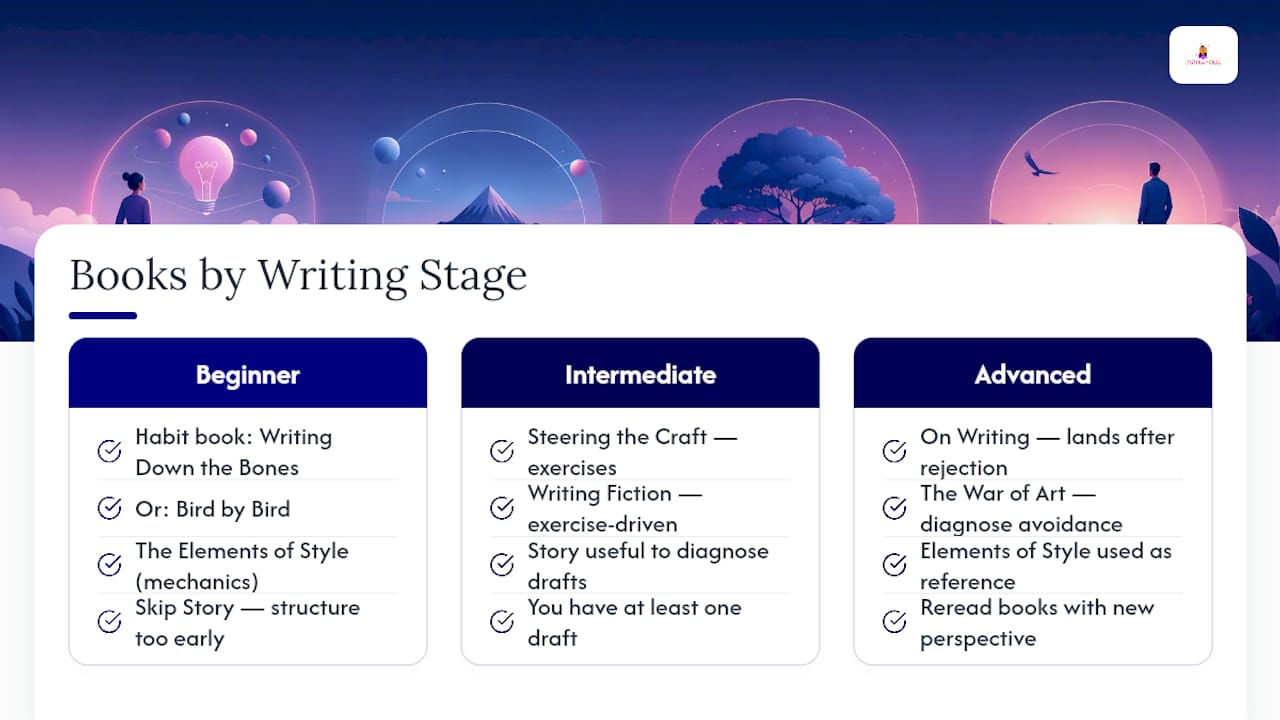
Advanced writers revisiting these books tend to reread them differently. On Writing lands harder once you've faced actual rejection. The War of Art reads less like motivation and more like diagnosis once you recognize your own specific avoidance patterns. Experienced writers often keep The Elements of Style as a reference rather than a read, dipping in during revision rather than working through it front to back.
If you're not sure where you land, the honest test is this: pick up Story and see if it means anything yet. If the structural language feels abstract, you're still in beginner territory. If it feels like it's naming problems you've already run into, you're ready for it.
Beyond the Bookshelf: Workshops, Courses, and Writing Communities
Books get you most of the way there, but the isolation of solo reading has limits, especially for feedback on your own pages. Every title on this list works better paired with some form of community or structured practice outside the book itself.
Local and online writing workshops give you what no book can: a reader's honest reaction to your specific sentences. Many writing programs and continuing-education centers run workshops built directly around craft books like Writing Fiction, using its exercises as assigned homework with peer feedback attached. Online courses, ranging from single-weekend intensives to multi-month programs, often follow the same structure as the sample plans in this article: read a chapter, write to a prompt, revise with feedback.
Writing communities, whether a local critique group or an online forum, solve the accountability problem that habit books like Writing Down the Bones can't solve on their own. A book can tell you to write daily; a group that expects pages from you on Thursday actually makes you do it.
If you're building toward publication rather than just skill, it helps to understand the full arc ahead of time. Our guide to getting a book published walks through what happens after the craft work is done, and pairs well with any of the structure-focused books on this list once you have a finished draft in hand.
A Note From Deirdre
I keep coming back to the same recommendation when a listener asks where to start: Writing Down the Bones, because it removes the pressure to be good before you've even started being consistent. Craft comes later. Habit comes first, or nothing else on this list matters. Pick one book from this shortlist, commit to one of the four-week plans above, and give yourself permission to write badly for the first two weeks. That's the whole plan.
— Deirdre
Pair Your Reading With the Bookaholic Podcast
Reading these craft books solo gets you far, but hearing working authors talk through their own messy drafts, rejections, and breakthroughs fills in what no instruction manual can. Podcasts like this one aim to bridge the gap between what a craft book teaches and what it actually feels like to live the writing life day to day.

If you're working through a habit-building plan like the one above, our episode "From Fairytales to Reality: A Young Writer's Dream" pairs naturally with Bird by Bird or The Artist's Way, since it follows a young writer's actual path from first attempts to finished work. If you're more curious about the production side of storytelling, especially once you've started thinking about structure the way Story teaches, our conversation with Audiofile Magazine's Robin Whitten offers a different lens on how narrative craft translates to audio. Queue up an episode next time you're between chapters, and let it do the work a book alone can't: make the writing life feel less solitary.
Sources
These recommendations draw on publisher pages, author sites, and public-domain texts rather than secondhand summaries. Each source below lets you read further or buy directly:
- Writing Down the Bones by Natalie Goldberg
- Essential Books for Writers | The Center for Fiction
- The Elements of Style — Project Gutenberg eBook
FAQ
What is the best book on writing for beginners?
Writing Down the Bones by Natalie Goldberg works best for absolute beginners because it prioritizes building a daily habit over getting things technically right, which removes the pressure that stalls most new writers.
What is the best book to learn writing craft and technique?
Story by Robert McKee and Writing Fiction by Janet Burroway are the strongest picks for learning technical craft, covering structure, scene-building, and character in a workbook format built for practice, not just reading.
What is the 2/3-1 rule in writing?
There's no single agreed-upon definition of a "2/3-1 rule" in the craft books covered here, and it doesn't appear in the major texts referenced in this list, so treat any specific claim about it with caution.
What are the 5 C's of effective writing?
Definitions of the key "C's" vary by source, and none of the major books on writing in this list define a canonical version, so there's no single standard answer worth stating as fact.
Should I read these books in order, or pick just one?
Pick one habit or mindset book and one craft manual to start, rather than reading all nine straight through; pairing two complementary titles, like Writing Down the Bones with The Elements of Style, builds both consistency and clarity faster than reading in sequence.