
Start with Boundaries by Dr. Henry Cloud and Dr. John Townsend if you want the classic primer, Set Boundaries, Find Peace by Nedra Glover Tawwab if you want a therapist-built workbook, and The Book of Boundaries by Melissa Urban if you want scripts you can copy word for word. Add Where to Draw the Line by Anne Katherine for everyday case studies. Pick one based on whether you want theory, exercises, or exact language for the hard conversation.
TL;DR:
- Choosing the right boundaries book depends on whether you prefer theory, exercises, or ready-to-use scripts for specific situations.
- Pairing a conceptual book like Cloud and Townsend with a practice-heavy workbook like Urban's scripts significantly improves actual boundary-setting skills.
- Focus on relationship context: family, work, or romantic boundaries require different approaches and language for effective change.
- If trauma or sensory overwhelm underlies boundary difficulties, supplement reading with therapy rather than relying solely on books.
- Practice daily, starting with low-stakes conversations, to transform insights into real boundary-setting behavior and confidence.
Table of Contents
- The Best Books About Boundaries, Ranked by What They Actually Do
- Which Book Fits Your Situation Right Now?
- How to Pick the Right Boundary Book for You
- Turning a Boundaries Book Into an Actual Skill
- Why Book-a-holic Curates These Titles This Way
- What Actually Moves the Needle on Boundaries
- Keep the Conversation Going Past the Last Page
- Sources
The Best Books About Boundaries, Ranked by What They Actually Do
Every book on this list earns its place for a specific reason, not just because it topped a bestseller chart somewhere. Some are frameworks. Some are toolkits. A couple are practically phrasebooks for the conversations you've been avoiding. Here's how they break down.
-
Boundaries: When to Say Yes, How to Say No to Take Control of Your Life — Dr. Henry Cloud & Dr. John Townsend. This is the book that started the modern boundaries conversation for a lot of readers, and it's sold millions of copies for a reason. Cloud and Townsend, both clinical psychologists, build the case that boundaries aren't selfish or cold. They're the property lines that let relationships function without resentment quietly rotting underneath them. The updated and expanded edition folds in digital-age boundary problems (texting, social media, always-on work culture) that the original 1992 edition couldn't have anticipated. Best for readers who want the "why" fully mapped out before they touch the "how."
-
Set Boundaries, Find Peace — Nedra Glover Tawwab. Published in 2021, this is where a lot of readers go after Cloud and Townsend, because Tawwab is a licensed therapist who builds her guidance on cognitive behavioral therapy techniques rather than pure theory. The book walks through boundary violations by relationship type (parents, partners, friends, coworkers) and gives you language and exercises for each. It reads less like a lecture and more like sitting across from a clinician who's heard every excuse for why you "can't" say no.
-
The Book of Boundaries — Melissa Urban. If scripts are what you're after, this November 2023 release is the heaviest hitter on the list, with more than 130 ready-to-use scripts and templates for situations ranging from declining a wedding invitation to shutting down unsolicited diet talk. Urban, the founder of the Whole30 program, writes with a directness that some readers find refreshing after wading through more clinical texts. Best for people who know exactly what they need to say but freeze the moment they open their mouth.
-
Where to Draw the Line — Anne Katherine. An older title that's stayed relevant because it's built almost entirely around case studies of everyday boundary decisions: how much to share with a coworker, when to end a phone call, what to do when a relative overstays a visit. It's less theoretical than Cloud and Townsend, more situational than Tawwab. Good for readers who learn best by seeing a problem played out rather than reading a framework.
-
The Set Boundaries Workbook — Nedra Glover Tawwab. The companion workbook to Tawwab's main title, built around checklists, writing prompts, and structured exercises rather than narrative chapters. If you finished Set Boundaries, Find Peace and felt like you understood it but hadn't actually done anything differently, this is the fix.
-
The Assertiveness Workbook — Randy J. Paterson. A staple of clinical reading lists that keeps showing up in fresh roundups, including a 2026 New York Times Well feature on boundary-setting books. It's more clinical than Urban's scripts, built on structured self-assessment and skill-building exercises rather than relationship anecdotes. Best for readers who like homework.
-
Codependent No More — Melody Beattie. A foundational text for anyone whose boundary problems trace back to a pattern of overfunctioning for other people's emotions, moods, or crises. Older than most titles here, but the core insight (that caretaking someone past the point of health helps no one, including the caretaker) hasn't aged out of relevance.
-
The Highly Sensitive Person — Elaine N. Aron. Not a boundaries book on its surface, but essential for readers whose boundary struggles stem from sensory or emotional overwhelm rather than people-pleasing alone. Aron's framework helps explain why certain boundary violations feel unbearable to some readers and barely register for others.
-
Daring Greatly — Brené Brown. Useful less for scripts and more for the emotional groundwork: why setting a boundary triggers shame, and how to tolerate that discomfort without abandoning the boundary halfway through. Pairs well with any of the script-heavy titles above.
Pro Tip: Don't read a boundaries book cover to cover and expect the skill to stick. Read one chapter, try the exercise or script that same week, and only then move to the next chapter. The books that build in exercises (Tawwab's workbook, Urban's scripts) are designed for exactly this rhythm.
Which Book Fits Your Situation Right Now?
The right book depends less on how much you already know about boundaries and more on the specific relationship or context giving you trouble. Here's how to match the two.
-
New to the topic entirely: Start with Boundaries by Cloud and Townsend. You need the concept before you need the tactics, and this book builds that foundation without assuming prior knowledge.
-
Struggling with family, especially parents: Set Boundaries, Find Peace devotes real attention to family dynamics, where guilt runs highest and old patterns run deepest. Pair it with The Set Boundaries Workbook if reading alone isn't translating into action.
-
Workplace boundaries, including overwork and scope creep: The Book of Boundaries has scripts built specifically for professional contexts. If burnout is the underlying driver, a piece like this work-life balance and health guide fills in the physical toll that unchecked overwork takes.
-
Codependency or chronic caretaking patterns: Codependent No More addresses the root pattern directly, while Set Boundaries, Find Peace offers the day-to-day language to act on what Beattie's book helps you recognize.
-
Romantic relationships: Where to Draw the Line offers relationship-specific case studies that feel less clinical and more like watching a scenario unfold, which some readers find easier to apply than pure frameworks.
-
Trauma-informed or high sensitivity concerns: Pair The Highly Sensitive Person with a gentler entry point like Boundaries rather than jumping straight into script-heavy books, which can feel transactional before the emotional groundwork is laid.
-
Digital and technology boundaries: The updated edition of Boundaries addresses this directly, and a piece on information overload and attention limits is worth reading alongside it if constant notifications are part of the problem.
If you're the type who learns by doing rather than reading, favor the workbooks. If you process best through story and example, Katherine's case-study format will land harder than a framework-heavy text.
How to Pick the Right Boundary Book for You
Five things determine which book will actually work for you, more than any bestseller list will.
- Your learning style. If you retain information best through structured exercises, choose a workbook. If you prefer narrative and case studies, Katherine's approach will stick better than a checklist ever will.
- How urgent your situation is. If you need language for a conversation happening this week, go straight to Urban's scripts. If you have time to build understanding first, start with Cloud and Townsend.
- The relationship context causing the problem. Family, romantic, and workplace boundary violations each call for different scripts and different emotional preparation.
- Whether trauma is part of the picture. If past trauma is tangled into your boundary struggles, pair any of these books with a licensed therapist rather than treating the book as a standalone fix.
- Format and accessibility. Some readers do better with audiobooks for narrative titles and physical copies for workbooks, where writing directly in the margins matters.
Run through this checklist before you commit to a title:
- Do I want theory, exercises, or exact scripts?
- Is there one relationship driving most of my frustration right now?
- Do I have 20 minutes a day to actually do the exercises, not just read them?
- Would a workbook format keep me more accountable than straight narrative chapters?
- Am I dealing with anything trauma-related that a book alone won't be enough to address?
Pro Tip: Match your first practice attempt to the lowest-stakes relationship in your life, not the hardest one. Test a script from Urban's book on a coworker you barely know before you try it on a parent. Confidence built on small wins carries over to the harder conversations.
Turning a Boundaries Book Into an Actual Skill
Reading about boundaries and practicing them are two different skills, and most readers stall out because they treat the first as a substitute for the second. A Stanford student affairs resource on boundaries makes a point worth sitting with: boundaries aren't walls meant to shut people out. They're the mechanism that makes trust and safety possible in the first place. Reading builds the mental model. Practice builds the muscle.
A four-week plan works well for most readers:
- Week 1: Read the first two to three chapters of your chosen primer (Cloud and Townsend or Tawwab). Journal on one boundary you've avoided setting and why.
- Week 2: Move into scripts or workbook exercises. Practice one script out loud, alone, before using it on a real person. Try it on a low-stakes relationship.
- Week 3: Apply a script to a moderate-stakes relationship, such as a friend or coworker. Journal on what felt different from the practice run.
- Week 4: Attempt one higher-stakes boundary conversation. Review what worked, what didn't, and revise your script accordingly.
Building a reading list you'll actually finish matters more than people admit. A boundaries book abandoned at chapter three does nothing for you. This structure works because it's built around gradual exposure: primer first, then application, then reflection, then a small real-world test each week.
Sample scripts worth adapting: "I can't take this on right now, but I hope it goes well." "I need to leave by 6, so let's plan around that." "I'm not able to discuss that topic, but I'm happy to talk about something else." Therapists and communication researchers note that most people don't fail at boundaries because they lack conviction. They fail because they lack the exact words, and apologize their way out of the boundary mid-sentence.
Pro Tip: Practice your script in the mirror or with a trusted friend before using it in the real conversation. The awkwardness fades fast once the words have left your mouth once.
Why Book-a-holic Curates These Titles This Way
Deirdre Pippins built the Bookaholic Podcast around a simple belief: books hit differently when they're paired with the right context, whether that's an author's own story or a listener's real situation. The show's focus on mental health and the writing journey means boundary-related titles come up often, not as an afterthought but as a recurring thread in conversations about creative work, personal growth, and the emotional cost of not protecting your time.
The curation process behind this list isn't about chasing whatever's trending. It's about layering three checks against each title:
- Credentials first. Tawwab and Cloud/Townsend are licensed clinicians, which matters more than follower counts when the topic touches mental health.
- Practical use second. A book earns a spot only if it gives readers something to do, not just something to understand intellectually.
- Editorial validation third. Continued inclusion in outlets like the New York Times Well section signals these titles hold up over time, not just at launch.
Podcast episodes extend this work past the page. Author interviews add context a book alone can't, and a community around the podcast gives readers a place to talk through what they're practicing, not just what they're reading. That combination, credentialed authors plus lived conversation, is the same logic behind pairing self-love reading with boundary work: the two skills reinforce each other more than most readers expect.
What Actually Moves the Needle on Boundaries
The conventional advice on boundary books treats them as a single category, as if reading any title on the topic gets you to the same place. That's not what the evidence supports. There's a real, measurable gap between books that explain boundaries and books that make you practice them, and most readers who feel stuck after finishing a boundaries book picked one from the wrong side of that gap.
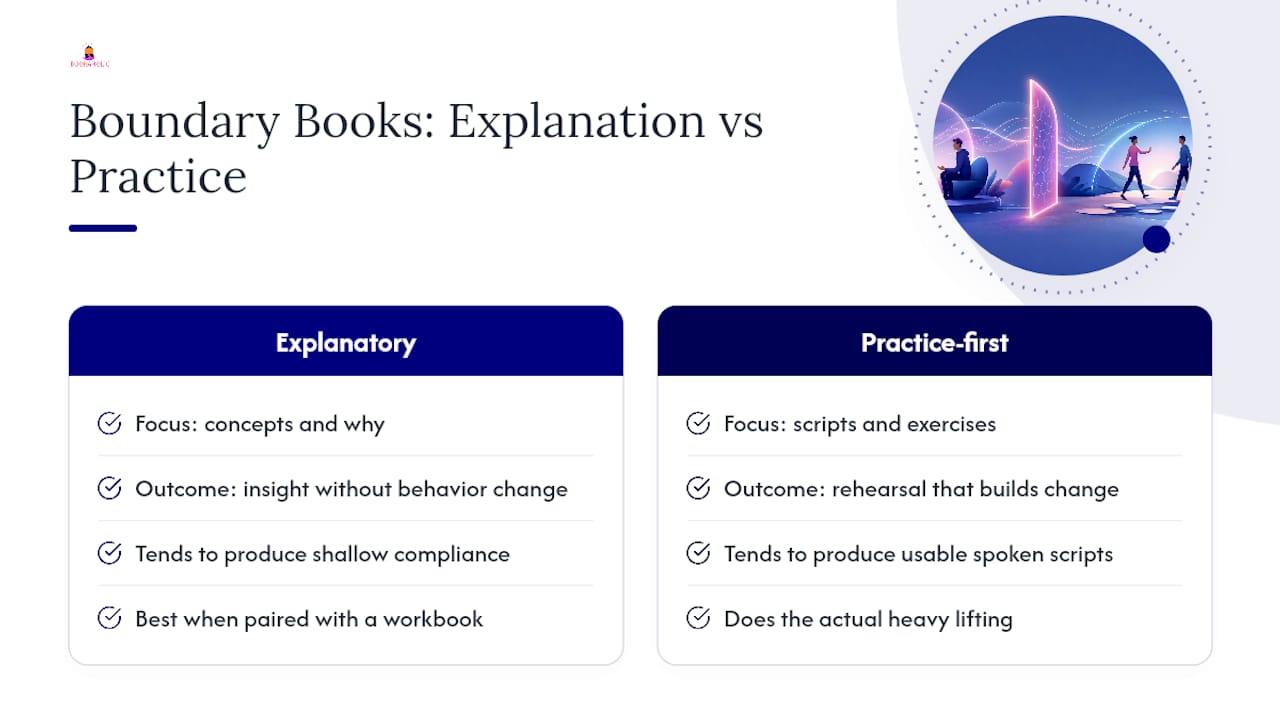
Here's what I think gets underweighted: the order matters as much as the content. Reading Urban's scripts before you understand why you keep over-apologizing produces shallow compliance, not real change. Reading Cloud and Townsend without ever touching a script or exercise produces insight without behavior change. The strongest path pairs a conceptual book with a practice-heavy one, read close together, with the practice book doing the actual heavy lifting.
If you only take one thing from this list, take this: buy the workbook, not just the narrative. The narrative convinces you boundaries matter. The workbook is what actually gets you to say the sentence out loud.
— Deirdre
Keep the Conversation Going Past the Last Page
A book can hand you the script, but hearing an author talk through the thinking behind their work often makes the ideas land differently than the page alone. That's the gap Bookaholic fills between reading sessions.
If you want more of that context, the episode "From Fairytales to Reality: A Young Writer's Dream" digs into the emotional weight behind a writer's journey, useful listening if boundary work and creative burnout have been tangled together for you. And the conversation with Audiofile Magazine's Robin Whitten is worth a listen if you're deciding whether an audiobook or physical workbook format will actually keep you accountable through a four-week practice plan.
Beyond individual episodes, joining the Bookaholic community gets you reading-group questions and episode notes that turn a solitary reading habit into a shared one, which tends to make the practice stick longer than reading alone ever does. Head to Book-a-holic to browse the episode library and find the next author conversation worth your time.
Sources
- Set Boundaries, Find Peace by Nedra Glover Tawwab
- Where to Draw the Line — Anne Katherine
- 5 Books for Setting Better Boundaries (NYT Well)