

There's a persistent belief that why women read more books than men comes down to men simply not liking books with female protagonists. It's a tidy explanation, and it's mostly wrong. A large-scale Cornell University study found that men showed no significant preference for protagonist gender at all. So if men aren't avoiding female-led stories, what's actually driving the reading gap? The answer is more layered, more cultural, and honestly more interesting than most people expect.
Table of Contents
- Key Takeaways
- The gender reading gap by the numbers
- Debunking the "men avoid female protagonists" myth
- Sociocultural forces behind female reading habits
- Digital communities and new reading formats
- Building reading habits across genders
- My take on the reading gap
- Explore more at Book-a-holic
- FAQ
Key Takeaways
| Point | Details |
|---|---|
| Women read more across all formats | 78% of U.S. women read at least one book last year, compared to 71% of men. |
| Protagonist gender is not the issue | Research shows men enjoy stories with female leads just as much as male ones. |
| Socialization shapes reading habits | Girls are culturally encouraged to read more from an early age, widening the gap over time. |
| Digital communities are changing things | Platforms like BookTok are drawing younger men into reading in ways traditional book clubs never did. |
| Small habits build big readers | Attaching reading to daily routines works for all genders, regardless of background or genre preference. |
The gender reading gap by the numbers
The gap between men and women reading is real, measurable, and consistent across countries. In the U.S., 78% of women read at least one book in the past year compared to 71% of men, with women leading in both print and e-book formats. That seven-point difference might not sound dramatic, but it holds up across nearly every demographic slice you look at.
The gap widens considerably in Europe. 60.5% of European women read books compared to 44.5% of men, a 16-point difference that suggests cultural factors beyond any single country's habits are at work. Women in the U.S. also attend book clubs at roughly double the rate of men, which points to a social dimension of reading that goes beyond just picking up a book alone.
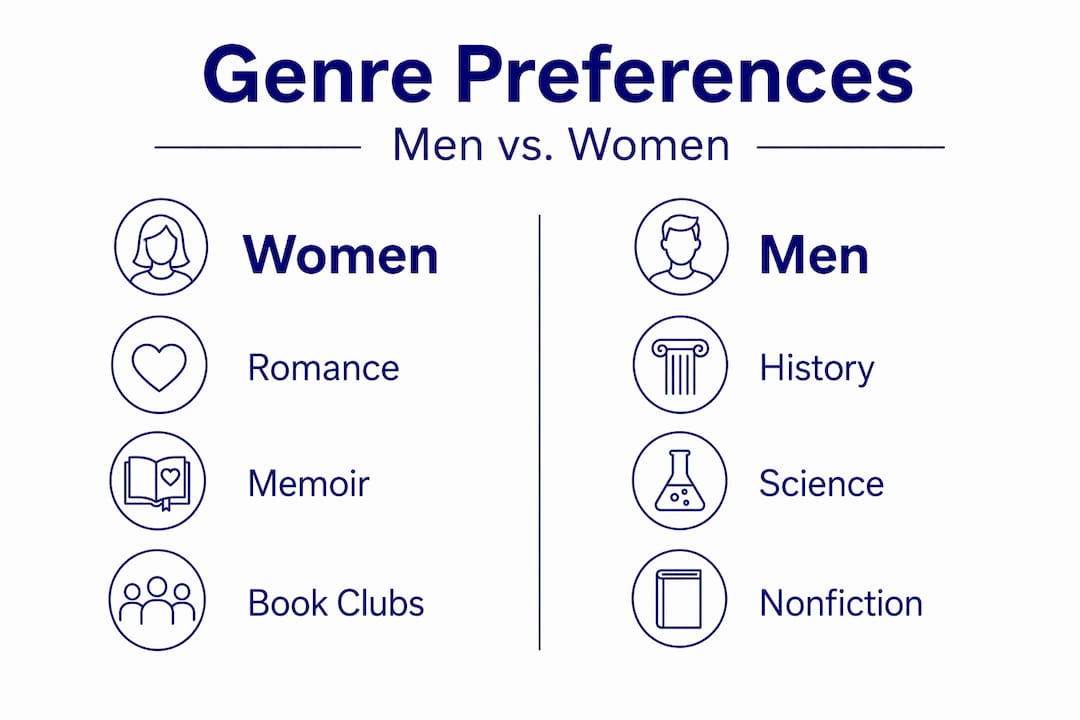
Genre preferences reveal just as much about the differences in reading habits as raw numbers do. A December 2025 survey of nearly 2,200 U.S. adults found that:
- Romance: 32% of women prefer it vs. 12% of men
- History: 42% of men prefer it vs. 20% of women
- Mystery and thriller: Consistently popular across both genders
- Science fiction and fantasy: Skews male but has a strong and growing female readership
These genre differences matter because they shape how books are marketed, shelved, and recommended. When publishers target romance almost exclusively at women and history almost exclusively at men, they reinforce a reading culture that feels gendered before anyone even opens a cover.
Debunking the "men avoid female protagonists" myth
Here's where things get genuinely surprising. The publishing industry has long operated on the assumption that male readers won't engage with female-led stories. It's why certain books get covers that obscure the gender of the protagonist. It's why some female authors publish under initials or male pen names.
But men showed no significant preference for protagonist gender in a Cornell University study of nearly 3,000 participants. What readers of all genders actually want is a good story. Character quality, narrative tension, and emotional resonance matter far more than whether the lead character is a man or a woman.
"The assumption that men won't read books with female protagonists says more about how we market books than about how men actually read." — Cornell University research findings, 2026
So why does the myth persist? Partly because of how reading behavior is measured. Men's reading habits tend to be specific, passion-driven, and less socially visible. A qualitative analysis of 2,000 men found deep emotional connections to genres like sci-fi, fantasy, and nostalgic series from their youth. These men read intensely within their chosen worlds but rarely join book clubs or discuss their reading publicly, which makes their habits harder to count.
Pro Tip: If you're recommending books to a male reader in your life, don't filter by protagonist gender. Filter by what kind of story they love. A man who devours fantasy epics might be just as gripped by a female-led thriller as by anything else.
Sociocultural forces behind female reading habits
The differences in reading habits between men and women don't start in adulthood. They start in childhood, and they're shaped by the culture around reading itself.
Girls are consistently encouraged to read from an early age. Reading is positioned as a quiet, reflective, and socially acceptable leisure activity for girls. Boys, by contrast, are often steered toward more physically active pursuits, and reading can carry an unspoken stigma in certain peer groups. These early messages accumulate over years and decades.

By the time people reach adulthood, the reading gap reflects a complex mix of genre preferences, social encouragement, and leisure alternatives. Men on average spend more time on video games and video content consumption. Neither of those is inherently better or worse than reading, but they do compete for the same hours in a day.
A few cultural patterns that consistently show up in the research:
- Girls receive books as gifts more often than boys do
- School reading lists historically skewed toward male protagonists, which may have alienated female readers less but didn't actively recruit male ones
- Women's social circles more often include reading as a shared activity
- Traditional masculine norms in many cultures frame reading fiction as less productive than other leisure
The social dimension is particularly telling. Women attend book clubs at double the rate of men. Reading, for many women, is both a solitary pleasure and a community activity. That dual function keeps the habit alive in a way that purely solo reading sometimes doesn't.
Digital communities and new reading formats
Something genuinely exciting is happening right now in reading culture, and it's shifting the gender reading gap in ways that traditional book clubs never could.
BookTok, the book-focused corner of TikTok, has exploded into one of the most influential forces in publishing. Silent book clubs, where people simply gather in a coffee shop or library and read together without discussion, are growing rapidly in cities across the U.S. These digital book communities offer flexible, low-pressure ways to engage with reading that appeal to younger readers of all genders.
Here's what makes these communities different from traditional book clubs:
- No homework. You don't have to finish a specific book by a specific date. You just show up and read whatever you want.
- No performance. Silent book clubs remove the social pressure of having to articulate your thoughts about a book in front of others.
- Algorithm-driven discovery. BookTok surfaces books based on what you actually enjoy, not what a curriculum or a bestseller list tells you to read.
- Short-form engagement. A 60-second video about a book is a much lower barrier to entry than a 400-page commitment.
Gen Z and millennial men are showing up in these spaces in ways their fathers' generation rarely did. The reading trends among younger generations suggest the gender gap may genuinely be narrowing, not because women are reading less, but because men are finding entry points that feel natural to them.
Pro Tip: If you want to get someone reading more, don't hand them a list. Send them a BookTok video about a book in a genre they already love. The visual, social proof of someone else being excited about a story is often more persuasive than any recommendation.
Building reading habits across genders
Understanding why the gap exists is useful. Knowing what to do about it is even better. Whether you're trying to read more yourself, encourage a partner, or support a student, the same core principles apply regardless of gender.
The research is clear that sustainable reading habits come from small, attainable goals and personalized book choices, not from ambitious reading challenges that collapse by February.
A few approaches that actually work:
- Start with 10 minutes a day. Attach it to something you already do, like morning coffee or the commute home. Consistency beats duration every time.
- Let genre lead. Someone who loves crime documentaries will probably love crime fiction. Someone obsessed with World War II history might love historical fiction set in that period. Meet readers where they already are.
- Mix solo and social reading. Some people thrive with accountability. Others need solitude. Knowing which type you are saves a lot of abandoned book clubs.
- Ditch the guilt about what you read. Graphic novels, audiobooks, short story collections, and genre fiction all count. The impact of gender on reading is partly sustained by the idea that certain books are more "serious" than others. They're not.
You can explore diverse book reviews and recommendations at Book-a-holic to find titles across genres that genuinely excite you, regardless of who they were supposedly written for.
Pro Tip: Audiobooks are an underrated equalizer. Men who commute, exercise, or do manual work often find audiobooks fit their lifestyle far better than sitting down with a physical book. Don't count them out when thinking about how to build a reading habit.
My take on the reading gap
I've been talking about books for years, and the question of why women read more than men comes up more than almost anything else. What I've noticed is that the conversation almost always starts in the wrong place. People want to talk about what men won't read. I think the more interesting question is what we've never offered them.
When I look at the men in my life who are passionate readers, their reading looks different from the average book club discussion. It's deep, specific, and often invisible to the outside world. They're not posting about it. They're not joining clubs. But they're reading. That qualitative analysis of 2,000 men describing their childhood reading experiences was one of the most poignant things I've come across in years of covering book culture. These men had profound emotional connections to books formed in their youth, and many of them carried those connections quietly into adulthood.
What I've come to believe is that the gender reading gap is real but also partly a measurement problem. We count what's visible: book club memberships, library visits, social media posts about reading. We miss what's private. And a lot of male reading is private.
The rise of BookTok and silent book clubs genuinely excites me. Not because they're making reading "cool" in some superficial way, but because they're removing the social gatekeeping that made reading feel like it belonged to a particular kind of person. Reading belongs to everyone. The data is starting to reflect that.
— Deirdre
Explore more at Book-a-holic
If this conversation about reading habits and gender has you thinking about your own reading life, I'd love for you to come spend some time at Book-a-holic.

At Book-a-holic, you'll find book reviews, author interviews, and reading news across every genre, from literary fiction to romance to sci-fi. Whether you're a lifelong reader looking for your next obsession or someone just getting back into the habit, there's something here for you. Check out the summer reading recommendations for a curated list of titles that span genres and perspectives. And if you're new to the book community online, the Booktube Newbie Tag is a warm, welcoming place to start. Books are better when we talk about them together.
FAQ
Why do women read more books than men?
Women read more due to a combination of sociocultural factors, including early encouragement to read, stronger participation in reading communities, and genre preferences that align with widely available fiction. The gap is consistent across the U.S. and Europe.
Do men avoid books with female protagonists?
No. A Cornell University study of nearly 3,000 participants found men showed no significant preference for protagonist gender. The belief that men avoid female-led stories reflects marketing assumptions more than actual reading behavior.
What genres do men and women prefer?
Women prefer romance at nearly three times the rate of men, while men favor history books at roughly double the rate of women. Mystery, thriller, and speculative fiction have strong readership across both genders.
Are younger generations closing the reading gap?
Yes, gradually. Digital communities like BookTok and silent book clubs are drawing younger men into reading by offering flexible, low-pressure engagement. Reading trends among Gen Z suggest the gap may be narrowing.
How can I build a reading habit regardless of gender?
Start with 10 minutes a day attached to an existing routine, choose books in genres you already love, and don't dismiss audiobooks or graphic novels. Sustainable reading habits come from personalized, achievable goals rather than ambitious reading challenges.