
The three moves that matter most: pick a stable interior room away from attics, basements, and garages, keep humidity around 30 to 55% with temperature at or below 70°F, and shelve or box your books so their spines and boards aren't under strain. Get those right, and everything else, dusting, bookends, the occasional inspection, is just upkeep.
TL;DR:
- Keeping books in a stable interior room away from attics, basements, and garages significantly reduces risks from temperature swings and moisture-related damage.
- Maintaining consistent humidity levels between 30% and 55% at or below 70°F is more effective than chasing exact readings, especially with multiple sensors.
- Shelving most books upright with support and grouping by size prevents warping and spine damage, while avoiding leaning at an angle over time.
- Using appropriately sized, acid-free boxes and supporting books upright or flat during packing prevents crushing and shifting in long-term storage.
- Regularly inspecting humidity, dust, and pests every few months is vital to catching slow damage early and preserving the collection long-term.
Table of Contents
- How to store books properly: the environment that protects them
- Where should you put your bookshelves?
- What's the best way to pack books for storage or a move?
- How often should you clean and handle your books?
- How do you prevent mold and deal with wet books?
- What enclosures actually protect books long-term?
- What tools help you catch problems early?
- Long-term storage: what changes over months and years
- A note from Deirdre: small habits that protect books
- Give your collection a little extra love
- Where to go for deeper preservation guidance
- Sources
- FAQ
How to store books properly: the environment that protects them
Books don't fail because of one dramatic event. They fail slowly, from swings in heat and moisture that warp boards and feed mold. The Library of Congress recommends keeping books at or below 70°F with relative humidity between 30% and 55%, and staying out of attics, basements, and garages entirely, since those spaces swing wildly and flood risk runs higher.
Consistency beats precision here. A room that holds steady at 50% humidity protects your books better than one that bounces between 35% and 65%, even though both average out to the same number.
To keep tabs on conditions:
- Use a simple hygrometer or humidity indicator card in each room where books live
- Place more than one sensor per room, since corners and the space behind shelving often run more humid than the room average
- Add a small dehumidifier or humidifier depending on your climate, rather than chasing a perfect reading
Keep shelves away from windows and exterior walls, where temperature swings hit hardest, and make sure air can actually move around the room. A closet stuffed with sealed bins is worse for books than an open shelf with a fan running nearby.
Where should you put your bookshelves?
Interior walls win, every time. Placing shelves against exterior walls exposes books to the temperature swings happening outside your insulation, and the University of Illinois Preservation program recommends leaving roughly three inches between books and the wall so air can circulate behind them.
On materials, skip raw wood if you can. Wood off-gasses chemicals that degrade paper over time, and unsealed oak is particularly bad news for a collection you care about. Powder-coated steel or anodized aluminum shelving is the safer long-term choice. If wood is what you have, seal it well and steer clear of oil or alkyd based paints.
For orientation:
- Shelve most books upright, spine out, with enough neighbors on either side to keep them standing straight
- Store oversized or heavy volumes flat, stored in small stacks to avoid excess weight
- Leave one to two inches of clearance at the front edge so nothing overhangs and gets crushed when you push books back
- Use sturdy bookends to stop leaning, which slowly warps boards and cracks spines
- Group books by size rather than alphabetically alone, so tall and short volumes aren't fighting for space
Pro Tip: Never let books lean at an angle for months at a time. A five-degree tilt today becomes a permanently warped spine within a year.
What's the best way to pack books for storage or a move?
Box size matters more than most people assume. A box that's too large invites shifting and crushing; one that's too small forces you to jam books in sideways. For anything you plan to store longer than a season, archival acid-free boxes are worth the extra cost, since standard cardboard breaks down and can transfer acid to paper.
- Choose a box you can lift comfortably when full. Books are dense, and a "medium" box packed solid with hardcovers can hit 40 pounds fast.
- Pack upright books spine down, not fore-edge down, to keep the weight resting on the sturdiest part of the binding.
- Lay oversized books flat, stack no more than two or three per box, and pad any gaps with acid-free tissue so nothing shifts in transit.
- Never pack a box loosely enough that books can slide. Movement during transport is what cracks spines.
Plastic totes have a place, but only as backup. The Library of Congress notes that plastic bins protect against water intrusion but can trap moisture inside if the storage area itself runs humid, which raises mold risk rather than lowering it. If you're storing in a basement out of necessity, a stable, low-humidity space still matters more than the container.
How often should you clean and handle your books?
Dust is abrasive, and it attracts pests, so a little regular care goes a long way. The safest cleaning combination is a soft brush attachment on a vacuum with HEPA filtration, which captures the vast majority of particles down to submicron size, paired with a magnetic duster for quick passes between deeper cleans.
- Dust from the spine toward the front edge, never the reverse, to avoid pushing debris into the binding
- Remove a book by pushing its neighbors back slightly, then gripping the spine's middle, rather than yanking the top of the spine
- Use both hands for larger volumes to keep the spine from twisting
- Skip dog-earing entirely; a bookmark costs nothing and does no damage
- Do a quick monthly scan for leaning, dust buildup, or loose pages, with a deeper seasonal check of humidity readings and shelf conditions
How do you prevent mold and deal with wet books?
Mold needs two things: moisture and stagnant air.
If a book gets wet:
- Air-dry it standing on end with pages fanned open, in a well-ventilated space
- If it can't dry within about 48 hours, freeze it to halt mold growth until you can process it properly, a step the Library of Congress outlines in its guidance on wet and moldy books
- For rare, valuable, or heavily mold-affected volumes, contact a conservator rather than attempting a full restoration yourself
Handling moldy books carries real health risk. Wear gloves and, ideally, an N95 respirator, and work in a ventilated area rather than a closed closet or basement corner.
What enclosures actually protect books long-term?
Archival document boxes suit most home collections: rigid, acid-free, and breathable enough to avoid trapping moisture. Polyethylene or polypropylene sleeves work well for dust jackets and paperback covers, protecting against scuffing without sealing the book in a way that blocks airflow.
- Slipcases suit sturdy hardcovers you handle often
- Custom clamshell boxes make sense for rare or fragile items where a snug, book-shaped fit prevents internal shifting
- Standard corrugated boxes should be re-housed every few years, since the cardboard itself degrades and can acidify what's inside
- Avoid fully sealed containers in anything but a stable, low-humidity room, for the same trapped-moisture reason plastic totes carry risk
If a single volume is valuable enough that losing it would genuinely sting, a custom enclosure or a conservator consultation is money well spent.
What tools help you catch problems early?
A $15 hygrometer beats a guess every time. Combine it with a humidity indicator card and, in flood-prone spaces, a small battery-powered water sensor that alerts you before damage spreads.
- Run more than one sensor per room, since a corner behind a bookcase can sit five to ten points more humid than the center of the room
- Check readings on a consistent schedule rather than only when something feels off
- Add a compact dehumidifier if your baseline humidity regularly climbs past 55%
Pro Tip: Climate-controlled storage units make sense mainly for large, valuable, or rare collections that no longer fit in living space. For a working home library, a stable room with a hygrometer usually does the job just as well.
Long-term storage: what changes over months and years
Books stored for the long haul face a different set of risks than books you handle weekly. Static conditions can hide slow damage, since nothing forces you to notice a shelf drifting into 60% humidity if you never check it.
Set a real inspection schedule and stick to it. A quarterly walk-through, checking hygrometer readings, scanning for new mold spots, leaning volumes, or pest activity, catches problems while they're still cheap to fix. An annual deeper check makes sense too: pull a sample of books off each shelf, look at spine and hinge condition, and confirm nothing has shifted or absorbed moisture from a slow leak you haven't noticed.

Rotate your attention around the room, not just the shelf nearest the door. Corners, closets, and anything near plumbing or an exterior wall deserve extra scrutiny, since those are the spots where conditions drift first. If you're storing boxed books rather than shelved ones, open a box every few months rather than assuming it's fine because it was fine last year; corrugated cardboard degrades, and a box that seemed stable at packing time can acidify over several seasons.
Pests deserve a place on this schedule too. Check for insect activity, silverfish, booklice, and signs of rodents, especially in storage areas adjacent to kitchens or damp basements. A five-minute visual scan during each inspection catches an infestation while it's still limited to one shelf instead of an entire room.
Collections that sit untouched for years benefit most from labeling and a simple inventory, so you know what's where and can spot a missing or damaged volume quickly.
A note from Deirdre: small habits that protect books
I've spent years talking with authors and readers on the Bookaholic Podcast about what makes a personal library feel alive rather than just decorative. The habits that matter most are boring: check your humidity, and never let books sit on the floor where moisture and dust collect fastest. Start there, and everything else in this guide gets easier.
— Deirdre
Give your collection a little extra love
A well-shelved library deserves accessories that match the care you've put into it, and that's where Book-a-holic's own literary merchandise comes in. Beyond the podcast, there are bookish accessories, bookmarks, and gift-ready pieces built for readers who treat their shelves as more than storage, small touches that pair naturally with the preservation habits above.

If you're building out a reading list alongside your preservation routine, our guide on building a reading list you'll actually finish helps you decide which titles stay on easy-reach shelves and which ones belong in long-term storage. And if a gift is on your mind, browsing the merchandise page is the simplest next step: pick a piece, and give a fellow reader something that celebrates the shelf they're building.
Where to go for deeper preservation guidance
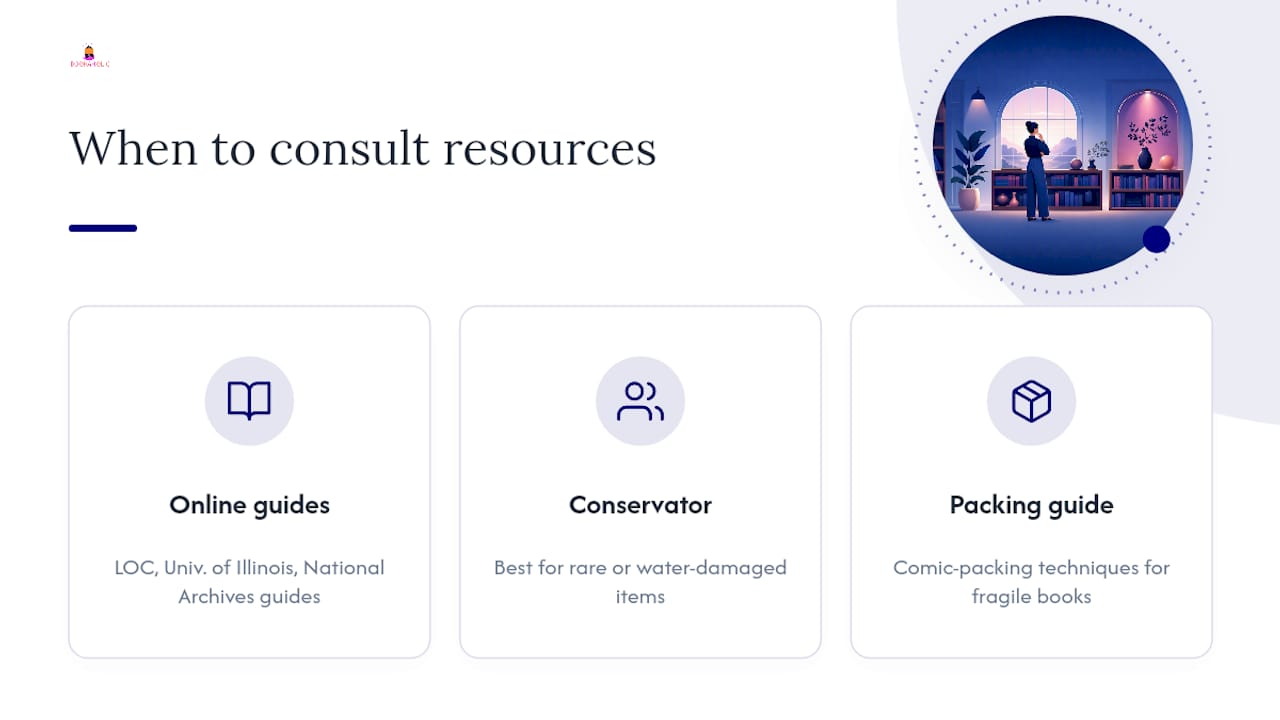
For technical detail beyond this guide, consult the Library of Congress preservation FAQs, the University of Illinois home library guide, and the National Archives shelving guidance. For rare or water-damaged items, a professional conservator remains your safest option, and for packing fragile paper goods for a move, this comic-packing guide offers useful padding techniques that translate well to books.
Sources
- Books - FAQ - About (Preservation, Library of Congress)
- Preserving books in your home library (University of Illinois Preservation)
- Shelving bound volumes (National Archives)
- Preserving your books - Library of Congress FAQs
FAQ
Is it better to store books laying down or standing up?
Most books should stand upright, supported on both sides so they don't lean or slump. Oversized or heavy volumes are the exception. The National Archives recommends storing those flat, stored in small stacks to avoid excess weight, since standing them upright puts too much strain on the binding.
What is the most efficient way to store books?
Keep them in a stable interior room with humidity between 30 and 55% and temperature at or below 70°F, shelved upright on steel or aluminum shelving, away from windows and exterior walls. Combine that with regular dusting and a quick monthly check, and you've covered most of what damages a collection over time.
What is the 5 finger rule for books?
The "five finger rule" is a reading-level tool teachers use to judge whether a book is a good fit for a young reader, not a preservation guideline. It has no connection to how books should be shelved, cleaned, or stored.
Is it better to store books in plastic or cardboard boxes?
Archival acid-free cardboard boxes are the better choice for most long-term storage, since they breathe and don't trap moisture. Plastic totes work only as secondary protection against water, and sealed plastic in a humid space can actually raise mold risk rather than lower it.