

You want to read more. You have a stack of books, a wishlist that keeps growing, and a nagging feeling that you're not making real progress. The struggle to build a reading list that actually works is something almost every book lover knows. Too many choices, too little direction, and suddenly your "to be read" pile feels more like a source of guilt than joy. This guide walks you through a practical, genre-spanning approach to curating a personalized reading list, setting goals that stick, and keeping the momentum going long after the first chapter.
Table of Contents
- Key takeaways
- How to build a reading list that fits your goals
- Curating your list: sources, selection, and balance
- Building a schedule and tracking your progress
- Common challenges and how to handle them
- Measuring success and evolving your list
- My honest take on building a reading life
- Explore Book-a-holic for your next great read
- FAQ
Key takeaways
| Point | Details |
|---|---|
| Start with self-assessment | Clarify your reading goals before selecting a single book to keep your list focused and meaningful. |
| Cap your active list | Keeping your to-be-read queue between 15 and 25 titles reduces decision fatigue and guilt. |
| Balance genres deliberately | Mix fiction, nonfiction, and biography to build empathy, skills, and perspective all at once. |
| Track and review quarterly | Logging what you read and reviewing it every three months helps you refine future selections. |
| Leave room for surprises | Unexpected reads often reshape your thinking more than carefully planned ones do. |
How to build a reading list that fits your goals
Before you pick a single book, you need to know what you're reading for. This sounds obvious, but most readers skip this step entirely. They grab whatever looks interesting, finish half of it, and wonder why their reading life feels scattered.
Start by asking yourself three questions. What do I want to learn? What do I want to feel? What skill or perspective am I trying to develop? Your answers will shape every choice you make from here on.

Once you have a sense of your purpose, break it into manageable milestones. If you want to read more history, don't just say "I'll read history books." Decide how many, over what time frame, and what specific period or region interests you most. Realistic milestones keep you moving without the pressure of an impossible target.
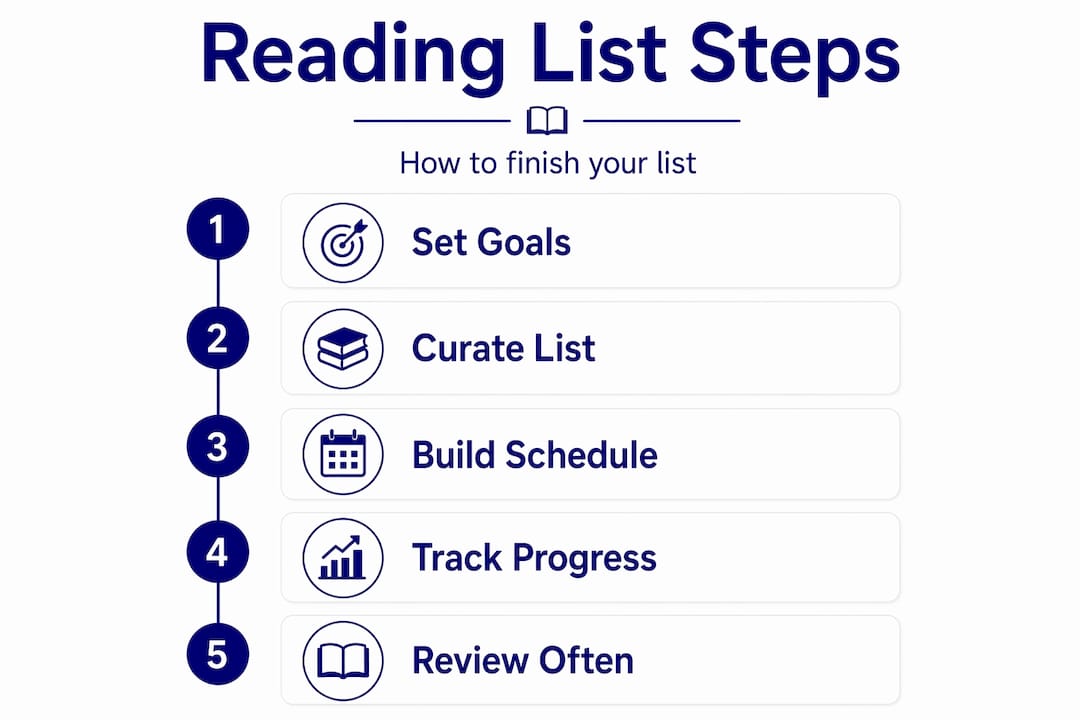
A useful framework here is T-shaped thinking, which balances deep expertise in one area with creative breadth across adjacent topics. In reading terms, that means going deep on one subject you care about while also sampling widely across genres. The result is a reading life that feels both purposeful and genuinely surprising.
Here's how to apply this in practice:
- Pick one anchor subject per quarter. This is your "deep" reading. Think narrative nonfiction on climate, or literary fiction from a specific country.
- Add two or three breadth picks that sit outside your comfort zone. A memoir, a science book, a graphic novel.
- Revisit your answers to the three questions above every few months. Your goals will shift, and your list should shift with them.
Pro Tip: Write your reading goals somewhere you'll see them regularly. A sticky note on your nightstand or a pinned note on your phone works better than a buried document you never open.
Curating your list: sources, selection, and balance
Knowing what you want is step one. Finding the right books to match is where most readers get overwhelmed. The good news is that you don't need to search everywhere. You need a few trusted sources and a clear selection process.
Platforms like Goodreads and BookBub are genuinely useful for discovery. Goodreads lets you see what people with similar taste are reading, and BookBub surfaces deals and new releases in genres you already love. Beyond platforms, lean on expert recommendations from literary podcasts, book review publications, and author interviews. At Book-a-holic, we cover book news and new releases regularly, which makes it easier to stay current without drowning in options.
One of the most practical rules you can follow: cap your active TBR list between 15 and 25 titles. More than that and the list becomes a source of anxiety rather than excitement. It also makes it harder to commit to any single book when you know there are 60 others waiting.
When it comes to balance, think of your reading list like a well-planned playlist. You wouldn't listen to the same genre for hours on end. The same logic applies to books.
| Genre | What it builds | Example types |
|---|---|---|
| Literary fiction | Empathy, emotional intelligence | Character-driven novels, short story collections |
| Nonfiction | Knowledge, practical skills | History, science, business, self-development |
| Biography and memoir | Perspective, resilience | Athlete memoirs, political biographies, creative life stories |
| Genre fiction | Pleasure, imagination | Mystery, thriller, fantasy, romance |
| Essays and poetry | Language, reflection | Personal essays, collected poems |
Pro Tip: When you add a book to your list, write one sentence about why you chose it. This keeps your list intentional and helps you remember your reasoning when you return to it weeks later.
Strategic reading with 10 to 20 focused titles yields better measurable growth than a sprawling, unfocused collection. Quality of curation beats quantity every time.
Building a schedule and tracking your progress
A reading list without a schedule is just a wishlist. The difference between readers who finish books and those who don't often comes down to one thing: protected reading time.
Here's a simple four-step process to get your reading schedule working for you:
- Identify your best reading window. Morning readers tend to absorb more because mental energy is high. Evening readers often find it easier to decompress with fiction. Neither is wrong. Pick the window that fits your actual life.
- Set a session length you can sustain. Twenty to thirty minutes daily beats a two-hour Sunday session you'll skip half the time. Consistency matters more than volume.
- Log what you read within 24 hours of finishing. Tracking books and reviewing quarterly lets you spot patterns in your reading speed, genre preferences, and completion rates. This information shapes every future list you build.
- Set a public commitment. Publicly committing to a reading goal increases follow-through by 50%. Tell a friend, post in a community, or share on social media. The accountability is real.
Here's a simple tracking template you can adapt:
| Field | What to log |
|---|---|
| Title and author | Full name and publication year |
| Start and finish date | Tracks your actual reading pace |
| Genre | Helps you spot imbalances over time |
| Key takeaway | One sentence on what you gained |
| Would recommend? | Yes, no, or maybe, with a short reason |
Pro Tip: Experts recommend a "3x3" routine: three reading sessions, three implementation sessions, and three reflection sessions each week. Even a scaled-down version of this, one of each, dramatically improves how much you retain.
Common challenges and how to handle them
Even the best-built reading list runs into friction. Here are the most common problems and what actually helps.
The TBR spiral. You keep adding books faster than you finish them. The fix is simple but requires discipline: freeze your active list at 25 titles. Create a separate "discovery archive" for books you want to explore later. Separating discovery from consumption using tools like a dedicated app or even a separate notebook prevents new finds from derailing your current reading momentum.
The guilt of unfinished books. You're 80 pages into something and it's not working. Most readers push through out of obligation. But reading meaningfully beats reading completely. Give a book 50 pages. If it hasn't earned your attention by then, set it aside without guilt. Your list should serve your growth, not the other way around.
The unexpected find. Someone recommends a book that's completely outside your plan. Take it. Exposure to unexpected books challenges your assumptions and fosters deeper growth than a perfectly curated list ever could. Build a small "wildcard" slot into every quarter specifically for these moments.
The best reading lists are living documents. They grow, shrink, and change direction with you. Treat yours as a conversation with your future self, not a contract you have to honor.
Measuring success and evolving your list
Finishing books is not the only measure of a successful reading life. In fact, it's one of the least interesting metrics.
Here's a better way to evaluate whether your reading list is working:
- Ask what you've actually applied. Did a book change how you think about a relationship, a skill, or a problem you're facing? That's the real measure of a good read.
- Create artifacts from your reading. Write a short summary, record a voice note, or discuss the book with someone. Active engagement through note-taking transforms reading from passive to genuinely skill-building. Structuring notes as claim, evidence, and application is especially effective for nonfiction.
- Review your tracking log every quarter. Look at your completion rates, your genre distribution, and your "would recommend" column. This data tells you exactly what kind of reader you are and what your next list should look like.
- Tap into community. Reading groups with structured formats increase motivation and deepen learning. Whether that's a formal book club or a casual chat with a friend who read the same book, talking about what you've read cements the ideas in ways that solitary reading rarely does.
The goal is a reading life that keeps evolving. Your list from two years ago should look different from your list today, because you are different. That's not inconsistency. That's growth.
My honest take on building a reading life
I've been building reading lists for years, and the biggest mistake I made early on was treating my list like a curriculum. Every book had a purpose. Every quarter had a theme. It was organized, intentional, and honestly, a little joyless.
What shifted things for me was allowing room for the books I didn't plan to read. The ones a stranger mentioned on a podcast, or the one I picked up in a used bookstore because the cover stopped me cold. Those books changed how I think in ways my carefully planned selections rarely did. There's real wisdom in that.
I've also learned to stop finishing books that aren't serving me. This was hard. It felt like failure. But the moment I gave myself permission to set a book down, my overall reading enjoyment went up significantly. I read more, retained more, and actually looked forward to picking up my next book.
If you're just starting to curate a book list, keep it simple. Ten to fifteen titles, a mix of genres, and one clear goal per quarter. You can always add more. What you can't get back is the time spent grinding through a book you resented.
Your reading list is yours. Make it feel that way.
— Deirdre
Explore Book-a-holic for your next great read
If you're ready to put this into practice, Book-a-holic is built for exactly this kind of reader. Deirdre brings you author interviews, book reviews, and curated picks that make it easier to find books worth your time.
Whether you're looking for top reading recommendations across genres or want to stay current with new releases, the Book-a-holic podcast and blog gives you a trusted starting point. For seasonal inspiration, the Summer Reading Wrap-Up is a great place to discover reviewed titles across fiction and nonfiction. Come for the recommendations, stay for the community. Your next favorite book is closer than you think.
FAQ
How many books should be on a reading list?
Keep your active to-be-read list between 15 and 25 titles to avoid decision fatigue. Larger lists tend to reduce motivation and reading consistency.
What's the best way to find books to read?
Use trusted platforms like Goodreads and BookBub alongside expert recommendations from literary podcasts and book review sources. Focusing on a few quality sources beats scanning dozens of lists.
How do I create a reading list that balances genres?
Aim to include at least one fiction title, one nonfiction title, and one biography or memoir per quarter. This mix builds empathy, practical knowledge, and perspective simultaneously.
How do I stay motivated to finish my reading list?
Set a public commitment, track your progress in a simple log, and review your list quarterly. Publicly committing to a reading goal increases follow-through by 50%.
Should I force myself to finish every book on my list?
No. Give each book around 50 pages, and if it hasn't earned your attention, set it aside. Reading meaningfully matters far more than hitting a completion number.