Book bans in the United States have hit a scale never recorded before, with the American Library Association's Office for Intellectual Freedom documenting 4,235 unique titles challenged in 2025 and 5,668 books banned or removed from library shelves that same year. If you want to know whether a specific title is affected where you live, the ALA's Office for Intellectual Freedom database, PEN America, and Banned Index are the three places to check first.
TL;DR:
- Most book challenges target LGBTQ+ themes, race, and sexual content, with some titles challenged repeatedly across multiple years and districts.
- A significant number of banned or removed books result from coordinated campaigns and legislation, not just individual parental objections.
- About two-thirds of challenges lead to temporary bans, especially in states with restrictive laws that encourage preemptive self-censorship by educators and librarians.
- Resources like the ALA database, PEN America, and Banned Index provide real-time or legislative context to track current bans locally and nationally.
- The wave of book bans is highly organized, impacting school staffing, library collections, and students’ access beyond official removal, creating a broad chilling effect.
Table of Contents
- What Books Are Being Banned Right Now in the USA?
- How Many Books Have Been Banned in the USA? The Numbers Behind the Surge
- Why Book Bans Are Rising: Campaigns, Legislation, and Technology
- Where to Check if a Book Is Banned Near You
- What You Can Do When a Book Is Challenged
- Historical Context of Book Banning in the USA
- How Book Bans Affect Schools, Libraries, and Students
- Key Organizations Fighting Book Bans and Censorship
- Notable Legal Battles Over Book Bans
- Common Reasons Books Get Banned: Sex, Race, and Politics
- The Bookaholic Take: Why This Story Isn't Just a Library Story
- Keep the Conversation Going with Bookaholic
- Sources
- FAQ
What Books Are Being Banned Right Now in the USA?
The titles landing on challenge lists in 2024 through 2026 fall into recognizable patterns, and once you see them, the pattern is hard to miss. Most challenged books share one or more of these traits: queer or transgender characters, frank discussions of race and racism, depictions of sexual assault, or scenes deemed "sexually explicit" by challengers who often haven't read the full book. Here's a snapshot of the titles that keep resurfacing on district and state challenge lists:
- "Gender Queer" by Maia Kobabe — challenged almost every year since 2021 over its graphic-memoir depiction of gender identity and sexuality.
- "All Boys Aren't Blue" by George M. Johnson — a memoir-in-essays about growing up Black and queer, frequently flagged for sexual content.
- "The Bluest Eye" by Toni Morrison — decades-old classic still challenged for its portrayal of racism, abuse, and trauma.
- "Flamer" by Mike Curato — a graphic novel about a closeted teen at scout camp, targeted for LGBTQIA+ themes.
- "Looking for Alaska" by John Green — challenged over sexual content despite its long tenure as a young-adult staple.
- "The Perks of Being a Wallflower" by Stephen Chbosky — perennial target for depictions of abuse, drug use, and sexuality.
- "This Book Is Gay" by Juno Dawson — a nonfiction guide for LGBTQIA+ teens, challenged as inappropriate for minors.
- "The Hate U Give" by Angie Thomas — challenged for language and its unflinching take on police violence and race.
- "Beloved" by Toni Morrison — challenged for violent and sexual content tied to its depiction of slavery.
- "Speak" by Laurie Halse Anderson — a novel about surviving sexual assault, challenged as "too mature."
Local status varies district by district, even within the same state, so a title pulled in one county might sit untouched on a shelf twenty miles away. Always confirm current status through the databases covered below rather than assuming a national list applies to your library.
How Many Books Have Been Banned in the USA? The Numbers Behind the Surge
The scale of the current wave becomes clear once you look at the raw figures. The ALA's Office for Intellectual Freedom tracked 4,235 unique titles challenged in 2025, and of those challenges, 5,668 individual books were ultimately banned or removed from library and classroom shelves.
Pro Tip: A single challenge can target dozens of books at once, which is why the number of books banned often exceeds the number of unique titles challenged. One coordinated complaint can sweep an entire reading list off the shelf.
| Metric | 2025 Figure |
|---|---|
| Unique titles challenged | 4,235 |
| Books banned or removed | 5,668 |
| Challenges resulting in a ban | 66% |
A 66% ban rate means that two out of three challenges succeed in getting a book pulled, at least temporarily, while a review takes place. That success rate matters because it shows challenges aren't just noise. They're working. Most of these challenges, per the ALA's own tracking, come from organized campaigns rather than individual parents raising concerns about their own child's reading list, changing how libraries and school boards need to respond.
Why Book Bans Are Rising: Campaigns, Legislation, and Technology
The current surge didn't happen by accident. It traces back to three overlapping forces.
First, organized pressure groups and partisan book-rating websites now generate ready-made lists of "objectionable" titles, and local chapters submit those lists en masse rather than filing individual, book-by-book complaints. PEN America's research shows these coordinated campaigns account for the majority of multi-title challenges, not isolated parental objections.
Second, state legislation plays a direct role. Academic analysis from Indiana University's Center for Evaluation and Education Policy found that 16 Republican-dominated states have enacted laws restricting how race, sexuality, and related topics can be taught, and vague statutory language creates a chilling effect. Teachers and librarians, uncertain what crosses a legal line, often pull materials preemptively rather than risk professional or legal consequences.
Third, technology has sped up the process. Rating sites and campaign networks use shared databases and social media to circulate identical challenge lists across dozens of districts simultaneously, turning what used to be a slow, local process into a fast, replicable one.
Where to Check if a Book Is Banned Near You
Three resources cover the current landscape from different angles, and knowing which one to use for what saves you time.
- ALA Office for Intellectual Freedom database: The most comprehensive national tracker, updated annually with challenge and ban totals by state, title, and reason. Best for understanding trends and confirming whether a title has faced formal challenges nationwide.
- PEN America: Tracks legislative context alongside individual bans, connecting specific removals to the educational gag orders driving them. Useful when you want to understand why a book was flagged, not just that it was.
- Banned Index: A near real-time tracker showing live status changes, relocations, and removals at the jurisdiction level. Best for checking what's happening this week in a specific district, though you should still cross-check with your library's own policy documents before assuming a status is final.
University library pages, like the University of Michigan's Banned Books Week guide, also maintain curated lists worth bookmarking for regional context.
What You Can Do When a Book Is Challenged
If a title you care about turns up on a challenge list, here's the order that actually works.
- Ask library or school staff directly what stage the challenge is at. Most districts have a formal review process, and a book on a "challenge list" hasn't necessarily been removed yet.
- Document everything: who filed the challenge, what policy it cites, and what the review timeline looks like. This paperwork matters if the decision gets appealed or challenged later.
- Request a formal policy review rather than an informal removal. Most library systems require a written reconsideration process, and skipping it is itself a policy violation worth flagging.
- Show up at school board meetings and participate in Banned Books Week each October, when libraries nationwide spotlight challenged titles and host community events.
- Use ALA's advocacy toolkits, including its "Book Résumé" templates, which give librarians and teachers a ready-made, policy-grounded defense for a flagged title.
Pro Tip: When defending a book, cite the library's selection policy and the title's educational purpose. Committees respond to policy-aligned arguments far better than to debates about personal offense.
Historical Context of Book Banning in the USA
Book banning in America isn't a new phenomenon. It's a recurring one, and the current wave has historical siblings.
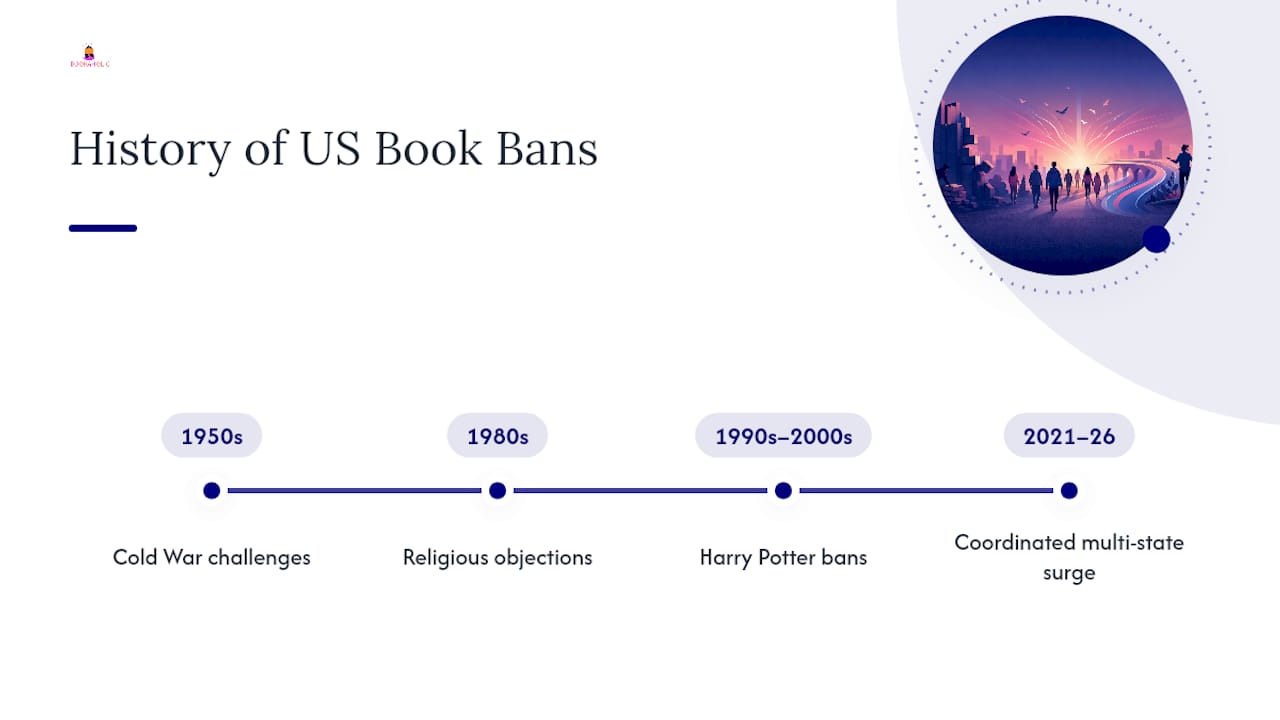
In the 1950s, Cold War anxiety fueled challenges against books perceived as sympathetic to communism or "un-American" values. The 1980s brought a wave of challenges rooted in religious objections, targeting titles like "The Adventures of Huckleberry Finn" and "Of Mice and Men" for language and moral content. The 1990s and 2000s saw the "Harry Potter" series repeatedly challenged over claims it promoted witchcraft.
What distinguishes the 2021 to 2026 wave is its organization and speed. Earlier eras of book banning were largely local and reactive: a single parent, a single school board, a single title. The current surge is coordinated, using shared target lists distributed across states, amplified by legislation that gives challengers legal cover, and executed at a volume no previous era approached. The ALA's data shows this isn't a gradual uptick. It's a structural shift in how censorship campaigns operate, moving from grassroots complaints to networked, multi-jurisdiction pressure.
How Book Bans Affect Schools, Libraries, and Students
The practical fallout from this surge lands the hardest on the people who rely on libraries the most: students without home libraries, LGBTQIA+ teens looking for representation, and kids of color searching for stories that reflect their own experience.
Librarians and teachers report a quieter, harder-to-measure effect: preemptive self-censorship. Rather than risk a formal challenge, some educators simply stop ordering certain titles, and some librarians pull books from open shelves before anyone files a complaint. PEN America's research frames this chilling effect as one of the most damaging consequences of vague legislation, because it suppresses access to books that were never formally banned at all.
There's also a staffing cost. School librarians and media specialists now spend hours managing formal reconsideration requests, documenting challenges, and attending board meetings, time pulled directly from collection development and student programming. Smaller districts, often lacking dedicated library staff, feel this strain acutely. When a single coordinated challenge targets dozens of titles simultaneously, a librarian's entire year can become consumed by the review process for books that, in many cases, get reinstated after review anyway.
Key Organizations Fighting Book Bans and Censorship
A handful of organizations anchor the pushback against censorship, each with a distinct role.
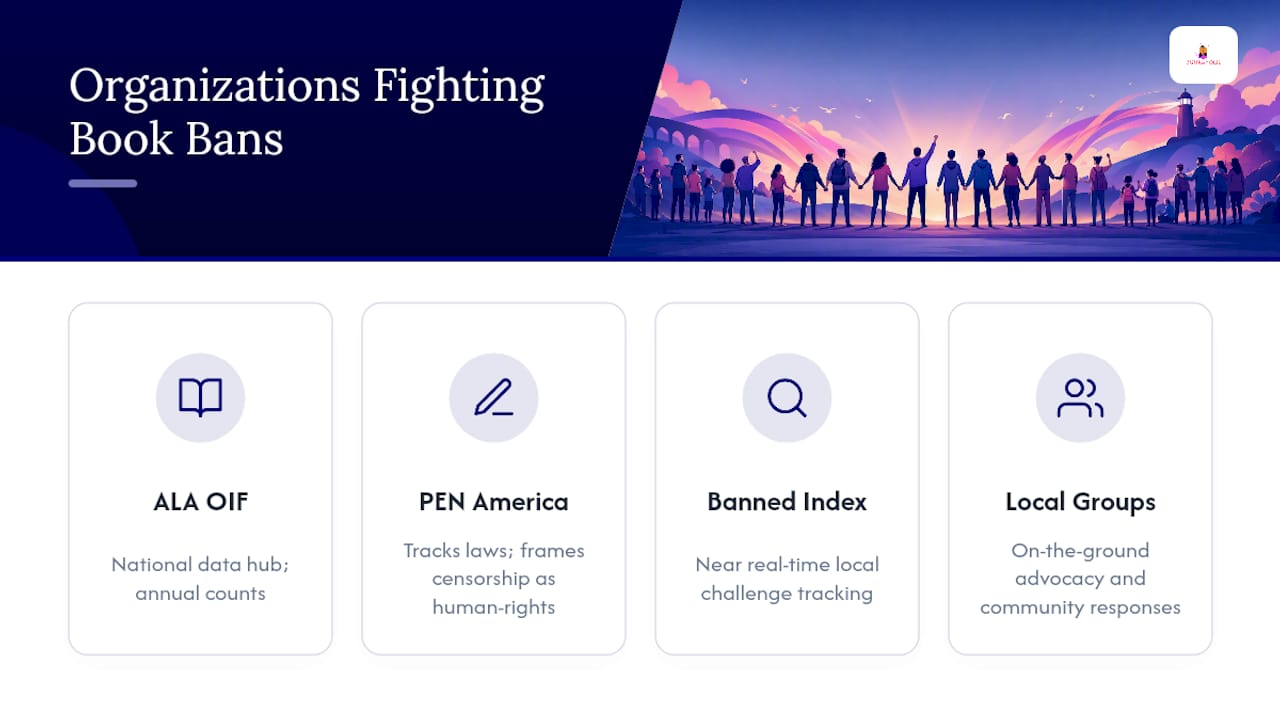
The American Library Association, through its Office for Intellectual Freedom, serves as the primary data hub, tracking challenges nationwide and publishing annual figures that most journalists and researchers cite as the standard reference. It also organizes Banned Books Week and produces practical toolkits, including book résumé templates, for librarians facing formal challenges.
PEN America focuses on the free-expression and legislative angle, documenting how state laws and educational gag orders enable censorship and publishing detailed tracking of both book bans and the legislation driving them. Its framing treats educational censorship as a human-rights concern, not just a library-policy issue.
Banned Index fills a gap the larger organizations can't move fast enough to cover: near real-time tracking of local actions as they happen, which makes it valuable for journalists, advocates, and concerned parents who need up-to-the-week information on a specific district.
Beyond these three, university library systems, the National Coalition Against Censorship, and local Friends of the Library chapters provide on-the-ground advocacy, hosting events and organizing community responses when a title in their district comes under fire.
Notable Legal Battles Over Book Bans
Courts have increasingly become the venue where book-ban disputes get resolved, and several cases have shaped how far school boards and libraries can legally go in restricting access.
Federal courts have repeatedly weighed whether removing books based on viewpoint or content violates First Amendment protections, particularly when a board's stated rationale (protecting minors) doesn't match the actual pattern of removals (disproportionately targeting books by or about LGBTQIA+ people and people of color). Plaintiffs in several ongoing suits argue that removing books based on the identity of characters or authors, rather than legitimate pedagogical concerns, amounts to unconstitutional viewpoint discrimination.
Other cases center on procedural questions: whether a school board followed its own reconsideration policy, or bypassed it entirely to pull a book on an administrator's unilateral decision. Courts have generally been more sympathetic to plaintiffs when a district skipped its own formal review process, since that combination (no due process, plus a content-based removal) is harder for defendants to justify. The legal terrain here remains active and unsettled, with new suits filed regularly as districts continue mass removals. Anyone directly affected by a ban should consult a qualified attorney or organizations like PEN America's legal network for guidance specific to their state and situation.
Common Reasons Books Get Banned: Sex, Race, and Politics
Nearly every challenge filed in the past three years falls into one of a few recurring categories, and recognizing them helps you understand what's really driving a specific complaint.
Sexual content tops the list by volume. Challengers frequently cite "sexually explicit" material, though the threshold varies wildly. Some challenges target graphic depictions of assault; others flag a single scene of consensual intimacy or even non-sexual nudity in graphic novels.
LGBTQIA+ themes make up a large share of challenges, often overlapping with the sexual-content category. Books featuring transgender characters, same-sex relationships, or queer coming-of-age narratives are challenged at rates far exceeding their share of published titles.
Race and racism form another major category, especially books depicting slavery, police violence, or systemic racism. Challengers often argue these books make white students feel guilty or promote "divisive concepts," language that traces directly back to the state legislation covered earlier.
Political and "ideological" objections round out the list, covering everything from climate change content to gender-identity curricula, usually filed by groups explicitly organized around a shared political agenda rather than individual family concerns.
The Bookaholic Take: Why This Story Isn't Just a Library Story
At Book-a-holic, we've watched this story evolve from a scattered set of local disputes into one of the defining literary issues of the decade, and we don't think that's an overstatement. The book-ban surge has been covered across multiple episodes of a podcast, and one thing keeps surprising us: how many people assume this is a "school board problem" that doesn't touch their own reading life.
It does. When a title gets pulled from a school library over a coordinated challenge, that same title often quietly disappears from summer reading lists, book fairs, and even some public library orders, because staff want to avoid the fight entirely. That's the chilling effect in action, and it's far bigger than any single ban count captures.
For a deeper dive, check out Episode 127, which unpacks PEN America's perspective on educational censorship, and Episode 115, which covers just how fast the numbers have climbed. Join the community to keep tracking this story alongside us.
— Deirdre
Keep the Conversation Going with Bookaholic
If this deep dive into book bans left you wanting more of the human side of the reading world, that's exactly what a certain podcast delivers every week. It features conversations with authors, editors, and creative minds shaping the books people fight to keep on shelves, paired with curated reading lists.
Start with "From Fairytales to Reality: A Young Writer's Dream," an author interview that shows the creative journey behind the kind of storytelling censorship campaigns so often target. Want the full picture on where the ban surge came from? Catch our conversation on "Second International Guest, Lauca, Shares Writing Details" for a writer's-eye view of what's at stake when stories get silenced. Subscribe to the Bookaholic Podcast wherever you listen, and follow along for ongoing coverage of the books, authors, and battles shaping American literary life.
Sources
- Censorship by the Numbers: Banned Books Data | Banned Books (ALA)
- Educational censorship in the United States poses serious human rights threat | PEN America
- Banned Index — Real-Time US Book Ban Database
- Censorship of critical perspectives in American schools | Indiana University CEEP
FAQ
What US States Have Banned Books?
Book bans have been documented across dozens of states, with the highest concentrations in states that have passed legislation restricting classroom content on race and sexuality; Indiana University's policy research identifies 16 Republican-dominated states with such laws in effect. Check the ALA's database for state-by-state totals.
What's the Most Banned Book in the United States?
"Gender Queer" by Maia Kobabe has topped or nearly topped the ALA's most-challenged list nearly every year since 2021, primarily due to its graphic-memoir depiction of gender identity.
Are Any Books Legally Banned in the US?
No book is banned by federal law in the United States; removals happen at the school, library, or district level through local policy decisions, and several are currently being challenged in court on First Amendment grounds. Legal status varies by jurisdiction, so consult PEN America's legal resources or an attorney for questions about a specific case.
What Are the 10 Most Banned Books Right Now?
Recent ALA and PEN America tracking consistently flags titles like "Gender Queer," "All Boys Aren't Blue," "The Bluest Eye," "Flamer," "This Book Is Gay," "The Hate U Give," "Beloved," "Speak," "Looking for Alaska," and "The Perks of Being a Wallflower" as among the most frequently challenged nationwide.